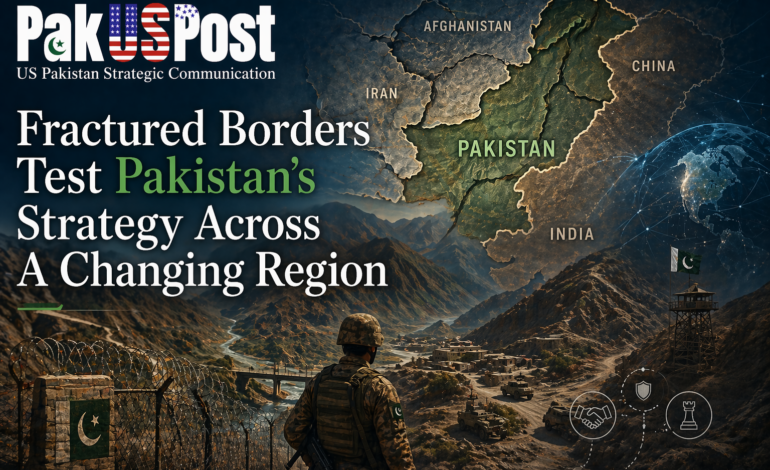
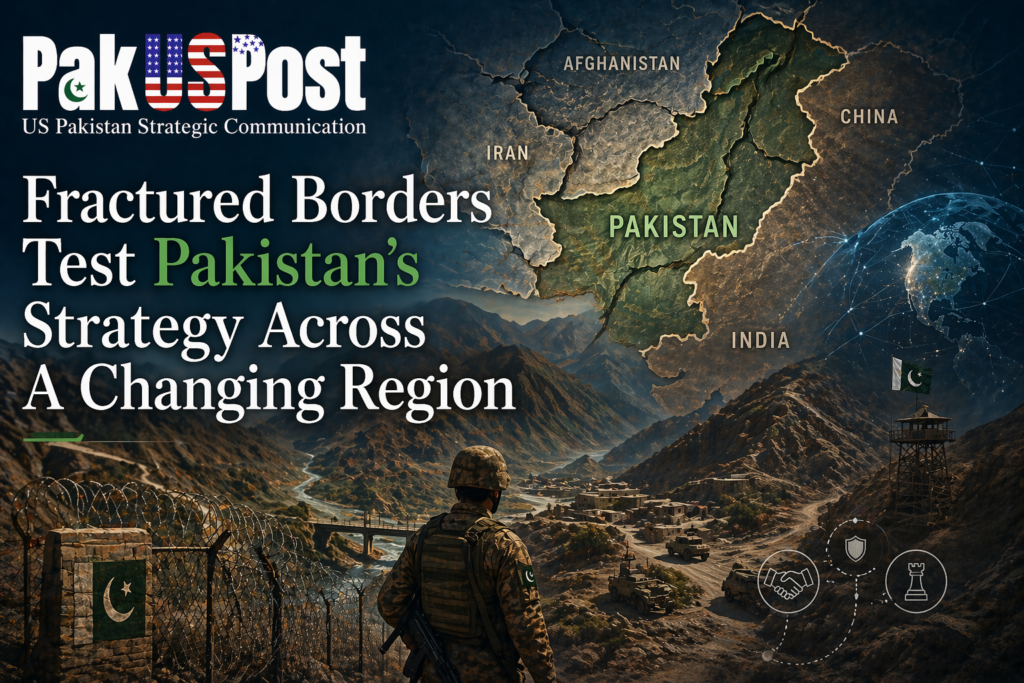
Fractured Borders Test Pakistan’s Strategy Across A Changing Region

Afghanistan has often entered the world’s imagination through dramatic moments. Invasions, withdrawals, regime collapses and sudden offensives have defined the headlines. Yet the most dangerous phase for neighbouring states is not always spectacular breakdown. It is slow fragmentation. When authority weakens unevenly, institutions decay quietly, armed actors multiply locally, economic desperation deepens and rival external powers begin probing opportunities, instability becomes chronic rather than cinematic. For Pakistan, this quieter form of Afghan disorder may prove more difficult to manage than outright collapse. It is diffuse, deniable and persistent. It leaks across borders through militancy, narcotics, refugees, illicit trade and ideological contagion. It also unfolds just as wider powers reassess Central Asia, connectivity routes and strategic access. Islamabad therefore faces a dual challenge. It must contain frontier insecurity while competing to remain relevant in the new Eurasian geography.
The current Afghan landscape resists simple labels. The ruling authorities may retain nominal control over national territory, yet governance capacity is uneven. Revenue extraction exists, but economic vitality is thin. Security operations occur, but factional tensions simmer. Diplomatic outreach continues, but recognition remains constrained. In many provinces, local power brokers, tribal arrangements and informal patronage networks matter as much as central directives. This is not state consolidation in the classic sense. It is a hybrid order balancing coercion, ideology and necessity.
Such systems can endure longer than outsiders expect. They can also deteriorate gradually without a decisive trigger. That ambiguity complicates Pakistani planning. Traditional strategy often prepares either for a hostile unified state or for overt collapse. Afghanistan today may be neither. Instead it risks becoming a patchwork arena where some zones remain governable, others transactional and others penetrated by transnational actors.
For Pakistan, the most immediate concern is militant diffusion. When one dominant insurgent movement transitions into government, splinter incentives emerge. Some commanders seek resources. Others reject compromise. Rival extremist organisations exploit disappointment, ethnic grievance or ideological purity narratives. The result can be a crowded militant marketplace rather than a single adversary. This is strategically harder to counter. Networks overlap with smugglers, local clans and cross border facilitators. Responsibility becomes blurred. Denial becomes easier.
The rise of competing armed actors along or near the frontier places pressure on Pakistan’s internal security architecture. Urban centres worry about attacks. Border districts worry about intimidation. Traders worry about extortion. Citizens worry about uncertainty. No wall or fence alone can solve such problems. Borders in this region are not merely lines on maps. They cut through social ecologies built over generations. Effective control requires technology, intelligence, legal trade routes and administrative legitimacy on the Pakistani side.
That last point is often neglected. Frontier management is not simply about keeping threats out. It is about making the borderlands worth governing. Roads, schools, digital access, courts and economic opportunity reduce the space in which illicit systems thrive. Where the state is absent except as a checkpoint, armed entrepreneurs gain narrative ground. Pakistan’s western districts therefore sit at the heart of national strategy, not at its margins.
Refugee pressures add another layer of complexity. Afghanistan’s weak economy, sanctions related constraints, climate stress and limited employment prospects create constant outward pressure. Pakistan has historically hosted large Afghan populations at significant social and fiscal cost. Hospitality has often exceeded recognition abroad. Yet unmanaged migration can strain labour markets, public services and security screening systems. The answer lies neither in indefinite informality nor in harsh episodic expulsions alone. It lies in structured registration, burden sharing diplomacy and pathways that distinguish vulnerable civilians from exploitative networks.
Economics may ultimately prove as important as security. Afghanistan’s internal fragmentation narrows legitimate commerce while expanding grey trade. Informal flows distort Pakistani markets, undermine taxation and empower criminal intermediaries. If Islamabad wants stability, it must make formal trade easier than smuggling. That means customs reform, border market zones, digitised clearances and coordinated tariff policy. Traders respond to incentives faster than speeches.
The wider geopolitical context is shifting in ways Pakistan cannot ignore. Central Asia has renewed significance because supply chains are being reimagined, energy routes diversified and middle corridor concepts promoted. Russia’s recalibration after years of confrontation with the West has pushed Moscow to look harder at Asian linkages. China continues exploring westward logistics resilience. Turkey seeks influence through Turkic connectivity narratives. Europe searches for alternatives that reduce dependency on contested routes. Even the United States, despite reduced military presence, retains interest in regional balance and counterterrorism visibility.
In this emerging contest, Afghanistan remains both obstacle and opportunity. If stable and connected, it could bridge Central and South Asia. If fragmented, it diverts trade and raises insurance costs. Pakistan’s long stated ambition has been to serve as the natural southern gateway for Central Asia through ports, roads and rail. Geography supports that claim. Policy execution has not always done so.
Competing routes are advancing. Iran offers access through Chabahar and broader north south networks. The Caucasus and Caspian corridors attract new diplomatic energy. Gulf ports continue to dominate logistics through efficiency and capital depth. Geography gives Pakistan a chance, not a monopoly. To secure relevance, it must become easier to use than alternatives.
That requires hard reforms. Port turnaround times matter. Rail modernisation matters. Customs predictability matters. Contract enforcement matters. Security premiums matter. Investors compare realities, not patriotic maps. Pakistan often assumes location will compensate for institutional weakness. Increasingly, it will not.
China’s role remains crucial. Beijing values Pakistan as a strategic partner and corridor option, but it is pragmatic. Chinese capital seeks returns, security and continuity. If Afghan instability repeatedly threatens western connectivity visions, China will diversify routes rather than wait indefinitely. Pakistan should therefore frame frontier stabilisation partly as corridor protection. Security and economics are not separate files.
Relations with the United States also deserve pragmatic recalibration. Washington no longer defines Pakistan primarily through Afghanistan, yet it still values counterterrorism cooperation, regional awareness and nuclear stability. A Pakistan that demonstrates responsible border governance, anti militant seriousness and commercial openness can widen the agenda into trade, technology and climate resilience. A Pakistan trapped in recurring frontier crises will struggle to shift perceptions.
Media narratives often fail to capture these subtleties. Afghanistan is commonly portrayed either as a humanitarian tragedy or as a perpetual terrorism factory. Pakistan is alternately depicted as manipulator, victim or bystander. Such binaries obscure the reality that both states are entangled in geography neither can escape. Public discourse in Pakistan too often defaults to blame allocation rather than policy design. Every incident becomes proof of betrayal. Every setback becomes evidence of conspiracy. This emotional framing may mobilise sentiment, but it rarely produces strategy.
Islamabad needs a doctrine of managed interdependence. That means recognising that Afghanistan’s fate will affect Pakistan regardless of diplomatic frustration. Isolationist fantasies are impractical. So are domination fantasies. The workable middle path combines selective engagement with hard conditionality. Talk where useful. Trade where beneficial. Secure relentlessly. Reward cooperation. Penalise tolerated militancy. Avoid maximalist expectations.
Education and ideology deserve greater attention. Cross border radical narratives spread through digital ecosystems faster than fighters move physically. Pakistan’s response cannot rely solely on policing. It requires civic confidence, curriculum reform, religious scholarship engagement and online counter messaging rooted in credibility. States lose ideological contests when they outsource them.
There is also a humanitarian dimension. A collapsing neighbour generates moral and practical spillovers. Food insecurity, drought and unemployment in Afghanistan can fuel migration and recruitment. Pakistan should support targeted humanitarian channels, especially where international mechanisms exist, not from sentimentality but from strategic prudence. Desperation next door rarely stays next door.
What practical steps should Pakistan prioritise now. First, complete the transition from ad hoc border control to integrated smart management using data systems, vetted crossings and joint incident mechanisms where possible. Second, accelerate economic development in former frontier regions so security gains rest on livelihoods. Third, create a specialised Central Asia trade strategy linked to ports, warehousing and transport finance. Fourth, maintain open but firm diplomatic channels with Kabul focused on measurable security benchmarks. Fifth, coordinate quietly with China, Gulf partners and Western institutions where interests overlap on stability.
Pakistan must also think in decades, not incidents. Afghanistan’s internal order may remain unsettled for years. That means no single summit, crackdown or handshake will solve the challenge. Strategic endurance is required. Institutions matter more than episodic headlines. The countries that manage long frontiers best are not those with the loudest rhetoric but those with the most consistent administration.
For readers in the United States, Pakistan’s western challenge should be viewed as part of a larger Eurasian puzzle. Stability along the Afghanistan Pakistan corridor affects migration, extremist mobility, narcotics flows and trade diversification. Supporting Pakistan’s capacity in customs modernisation, development finance and lawful mobility management may yield more durable returns than narrow transactional security programs of the past.
The central question for Islamabad is whether it can transform exposure into leverage. Pakistan is exposed to Afghan disorder because of geography. Yet the same geography could generate leverage if linked to efficient transit, secure commerce and credible diplomacy. Exposure unmanaged becomes vulnerability. Exposure organised becomes relevance.
Afghanistan’s quiet fragmentation is therefore not only a threat. It is also a strategic test of Pakistan’s maturity. Can the state move beyond reactive cycles. Can it build frontier institutions faster than militants build networks. Can it make legal trade more attractive than smuggling. Can it persuade external partners that Pakistan is a solution corridor rather than a risk corridor.
History offers a warning. Regions shaped by chronic low grade instability often normalise decline. Costs accumulate slowly until they seem permanent. Pakistan cannot afford such normalisation on its western flank while the rest of Asia reorganises trade and power.
The next chapter of Eurasia may be written through corridors, cables, pipelines and ports. But those routes will favour states that control their borders intelligently and govern their peripheries seriously. Pakistan still has the geography to matter. Whether it has the discipline to convert that geography into durable advantage remains the more consequential question.
A Public Service Message