Ceasefires Open Pakistan’s Narrow Strategic Window With Iran

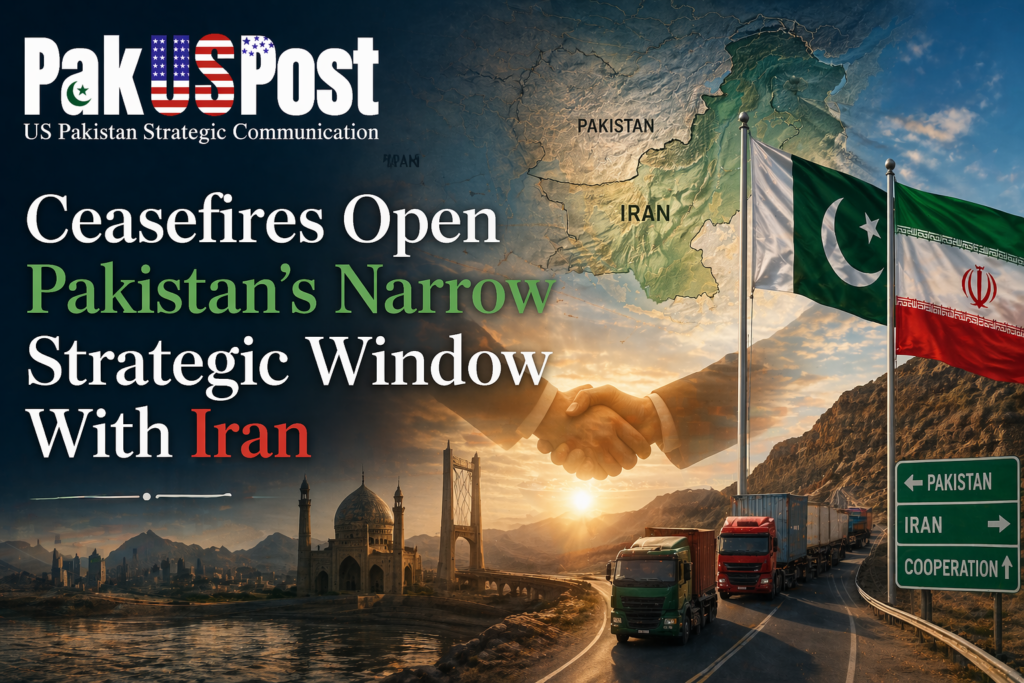
Temporary peace in the Middle East is rarely peace in the full sense of the word. It is usually an interval, a pause shaped by exhaustion, deterrence, diplomatic pressure or tactical necessity. When ceasefires emerge between adversaries such as Iran, the United States and Israel, they often reduce immediate violence without resolving the architecture of conflict beneath it. Yet even short de escalation phases can reorder incentives across neighbouring regions. For Pakistan, any temporary easing of tensions involving Iran creates a narrow but meaningful strategic window. It offers opportunities in energy access, border stabilisation and regional diplomacy, while also carrying risks linked to sanctions volatility, Gulf sensitivities and renewed competition over trade corridors. Islamabad’s challenge is not simply whether to welcome calm. It is whether it can use a brief calm intelligently before the region returns to turbulence.
Pakistan and Iran share geography, history and a long border, but they have seldom converted proximity into a fully productive strategic relationship. Trade remains below potential. Border areas have struggled with smuggling, militancy and underdevelopment. Political ties oscillate between cordial rhetoric and practical caution. External constraints have been decisive. United States sanctions on Iran have limited formal economic engagement. Gulf rivalries have complicated alignment choices. Afghanistan’s instability has distracted both states. Domestic administrative weakness on both sides of the frontier has further reduced implementation capacity.
A temporary ceasefire environment changes calculations because it lowers immediate escalation risk and creates political space for transactional initiatives that would be difficult during active confrontation. Energy is the clearest example. Pakistan’s chronic power shortages, import dependence and recurring external account stress have long made Iranian gas appear economically attractive. The pipeline debate has endured for years as a symbol of unrealised regional pragmatism. In periods of acute confrontation, advancing such projects becomes diplomatically costly. In periods of de escalation, space re opens for technical discussions, phased compliance mechanisms and creative financing structures.
Yet Pakistan should avoid the illusion that a ceasefire automatically equals sanctions relief. Washington may tolerate limited de escalation while retaining extensive economic restrictions. That means Islamabad must distinguish between political atmosphere and legal reality. Symbolic enthusiasm without careful sanctions navigation could trigger financial consequences at a time when Pakistan remains dependent on multilateral support and external financing confidence. Strategic patience is therefore essential. Pakistan should pursue lawful, modular and transparent engagement rather than dramatic announcements.
Electricity imports into border provinces may offer a more realistic near term path than grand pipeline politics. Peripheral regions often suffer the highest energy deficits and the weakest infrastructure. Limited grid arrangements, monitored payment channels and development focused cooperation could deliver immediate welfare gains while carrying lower geopolitical visibility than large pipeline megaprojects. Incrementalism may succeed where maximalism has repeatedly stalled.
Border security is the second major domain shaped by an Iranian de escalation phase. During periods when Tehran faces intense pressure elsewhere, frontier management with Pakistan can become secondary. Militant groups, criminal networks and sectarian actors exploit such distraction. If external pressures ease, Iran may devote greater attention to stabilising its eastern periphery. That creates an opening for deeper intelligence sharing, coordinated patrol mechanisms and joint economic zones designed to reduce illicit economies.
This frontier is often misunderstood. It is not merely a line separating states. It is a living zone where tribes, traders, transporters and informal networks have operated for generations. Heavy securitisation alone cannot solve its problems. Durable stability requires legal commerce, transport infrastructure, dispute resolution and local employment. Pakistan should therefore treat border management as economic statecraft as much as counterterrorism. A ceasefire window could help both sides shift from reactive crackdowns to structured development.
There is also a sectarian dimension that demands careful handling. Regional confrontations involving Iran often reverberate socially across South Asia through identity narratives amplified by media and clerical networks. Pakistan, with its diverse religious landscape, has repeatedly faced the domestic costs of imported sectarian tensions. A period of reduced Iran related confrontation can lower those temperatures, but only if Islamabad actively promotes internal cohesion and resists proxy rhetoric. Strategic neutrality abroad must be matched by civic responsibility at home.
The Gulf factor remains central. Pakistan’s relations with Saudi Arabia and the United Arab Emirates carry financial, labour and political significance that cannot be discounted. Millions of Pakistanis work in Gulf economies. Remittances support households and macroeconomic stability. Gulf capitals have periodically provided deposits and investment commitments during Pakistani crises. Any deepening Pakistan Iran engagement will therefore be watched carefully in Riyadh and Abu Dhabi, even in an era where those states themselves pursue more flexible diplomacy.
This does not mean Pakistan must choose one side. Indeed, the region is moving beyond rigid binary alignments. Gulf states now engage Iran selectively while still competing with it. They hedge among Washington, Beijing and regional actors. Pakistan should learn from that pragmatism. Its objective should be balanced functional relations with all major regional players, anchored in transparency and non hostility. Quiet consultation with Gulf partners can reduce suspicion regarding Pakistan Iran initiatives focused on energy or border stability.
China adds another layer of complexity. Beijing has significant stakes in both Pakistan and Iran. It values Pakistan as a corridor and security partner, while seeing Iran as an energy supplier and strategic node in westward connectivity. China generally prefers regional calm that protects trade and limits disruptive wars. A ceasefire phase may therefore align with Chinese interests in corridor continuity and stable shipping routes. Pakistan could potentially position itself as a practical facilitator of limited economic linkages that complement broader regional connectivity.
Still, Islamabad should not assume Chinese backing substitutes for sound policy. External partners may welcome stability, but they will not absorb Pakistan’s implementation failures. Projects require financing discipline, legal certainty and bureaucratic speed. Pakistan’s habit of over announcing under prepared initiatives has repeatedly weakened credibility. If a ceasefire creates openings, execution will matter more than declarations.
There is another risk often overlooked. A calmer Iran may become more outward looking and commercially assertive. That could benefit Pakistan through trade, but it could also intensify competition. Iran’s Chabahar port, developed with Indian interest, has long been framed as a rival to Gwadar. The reality is more nuanced. Ports can be complementary within wider regional trade networks. Yet investors and shippers compare efficiency, governance and access. If sanctions pressures ease even modestly, Iran may seek to accelerate transit relevance linking Central Asia, Afghanistan and the Arabian Sea.
Pakistan should respond not with zero sum anxiety but with competitiveness. Gwadar’s future depends less on what happens in Chabahar than on whether Pakistan can provide reliable logistics, customs efficiency, energy access and security predictability. Strategic assets lose value when domestic systems underperform. Regional competition should be treated as a reform incentive.
The media environment around Iran is often polarised and simplistic. Some narratives portray Tehran exclusively as a heroic resistance power. Others reduce it to an isolated pariah or collapsing state. Both lenses obscure strategic reality. Iran is a resilient but constrained middle power with real capabilities, internal debates and external vulnerabilities. Pakistan’s public discourse would benefit from more analytical sobriety and less emotive projection. States do not make policy through slogans. They make policy through interests.
For readers in the United States, Pakistan’s position deserves nuanced understanding. Islamabad’s engagement with Iran is not inherently anti American. It is rooted in geography, energy need and border management. Washington has legitimate sanctions and security concerns, but maximal pressure frameworks often underestimate how neighbouring states must manage practical coexistence. A calibrated American approach that allows narrowly defined humanitarian, electricity or frontier stabilisation arrangements could support regional calm while preserving broader leverage.
For Pakistan, diplomacy during ceasefires should be discreet rather than theatrical. Public grandstanding can trigger external pushback and domestic overexpectation. Quiet technical talks, commercial pilots and institutional channels usually deliver more than summit pageantry. Pakistan’s comparative advantage is not coercive power. It is relational access across multiple camps. Few states maintain working lines to China, the Gulf, Iran and the West simultaneously. That network, if handled professionally, can become strategic capital.
Domestic reform remains the hidden determinant of success. Energy deals matter less if distribution losses remain severe. Border trade matters less if customs corruption persists. Diplomatic openings matter less if political instability scares investors. Pakistan often seeks external solutions to internal bottlenecks. The ceasefire window with Iran will be no exception. Opportunity can arrive from abroad, but value must be created at home.
What should Islamabad do in practical terms. First, institutionalise a permanent Pakistan Iran economic and security mechanism insulated from headline cycles. Second, prioritise electricity cooperation and legal border markets before megaproject symbolism. Third, coordinate transparently with Gulf partners to reduce mistrust. Fourth, maintain compliance discipline regarding international financial obligations. Fifth, invest in Balochistan infrastructure so frontier diplomacy benefits local populations rather than elites alone.
The broader lesson is that ceasefires are strategic tests. They reveal whether neighbouring states can think beyond crisis management. Pakistan has often been reactive in regional affairs, waiting for shocks and then improvising. A temporary Iran de escalation phase offers a chance to behave differently. It allows planning instead of panic, sequencing instead of slogans, realism instead of romanticism.
No one should mistake an interval for a settlement. Tensions among Iran, Israel and the United States may return abruptly through miscalculation, proxy attacks or political change. Markets know this. Militaries know this. Diplomats know this. But uncertainty is precisely why windows matter. Durable peace is rare. Temporary space is more common. Successful states learn to use the latter when the former is unavailable.
Pakistan stands to gain from a calmer western horizon. It can secure its border more effectively, diversify energy options, reduce sectarian spillovers and enhance diplomatic relevance. It can also lose the moment through indecision, overstatement or external balancing errors. The difference will depend on whether Islamabad treats de escalation as a photo opportunity or as a policy deadline.
In geopolitics, narrow windows close quietly. They do not announce their end. By the time everyone agrees the opportunity has passed, it usually has. Pakistan should move with caution, but it should move.
A Public Service Message