
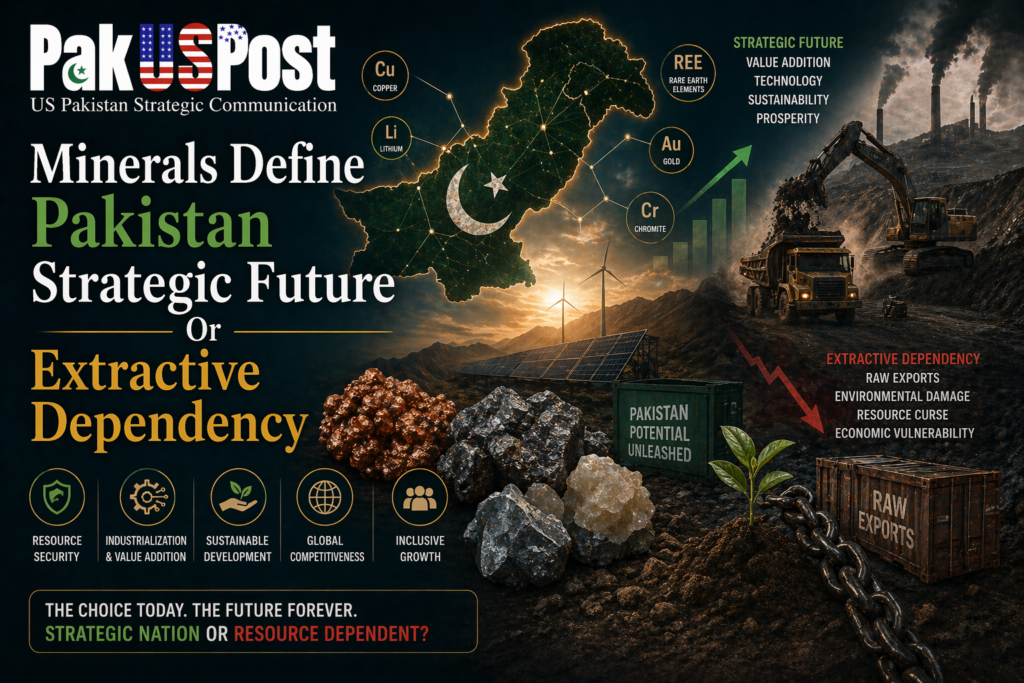
Minerals Define Pakistan Strategic Future Or Extractive Dependency

The global scramble for critical minerals has entered a new phase shaped by energy transition, technological competition and supply chain securitisation. Copper, lithium, rare earth elements, nickel and cobalt are no longer simply industrial inputs; they are strategic assets embedded in the geopolitical contest between major powers. Electric vehicles, renewable energy systems, semiconductors and advanced defence technologies all depend on these materials. As a result, mineral geography is increasingly being treated as strategic geography.
Pakistan sits on a complex but underexplored mineral landscape that includes copper and gold deposits in Balochistan, potential lithium bearing formations in the north, and rare earth prospects across several geological belts. Yet the central question is not whether these resources exist, but whether Pakistan can convert geological potential into developmental sovereignty without falling back into patterns of extractive dependency that have historically characterised resource rich developing economies.
The renewed global interest in minerals has created a paradox for resource rich but institutionally constrained states. On one hand, foreign investment interest is rising, driven by diversification away from concentrated supply chains dominated by a few countries. On the other hand, this interest often arrives in the form of capital seeking extraction rather than transformation. The difference between the two is decisive. Extraction generates revenue streams, while transformation generates industrial ecosystems.
Pakistan’s mineral sector has historically operated in fragmented governance conditions. Provincial jurisdictions, federal oversight, regulatory ambiguity and overlapping institutional mandates have often slowed coherent policy formation. This fragmentation creates uncertainty for investors and limits the state’s ability to negotiate from a position of strategic clarity. In global critical mineral markets, negotiation strength depends not only on resource availability but also on institutional discipline.
The case of large scale copper and gold projects illustrates this tension. Projects such as Reko Diq have become symbolic of both opportunity and delay. While they represent significant potential revenue and foreign investment inflows, they also highlight the complexity of balancing provincial rights, federal coordination, legal arbitration and long term economic planning. Such projects are not merely mining ventures; they are governance tests.
Globally, the competition for critical minerals is increasingly shaped by state backed industrial strategies. Countries are no longer treating mining as an isolated commercial activity. Instead, they are integrating it into broader value chain strategies that include refining, processing, manufacturing and technological application. Indonesia’s nickel strategy, Chile’s lithium governance model and Australia’s rare earth development illustrate how resource rich states can move beyond extraction if institutional frameworks are aligned with industrial policy.
Pakistan’s challenge lies in whether it can adopt a similar approach or whether it will remain confined to upstream extraction while value addition occurs elsewhere. The risk of enclave economics is particularly acute in mineral sectors. In such models, foreign companies extract resources, export raw materials, and generate limited domestic linkages. Local economies receive royalties and employment benefits, but the broader industrial base remains unchanged.
Critical minerals add another layer of strategic complexity. Unlike traditional commodities, these resources are embedded in geopolitical competition. China currently dominates significant portions of global rare earth processing and battery supply chains. The United States, European Union and other industrial economies are actively seeking diversification strategies. This creates both opportunity and risk for countries like Pakistan. Opportunity arises from demand diversification. Risk arises from becoming a contested space for competing external interests without domestic strategic coherence.
Media narratives around mineral investment in Pakistan often emphasise headline figures, projected revenues or foreign partnership announcements. However, they rarely engage with deeper questions of value chain integration, environmental sustainability or intergenerational equity. The discourse tends to celebrate investment inflows without examining whether these inflows generate structural transformation or reproduce dependency.
Environmental governance is another critical dimension that is frequently underemphasised. Mining operations carry significant ecological implications, including water consumption, land degradation and community displacement. In a climate constrained world, environmental compliance is no longer optional but a precondition for market access. International buyers increasingly require sustainability certifications and responsible sourcing assurances. Without aligning with these standards, Pakistan risks exclusion from premium supply chains.
Local community integration is equally important. Resource extraction in regions such as Balochistan is often embedded in complex socio political contexts. Without inclusive benefit sharing mechanisms, mining projects risk generating social tension rather than developmental stability. Global experience demonstrates that resource wealth without equitable distribution can exacerbate regional disparities and political instability.
The governance architecture of mineral policy therefore becomes central to its success. Effective mineral strategy requires clarity in licensing, transparency in contracts, stability in taxation regimes and coherence in regulatory frameworks. It also requires long term planning horizons that extend beyond electoral cycles. Resource development is inherently long gestation, and short term policy volatility undermines investor confidence.
One of the key strategic decisions facing Pakistan is whether to pursue a purely extraction oriented model or a vertically integrated mineral economy. The latter would involve developing domestic processing capacity, refining infrastructure and downstream manufacturing industries linked to mineral inputs. Such an approach would significantly increase value capture but would also require substantial investment in energy, technology and human capital.
Energy availability is particularly critical for mineral processing industries, which are often energy intensive. Without reliable and cost effective energy supply, domestic value addition becomes economically unviable. This links mineral strategy directly to broader energy policy reform. Similarly, transport infrastructure, industrial zoning and logistics systems must be aligned to support mineral based industrial clusters.
Foreign investment plays a necessary but not sufficient role in this transformation. While external capital can provide financing and technical expertise, strategic direction must remain domestically anchored. Countries that successfully leveraged mineral wealth into industrial development maintained strong state oversight over resource governance while selectively integrating foreign partners into value chains.
The role of China in Pakistan’s mineral landscape is particularly significant given its global position in critical mineral processing and industrial supply chains. Chinese firms bring both capital and technological capability, but integration into broader industrial ecosystems must be carefully structured to avoid overconcentration. Diversification of partnerships can enhance bargaining power and reduce dependency risk.
Western interest in critical minerals also presents potential opportunities for Pakistan, particularly as supply chain diversification accelerates. However, engagement with multiple external actors requires institutional capacity to manage competing interests while maintaining strategic autonomy. Without such capacity, mineral diplomacy risks becoming fragmented and reactive.
The financial architecture of mineral development is another important consideration. Resource backed financing models, sovereign mineral funds and public private partnerships can be structured to ensure long term revenue stability. However, without strong governance, such mechanisms can also become vehicles for short term extraction.
Technological upgrading is essential for moving beyond raw extraction. Modern mining increasingly relies on advanced geological surveying, digital monitoring systems and automated extraction technologies. Building domestic capacity in these areas can enhance efficiency and reduce environmental impact. It also creates opportunities for skilled employment and knowledge transfer.
Pakistan’s geological potential must therefore be understood not as an automatic economic asset but as a contingent opportunity. Natural resources do not generate development outcomes on their own. They require institutional frameworks, strategic vision and sustained policy discipline.
The broader global context reinforces the urgency of this issue. The energy transition is accelerating demand for critical minerals at a pace that will reshape global trade patterns over the coming decades. Countries that position themselves strategically within this transition will secure long term economic advantages. Those that fail to do so risk remaining peripheral suppliers of raw materials.
For Pakistan, the choice is increasingly clear. It can either become a strategically managed mineral economy integrated into global value chains or remain an extractive frontier where resources are exported with limited domestic transformation.
The difference between these two paths lies not in geology but in governance. Minerals can either anchor industrial sovereignty or reinforce dependency structures. The direction will depend on whether Pakistan treats its resource endowment as a foundation for long term economic strategy or as a short term fiscal opportunity.
In the evolving geopolitics of critical minerals, time is becoming a decisive variable. Global supply chains are being reorganised now, not in the distant future. Delayed policy coherence may result in lost entry points into emerging industrial ecosystems.
Ultimately, Pakistan’s mineral future will be defined less by what lies beneath its soil and more by what is constructed above it, institutions, industries and strategic choices that determine whether geological wealth becomes national strength or external extraction.
A Public Service Message