Middle Corridor Emerges Pakistan Strategic Trade Opportunity Window

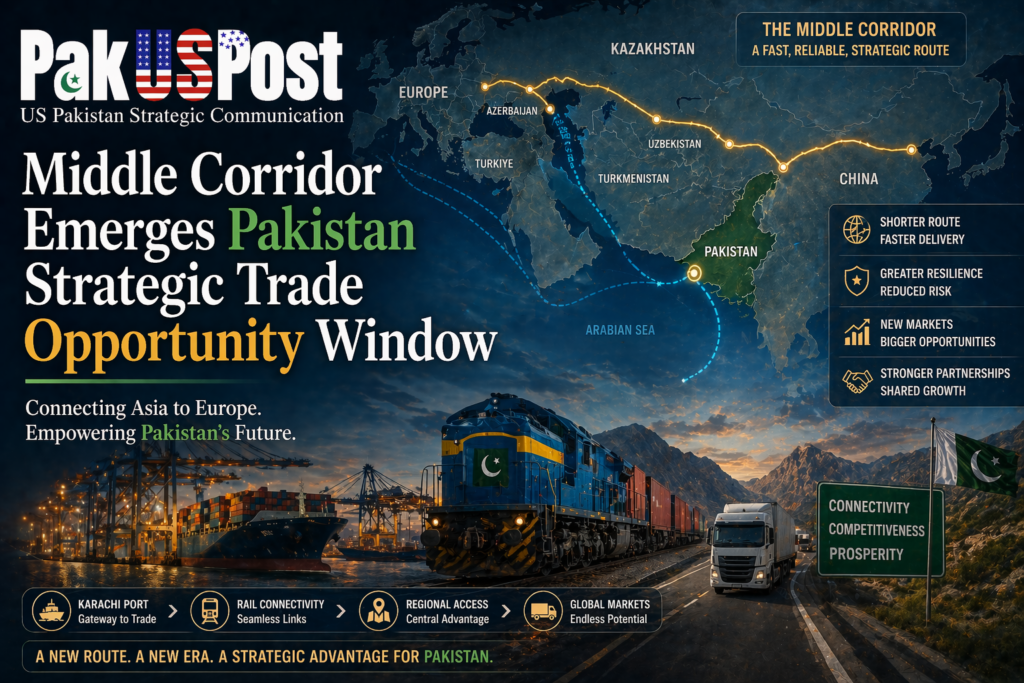
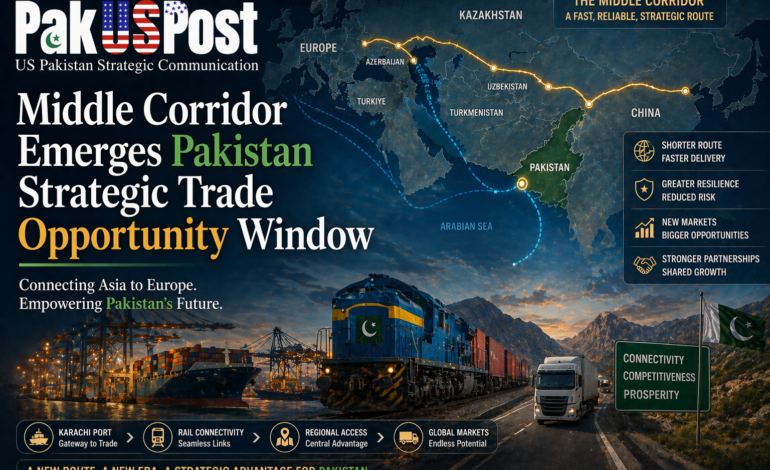
The global geography of trade is undergoing a subtle but consequential reordering, shaped less by grand designs and more by accumulated disruptions. Sanctions regimes, maritime insecurity, shifting alliances and the weaponisation of logistics routes have collectively weakened the assumption that global trade will remain anchored to a few predictable corridors. In this emerging landscape, the so called Middle Corridor, stretching from China through Central Asia, the Caspian region, the Caucasus and onward to Europe, has gained renewed strategic relevance. It is neither entirely new nor fully consolidated, but it is increasingly being treated as an alternative artery of Eurasian commerce.
For Pakistan, this development raises an uncomfortable yet important question. Can a country long positioned at the crossroads of South Asia and the Arabian Sea meaningfully integrate into a corridor that largely bypasses it? Or does the emergence of the Middle Corridor represent another instance in which regional trade architecture evolves around Pakistan rather than through it?
At first sight, Pakistan appears structurally peripheral to the Middle Corridor. The route is largely inland, connecting landlocked Central Asian republics to European markets through Azerbaijan, Georgia and Türkiye, with maritime linkages at both ends. Pakistan’s geography is oriented differently, facing south toward the Arabian Sea and west toward the Gulf. However, in a fragmented global trade environment, corridors are no longer linear. They are increasingly multimodal, overlapping and strategically interconnected. This opens space, at least in theory, for secondary integration points that were previously considered outside the core alignment.
The idea of geoeconomics has become central to Pakistan’s policy vocabulary in recent years, particularly in relation to China Pakistan Economic Corridor narratives. Yet much of this discourse has remained infrastructure centric rather than system centric. Roads, ports and energy projects have been prioritised, while trade facilitation systems, customs harmonisation, logistics digitisation and regulatory convergence have received comparatively less sustained attention. The Middle Corridor debate exposes this gap sharply. It is not only a physical route but a regulatory and institutional ecosystem.
Pakistan’s potential relevance to this emerging system lies in its ability to function as a complementary maritime gateway and logistical extension of broader Eurasian connectivity. Karachi and Port Qasim already serve as major nodes in global shipping networks. Gwadar, despite its developmental challenges, continues to be framed as a long term strategic port within regional connectivity visions. However, ports alone do not generate corridor integration. They require hinterland connectivity, predictable customs processes, efficient rail and road integration, and seamless cross border trade protocols.
The missing link in Pakistan’s connectivity ambition has often been inland logistics. The movement of goods from port to border, and from border to production centres, remains constrained by infrastructure bottlenecks, administrative delays and fragmented regulatory oversight. Without resolving these internal inefficiencies, external connectivity frameworks remain underutilised. In contrast, countries participating in the Middle Corridor have invested heavily in customs modernisation and digital trade facilitation systems, recognising that time is now a critical component of competitiveness.
Central Asia’s rising importance in global trade architecture is itself a function of geopolitical realignment. The Russia Ukraine conflict has altered traditional north south and east west trade flows, pushing European and Asian actors to diversify supply routes. Simultaneously, instability in maritime chokepoints has encouraged exploration of land based alternatives. In this environment, the Middle Corridor is being promoted not merely as an alternative route but as a resilience mechanism.
China’s interest in diversified connectivity routes also indirectly reinforces this development. While the Belt and Road Initiative remains anchored in multiple corridors, the logic of redundancy has become increasingly important. Supply chain resilience now requires multiple pathways rather than singular dependence. However, Pakistan’s integration into this broader logic is not automatic. It depends on whether it can reposition itself from a corridor endpoint to a corridor facilitator.
The role of Afghanistan is particularly significant in this context. Historically envisioned as a transit bridge between Central and South Asia, Afghanistan remains both a potential connector and a persistent source of uncertainty. Any serious attempt to link Pakistan with Central Asian connectivity frameworks must inevitably engage with Afghan transit dynamics. Yet the political instability and security concerns surrounding Afghanistan continue to complicate long term planning.
Media narratives within Pakistan often oscillate between optimism and fatalism when discussing connectivity projects. On one hand, there is a tendency to frame every new corridor proposal as a transformative breakthrough. On the other hand, repeated delays and underperformance generate scepticism about feasibility. This binary framing obscures a more important reality. Connectivity is not a single project but an incremental accumulation of institutional capability.
One of the least discussed aspects of corridor development is customs harmonisation. Differences in documentation standards, tariff classification systems, inspection protocols and border management practices can significantly increase transaction costs. The Middle Corridor’s effectiveness depends heavily on reducing such friction. For Pakistan, aligning its customs systems with regional standards could yield more tangible benefits than large scale infrastructure announcements.
Digitalisation of trade processes represents another critical frontier. Electronic data interchange systems, single window operations and automated clearance mechanisms are increasingly standard in efficient trade corridors. Pakistan has initiated reforms in this area, but implementation remains uneven. The gap between policy design and operational execution continues to limit efficiency gains.
Rail connectivity is another structural constraint. While road and maritime transport dominate current trade flows, rail based logistics are essential for cost effective bulk movement across long distances. The modernisation of Pakistan’s railway network has long been discussed but slow to materialise at scale. Without reliable rail integration, participation in transcontinental corridors remains partial.
Energy infrastructure also intersects with connectivity ambitions. Trade corridors are not only about movement of goods but also about the energy systems that support industrial zones along the route. Stable and affordable energy supply is essential for logistics hubs, warehousing centres and manufacturing clusters that emerge around corridors. Pakistan’s energy challenges therefore indirectly influence its corridor competitiveness.
The Middle Corridor also highlights the increasing importance of Türkiye as a strategic logistics hub. Türkiye’s positioning between Europe and Asia allows it to function as a critical node in Eurasian trade flows. Pakistan’s economic diplomacy with Türkiye, while growing, remains underdeveloped in terms of structured trade integration. Strengthening this relationship could provide indirect access to broader corridor systems.
From a strategic perspective, the question is not whether Pakistan can become the central axis of the Middle Corridor, but whether it can insert itself into overlapping systems of connectivity that define the new Eurasian trade order. In a fragmented global environment, multiple corridors are likely to coexist rather than compete in a zero sum manner. This creates space for secondary integration points if institutional readiness is sufficient.
However, there is also a risk of marginalisation. As new corridors develop, capital, logistics infrastructure and trade flows may increasingly bypass regions that fail to modernise their internal systems. In this scenario, geographical advantage becomes less relevant than operational efficiency. Countries that do not reduce trade friction risk becoming transit spectators rather than transit participants.
Pakistan’s long standing reliance on geographic rhetoric as a substitute for structural reform is therefore increasingly inadequate. Being located near major trade routes does not guarantee inclusion in them. Participation requires regulatory alignment, institutional coordination and logistical predictability.
The broader geopolitical environment adds further complexity. Competing interests among China, the European Union, Russia, Türkiye and Central Asian states create a layered and sometimes overlapping set of connectivity agendas. Pakistan must navigate these dynamics carefully to avoid overdependence on any single corridor narrative.
At the same time, diversification of trade routes globally provides a strategic opening. As supply chains move toward redundancy and resilience, countries that can offer reliability gain disproportionate advantage. Pakistan’s challenge is to translate this systemic shift into domestic reform momentum.
Ultimately, the Middle Corridor is less about geography and more about governance. It is a test of whether states can adapt their internal systems to external opportunities. For Pakistan, the corridor represents not a guaranteed pathway but a conditional possibility.
The outcome will depend on whether Pakistan can move beyond viewing connectivity as infrastructure and begin treating it as an integrated economic system. Without such a shift, the country risks remaining adjacent to emerging trade architectures rather than embedded within them, watching as new routes carry commerce around rather than through its territory.
A Public Service Message