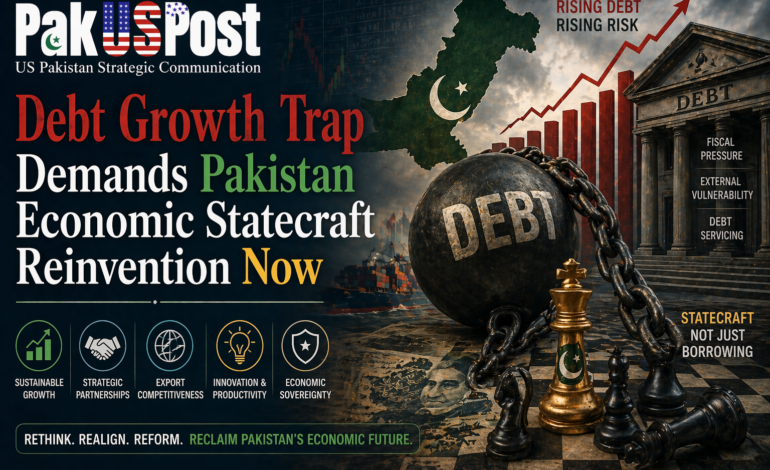
Debt Growth Trap Demands Pakistan Economic Statecraft Reinvention Now


Pakistan’s economic trajectory over the past several decades presents a paradox that has become increasingly difficult to ignore. Recurrent external inflows, whether through multilateral lending programmes, bilateral assistance, friendly deposits, or emergency refinancing arrangements, have repeatedly stabilised macroeconomic stress without producing sustained structural transformation. The economy has avoided collapse but has also struggled to evolve. It survives in cycles of relief and relapse, where short term liquidity replaces long term productivity, and external support substitutes for domestic reform.
At the surface level, these inflows appear to perform their intended function. Foreign exchange reserves stabilise, currency crises are delayed, import pressures are eased, and sovereign default is avoided. Yet beneath this cyclical stabilisation lies a more troubling pattern. Each infusion of external capital is absorbed into an economic structure that remains fundamentally unchanged. Productivity growth remains modest, export diversification limited, industrial upgrading slow, and tax mobilisation persistently weak. The result is not transformation but temporal extension of existing fragility.
The central question is not why Pakistan receives external support, but why such support repeatedly fails to generate developmental momentum. The answer lies not in capital scarcity but in what might be described as institutional absorption capacity. Capital inflows, in themselves, do not guarantee development. Their impact depends on how effectively they are converted into productive assets, technological upgrading, human capital formation and export competitiveness. In Pakistan’s case, this conversion mechanism remains structurally constrained.
One of the most persistent features of Pakistan’s economic governance is the dominance of short term stabilisation over long term planning. Fiscal policy is frequently shaped by immediate external requirements rather than strategic industrial objectives. Monetary adjustments are often reactive to balance of payments pressures rather than aligned with productivity goals. As a result, policy space is repeatedly consumed by crisis management, leaving limited room for structural reform.
External inflows, particularly from multilateral institutions, are typically tied to stabilisation frameworks. These frameworks prioritise fiscal consolidation, inflation control and external balance correction. While these objectives are necessary, they are not sufficient for development. Stabilisation without transformation creates equilibrium without progress. It ensures survival but not advancement. The repeated reliance on such frameworks has created a pattern in which economic adjustment becomes an end in itself rather than a means to structural change.
Pakistan’s export base illustrates this limitation clearly. Despite periodic improvements in specific sectors such as textiles, overall export complexity remains low. The economy continues to rely heavily on a narrow set of labour intensive goods with limited value addition. Efforts at diversification have often been fragmented, lacking sustained industrial policy backing. Without export complexity growth, external inflows merely compensate for structural trade deficits rather than resolving them.
Taxation remains another structural bottleneck. Pakistan’s tax to GDP ratio has historically lagged behind regional comparators. This is not merely a technical issue but a reflection of political economy constraints. Narrow tax bases, extensive exemptions, informal sector dominance and administrative inefficiencies limit fiscal capacity. As a result, external borrowing often substitutes for domestic revenue mobilisation. This creates a dependency loop where fiscal space is externally financed rather than internally generated.
The financial architecture of external inflows also reinforces short termism. A significant portion of inflows is directed toward debt servicing rather than productive investment. This creates a circular dynamic in which new borrowing is used to repay existing obligations, limiting net developmental impact. The economy remains solvent but not self sustaining.
Media narratives surrounding these inflows often reinforce a misleading sense of achievement. Each disbursement is frequently framed as diplomatic success or economic relief. However, the underlying structural dependency is rarely interrogated in depth. The focus tends to be on immediate liquidity rather than long term capability building. This narrative framing contributes to a political economy in which crisis management is valorised while structural reform remains secondary.
The comparison with other developing economies is instructive. Countries that successfully transitioned from external dependency to sustainable growth did not merely receive capital; they restructured their institutions to absorb and multiply it. South Korea, for instance, combined external assistance with aggressive industrial policy, export targeting and human capital investment. Vietnam integrated foreign direct investment into export oriented manufacturing clusters. Indonesia gradually strengthened fiscal institutions alongside resource sector reforms. In each case, external inflows were subordinated to a coherent developmental strategy.
Pakistan’s challenge lies in the absence of such coherence. Policy discontinuity, institutional fragmentation and governance inconsistency undermine long term planning. Economic decisions are often shaped by immediate political cycles rather than multi decade developmental horizons. This creates an environment in which reforms are initiated but rarely completed.
The concept of economic statecraft becomes central in this context. Economic statecraft refers to the deliberate use of economic tools, institutions and policies to achieve strategic developmental objectives. It requires aligning fiscal policy, trade policy, industrial policy and financial regulation within a unified framework. In Pakistan’s case, such alignment remains partial at best.
One of the critical missing elements is a sustained industrial strategy. Without clear prioritisation of sectors, value chains and technological upgrading pathways, capital inflows remain diffused rather than concentrated. Industrial clusters require long term commitment, infrastructure reliability and policy consistency. Frequent policy shifts discourage investment in higher value production segments.
Energy policy further illustrates the structural gap between stabilisation and transformation. While external financing has supported energy sector expansion, inefficiencies in pricing, distribution and governance persist. High energy costs undermine industrial competitiveness, reducing the productivity impact of capital inflows. Without energy reform, industrial upgrading remains constrained.
Human capital formation is another underdeveloped dimension. External inflows rarely translate into sustained investment in education, technical training or research capacity. Yet long term productivity growth depends fundamentally on skill development. Economies that escape dependency cycles typically invest heavily in aligning education systems with industrial needs. Pakistan’s education system remains only loosely connected to its economic structure.
The institutional environment for investment also plays a decisive role. Legal predictability, contract enforcement, regulatory transparency and bureaucratic efficiency shape investor confidence. Weak institutional frameworks increase transaction costs and discourage long term commitments. As a result, capital inflows tend to be short term or extractive rather than developmental.
Debt dynamics further complicate the picture. Pakistan’s external debt obligations create recurrent refinancing pressures. This reduces fiscal autonomy and increases reliance on external negotiation cycles. Each cycle reinforces the perception of vulnerability, which in turn shapes credit conditions. The result is a self reinforcing dependency structure.
Yet the persistence of this cycle does not imply inevitability. It reflects choices embedded in governance structures, policy priorities and institutional incentives. Breaking the cycle requires shifting from consumption of inflows to transformation through inflows. This means prioritising productive investment over consumption stabilisation, and long term capacity building over short term liquidity relief.
One potential avenue lies in restructuring how external capital is allocated. Instead of general budget support, greater emphasis could be placed on project linked financing tied to productivity outcomes. Infrastructure investment, export sector development, technological upgrading and agricultural transformation could form the core of such an approach. However, this requires robust implementation capacity and accountability mechanisms.
Another critical dimension is fiscal reform. Broadening the tax base, reducing exemptions and improving compliance are essential for reducing dependency on external borrowing. Fiscal sovereignty is a prerequisite for developmental sovereignty. Without it, policy remains externally constrained.
Export policy also requires recalibration. Moving beyond traditional sectors toward higher value manufacturing, services exports and digital industries is essential for long term sustainability. This requires integration into global value chains at more sophisticated levels rather than remaining at the lower end of production networks.
Agricultural productivity remains an underutilised source of growth. Despite its large share in employment, the sector suffers from low efficiency, water mismanagement and limited technological adoption. External inflows rarely target structural agricultural reform, yet this sector holds significant potential for income generation and export diversification.
The broader geopolitical environment adds both constraints and opportunities. Competing financial influences from China, the United States, Gulf states and multilateral institutions create a diversified funding landscape. However, diversification of lenders does not automatically translate into diversification of economic outcomes. Without coherent domestic strategy, external diversity can still produce internal stagnation.
Ultimately, the debt growth paradox in Pakistan is not a financial problem alone but a governance and institutional problem. It reflects the gap between liquidity management and developmental ambition. External inflows can stabilise an economy, but only internal transformation can sustain it.
The challenge for Pakistan is therefore not access to capital but conversion of capital into capability. This requires a shift from reactive economic management to proactive economic statecraft. It requires aligning political incentives with long term development, strengthening institutions of implementation, and embedding continuity in policy design.
Without such a shift, the cycle is likely to persist. External inflows will continue to arrive, crises will continue to be managed, and structural transformation will continue to remain incomplete. The economy will remain stable without becoming strong, and resilient without becoming self sustaining.
A Public Service Message