
Artificial Intelligence Sovereignty and the Rise of Global Digital Protectionism

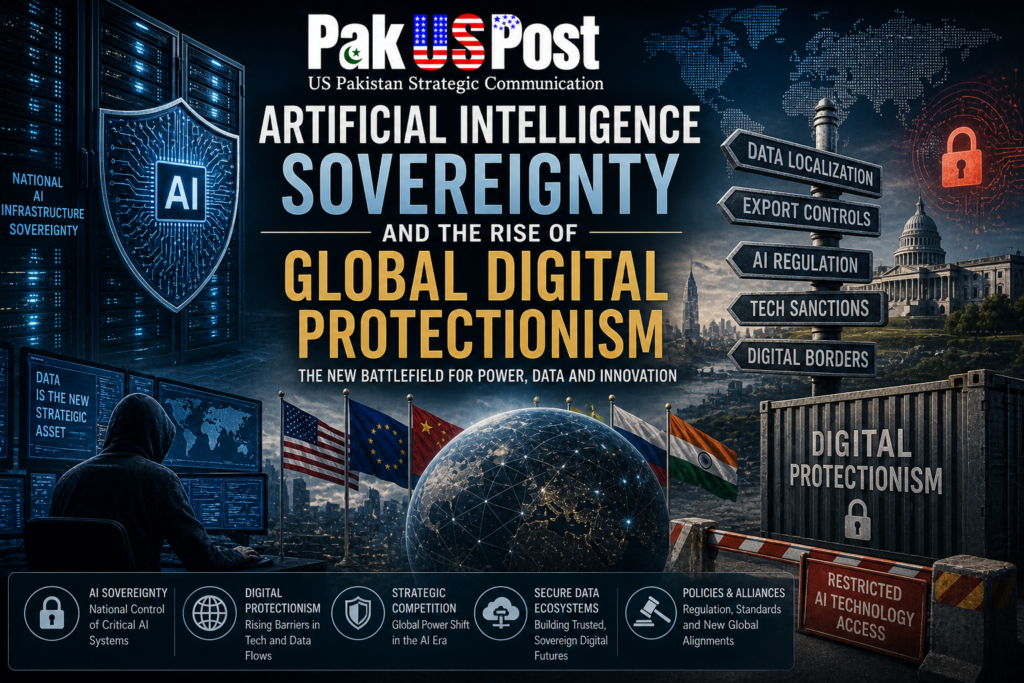
The global artificial intelligence landscape is undergoing a structural transformation that is no longer defined by open innovation rhetoric or borderless technological optimism, but by a hardening logic of sovereignty, control, and strategic enclosure. What was once framed as a collaborative ecosystem of shared datasets, open research publication, and cross border venture capital flows is increasingly being reorganized into segmented technological blocs, each governed by its own regulatory philosophy, compute infrastructure strategy, and geopolitical anxieties. Artificial intelligence is no longer simply a tool of economic acceleration. It has become a contested domain of statecraft, where access, restriction, and ownership define the new grammar of power.
At the core of this transformation is the recognition that artificial intelligence systems, particularly large scale foundation models, are not neutral instruments. They encode linguistic hierarchies, cultural assumptions, behavioral predictions, and economic priorities derived from the datasets and computational infrastructures on which they are trained. As a result, states are beginning to treat AI systems as strategic assets comparable to energy resources, semiconductor supply chains, and defense technologies. This shift is giving rise to what can be described as algorithmic sovereignty, a doctrine in which control over data, compute capacity, and model deployment becomes an extension of national security policy.
The most visible manifestation of this shift is the increasing wave of regulatory interventions targeting foreign acquisitions of artificial intelligence startups and technology firms. In the United States, Committee on Foreign Investment mechanisms have been expanded to scrutinize deals involving advanced computing and machine learning capabilities. In China, stringent data localization laws and state guided AI development strategies have effectively insulated domestic ecosystems from external dependency while accelerating indigenous innovation. The European Union, meanwhile, has positioned itself as a regulatory superpower, exporting compliance frameworks through the Artificial Intelligence Act that effectively shape global standards even beyond its territorial jurisdiction.
These developments collectively signal a departure from the earlier era of globalization, where capital, talent, and technology were assumed to circulate freely in pursuit of efficiency. Instead, the current phase is characterized by what might be termed digital protectionism, a strategic recalibration in which states prioritize technological self reliance over integration, and security over efficiency. This is not a temporary policy adjustment but a structural reconfiguration of the global technology order.
The implications of this shift are profound for emerging economies, particularly those positioned outside the primary axes of technological production. Countries like Pakistan find themselves navigating a rapidly fragmenting digital ecosystem in which access to advanced AI systems, cloud infrastructure, and training datasets is increasingly mediated by geopolitical alignment. Unlike previous industrial revolutions where latecomers could adopt existing technologies through relatively open markets, the AI revolution is unfolding in a more closed and stratified environment.
Pakistan’s position in this evolving landscape is emblematic of broader structural asymmetries. On one hand, it possesses a large and youthful population, expanding digital connectivity, and a growing ecosystem of software development talent. On the other hand, it remains heavily dependent on foreign platforms for compute infrastructure, model access, and digital services. This dependency is not merely technical but strategic, as control over AI systems increasingly translates into control over information flows, economic decision making, and even public discourse architectures.
Within the Pakistan United States policy framework, artificial intelligence presents both an opportunity for collaboration and a site of latent tension. The United States remains the global leader in foundational AI research, semiconductor design, and platform ecosystems. Pakistan, while not a primary producer of frontier models, is a significant consumer of digital infrastructure and a potential site for workforce expansion in the global AI value chain. However, without deliberate policy design, this relationship risks becoming asymmetrical, with Pakistan positioned as a downstream user of technologies whose standards, constraints, and governance structures are defined externally.
The emerging global narrative around AI sovereignty is deeply shaped by concerns over security, economic competitiveness, and ideological control. In Washington, AI is increasingly framed through the lens of strategic competition, particularly in relation to China. The focus is on maintaining leadership in foundation models, securing semiconductor supply chains, and preventing adversarial access to critical technologies. In Beijing, the emphasis is on technological self-sufficiency, data sovereignty, and the construction of domestic AI ecosystems capable of operating independently from Western infrastructure. In Brussels, the priority is regulatory sovereignty, ensuring that AI systems comply with European norms of privacy, transparency, and ethical deployment.
These competing models are not merely technical. They represent fundamentally different visions of how digital power should be organized. The United States model privileges private sector innovation within a security informed regulatory perimeter. The Chinese model integrates state planning with industrial policy and centralized data governance. The European model emphasizes rights based regulation and normative constraint. The result is a fragmented global AI order in which interoperability is decreasing and regulatory divergence is increasing.
This fragmentation has significant implications for global innovation dynamics. In the earlier internet era, the relative openness of digital architectures allowed for rapid diffusion of technologies across borders. Startups in one region could scale globally with limited friction. However, in the emerging AI era, access to compute resources, training data, and model architectures is increasingly conditional on jurisdictional compliance. This introduces friction into innovation ecosystems, potentially slowing diffusion while concentrating capability within sovereign blocs.
At the industrial level, this shift is already visible in the restructuring of cloud computing markets, semiconductor supply chains, and AI model distribution networks. Leading technology firms are increasingly required to maintain region specific versions of their models, comply with divergent regulatory frameworks, and establish localized data centers. This raises operational costs while reinforcing geopolitical segmentation. The idea of a unified global digital infrastructure is gradually giving way to a patchwork of semi interoperable systems governed by competing regulatory regimes.
For Pakistan, this raises a strategic dilemma. Integration into global AI ecosystems requires alignment with dominant technological standards, yet excessive dependence risks limiting autonomy in data governance and digital policy. At the same time, complete technological isolation is neither feasible nor desirable, given the capital and knowledge intensity of AI development. The policy challenge therefore lies in navigating a middle path that enables participation without dependency, and adoption without structural subordination.
One potential avenue lies in regional cooperation frameworks that pool resources across similarly positioned economies. South South collaboration in AI research, data infrastructure development, and digital skills training could provide a counterbalance to dependency on Northern technology ecosystems. However, such initiatives remain underdeveloped and often lack the institutional depth required to compete with established global platforms.
Another dimension of the AI sovereignty debate relates to data governance. Data has become the foundational resource of artificial intelligence systems, shaping model accuracy, bias, and adaptability. States are increasingly asserting control over data generated within their borders, treating it as a sovereign asset rather than a freely transferable commodity. This has led to the proliferation of data localization laws, cross border data transfer restrictions, and national data infrastructure projects.
While such measures are often justified in terms of privacy and security, they also reflect deeper anxieties about economic dependency and epistemic control. Whoever controls data pipelines effectively influences the behavior of AI systems trained on that data. This creates a new form of soft power, where influence is exercised not through military or financial means, but through informational architectures embedded in machine learning systems.
In parallel, the concentration of compute infrastructure in a small number of technology firms and states is creating new forms of digital hierarchy. Training advanced AI models requires massive computational resources, often concentrated in specialized data centers controlled by a handful of corporations. This centralization raises concerns about access inequality, innovation bottlenecks, and systemic vulnerability. It also reinforces the strategic importance of semiconductor manufacturing, particularly advanced chips capable of supporting large scale AI workloads.
The geopolitical significance of semiconductors has therefore increased dramatically. Export controls, industrial subsidies, and strategic alliances are increasingly shaped by the need to secure access to advanced chip manufacturing capabilities. This has transformed semiconductor supply chains into instruments of geopolitical leverage, linking AI development directly to industrial policy and international relations.
Within this evolving architecture, Pakistan’s strategic options are constrained but not negligible. Investment in digital infrastructure, AI literacy, and targeted research partnerships could enable selective integration into global AI ecosystems. However, this requires a coherent national strategy that aligns education policy, industrial development, and foreign relations with the realities of digital sovereignty.
The broader intellectual challenge lies in reconciling the promises of artificial intelligence with the realities of geopolitical fragmentation. AI systems hold significant potential for economic growth, public service delivery, and scientific advancement. Yet their development is increasingly embedded in competitive state behavior, regulatory divergence, and strategic mistrust. The result is a paradox in which the same technologies that promise global integration are simultaneously producing systemic fragmentation.
Ultimately, the rise of AI sovereignty and digital protectionism marks a decisive shift in the global technology order. It signals the end of an era in which digital innovation could be assumed to operate outside the constraints of geopolitics. In its place is emerging a more contested, segmented, and strategically governed digital landscape. For countries like Pakistan, the challenge is not simply to adapt to this new reality, but to actively shape their position within it before the boundaries of technological possibility become permanently encoded into the architecture of global AI systems.
A Public Service Message