
Weaponized Food Scarcity Reshapes Global Conflict and Strategic Power Dynamics

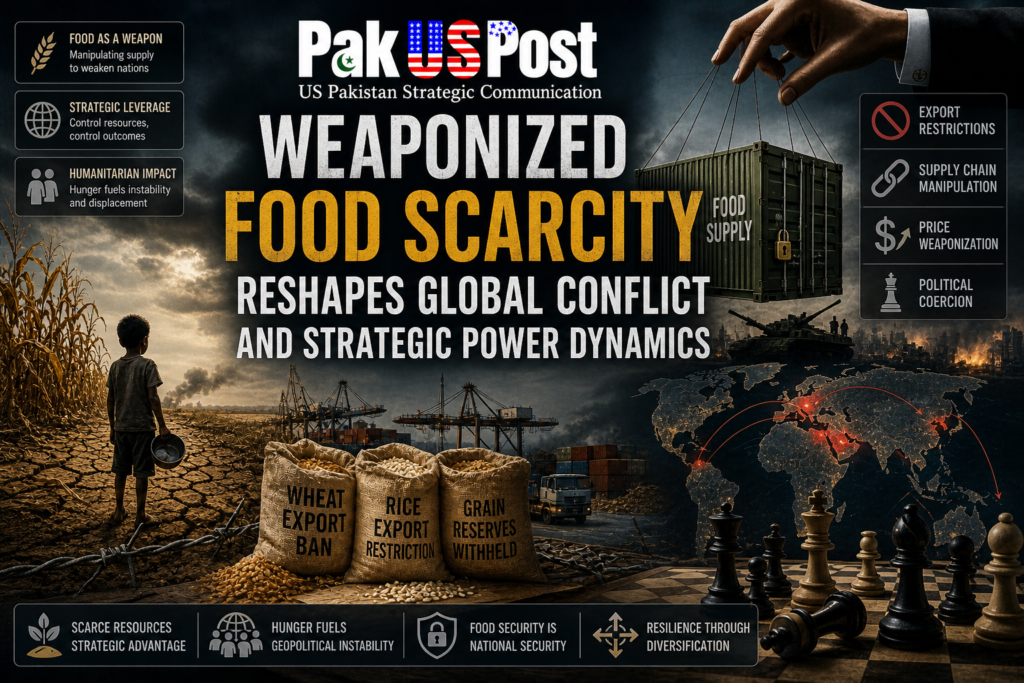
Food insecurity is increasingly being reinterpreted not as a peripheral humanitarian emergency but as a central instrument within the architecture of contemporary geopolitical competition. Across multiple theatres of conflict, from prolonged civil wars to sanctions constrained economies and contested maritime corridors, the control, disruption, and manipulation of food systems has begun to function as a deliberate mechanism of strategic pressure. What once appeared as collateral humanitarian suffering is now being reframed in policy and intelligence discourse as a domain of coercive statecraft, where scarcity is not merely endured but actively produced, calibrated, and deployed.
This transformation marks a decisive departure from the post Second World War humanitarian consensus, which treated hunger as an outcome of development failure or natural shock. In the current global environment, food systems are increasingly entangled with security doctrines, where access to grain, fertiliser, fuel for agricultural production, and maritime trade routes becomes embedded within the logic of geopolitical leverage. The weaponization of scarcity does not always manifest as overt blockade or declared siege. It also operates through subtler mechanisms such as export restrictions, logistical fragmentation, cyber disruptions of supply chains, financial constraints on food imports, and regulatory manipulation of agricultural inputs.
The implications of this shift are profound for global governance, particularly for middle powers such as Pakistan, which sit at the intersection of climate vulnerability, import dependency, and strategic alignment between competing global blocs. For the United States, the issue increasingly intersects with broader concerns of global stability, migration pressures, and the securitization of development assistance. Within the evolving Pakistan US post strategic space, food insecurity emerges not simply as a development challenge but as a potential vector of geopolitical alignment, influence, and vulnerability management.
Modern conflict economies demonstrate that food systems are no longer neutral infrastructures. Agricultural production zones are often located within contested territories, supply chains traverse politically sensitive corridors, and food aid itself becomes entangled in diplomatic bargaining. In such contexts, scarcity can be intensified or alleviated depending on strategic objectives. This represents a structural change in the nature of power, where influence is exercised not only through military superiority or financial dominance but through control over biological and logistical lifelines.
In several contemporary conflicts, civilian populations experience not only displacement and violence but also engineered deprivation. Restrictions on humanitarian access, destruction of storage facilities, targeting of irrigation infrastructure, and manipulation of border crossings all contribute to a condition in which hunger becomes systematically distributed rather than randomly experienced. The resulting humanitarian crises are then interpreted through competing narratives, each shaped by geopolitical alliances, media framing, and strategic communication campaigns. This narrative contestation further complicates the international response, as agreement on causality becomes as contested as the crisis itself.
Within this environment, Pakistan occupies a structurally exposed position. Its agricultural base is highly sensitive to climate variability, water stress, and input dependency. Fertiliser markets, energy imports, and wheat procurement are all linked to global price fluctuations and geopolitical disruptions. At the same time, Pakistan’s strategic partnership with the United States places it within a broader network of aid, security cooperation, and development financing that can be influenced, directly or indirectly, by global food system dynamics. The intersection of domestic food security and external strategic alignment creates a policy space in which scarcity can become both a vulnerability and a bargaining dimension.
The United States, for its part, increasingly views global food insecurity through the lens of systemic risk. Disruptions in agricultural production and distribution are no longer seen as isolated humanitarian concerns but as factors contributing to migration flows, political instability, and regional conflict escalation. In this sense, food security has become integrated into broader national security assessments, linking agricultural markets to defence planning and foreign policy calibration. The emergence of this securitized framing has significant implications for aid architecture, particularly in terms of conditionality, prioritisation, and geopolitical alignment of food assistance programmes.
A critical dimension of the weaponization of scarcity lies in its interaction with global trade architecture. The liberalisation of agricultural markets over recent decades created interdependence across regions, but it also introduced systemic vulnerabilities. Export bans during crises, concentration of grain production in a limited number of exporting states, and dependence on maritime chokepoints have collectively produced a global food system that is efficient but fragile. In moments of geopolitical tension, these vulnerabilities can be activated, intentionally or otherwise, producing cascading effects on importing states.
Climate change further intensifies these dynamics. Increasing frequency of floods, droughts, and heat stress events disrupts agricultural output in multiple regions simultaneously. When combined with geopolitical fragmentation, climate shocks contribute to synchronized scarcity conditions that amplify the potential for strategic manipulation. In such an environment, food insecurity becomes both a consequence of environmental stress and a product of political decisions regarding distribution, pricing, and access.
For Pakistan US policy coordination, this convergence of climate stress and geopolitical scarcity presents both risk and opportunity. On one hand, Pakistan faces heightened exposure to global food price volatility and supply chain disruptions. On the other hand, cooperation with the United States in agricultural resilience, climate adaptation, and supply chain diversification offers a pathway to reduce structural vulnerability. However, such cooperation is conditioned by broader geopolitical dynamics, including regional security considerations, economic reform trajectories, and alignment within competing global food governance frameworks.
Policy responses to weaponized scarcity require a shift from reactive humanitarian assistance to anticipatory resilience building. This includes investment in domestic agricultural productivity, diversification of import sources, strategic grain reserves, and regional food trade integration. It also requires strengthening logistical infrastructure, including storage, transportation, and digital monitoring systems that can reduce exposure to external shocks. At the diplomatic level, it necessitates engagement in multilateral efforts to prevent the politicization of food aid and to strengthen normative constraints against the use of starvation as an instrument of conflict.
For the United States, supporting such resilience measures aligns with broader strategic objectives of global stability and reduced conflict spillover. However, this requires moving beyond episodic emergency response towards sustained structural engagement with food systems in vulnerable regions. For Pakistan, it involves balancing immediate consumption needs with long term investment in agricultural sovereignty and climate adaptive capacity.
The narrative dimension of food insecurity is equally significant. Competing media framings of scarcity shape international perception and policy response. In an era of fragmented information ecosystems, the same food crisis can be interpreted as a failure of governance, a consequence of external aggression, or a symptom of global market volatility. These competing narratives influence diplomatic positioning, aid flows, and public legitimacy of interventions. As a result, information strategy becomes intertwined with food security policy, further reinforcing the politicization of scarcity.
Ultimately, the weaponization of food scarcity reflects a deeper transformation in global order, where traditional distinctions between war and peace, civilian and military domains, and humanitarian and strategic spaces are increasingly blurred. Scarcity is no longer simply an absence of resources but a condition that can be actively structured within geopolitical competition. This demands a recalibration of both analytical frameworks and policy instruments.
For Pakistan US Post strategic engagement, the challenge is to develop a shared understanding of food security not as a peripheral development issue but as a core component of regional and global stability architecture. This requires integrating agricultural policy with security dialogue, embedding climate adaptation within strategic cooperation, and ensuring that humanitarian norms are protected even amid intensifying geopolitical rivalry.
If unmanaged, the continued weaponization of scarcity risks normalizing hunger as an acceptable instrument of influence, thereby eroding the normative foundations of the international system. If addressed through coordinated policy innovation, however, it may also provide an opportunity to reassert principles of shared vulnerability and collective security in an increasingly fragmented world.
A Public Service Message