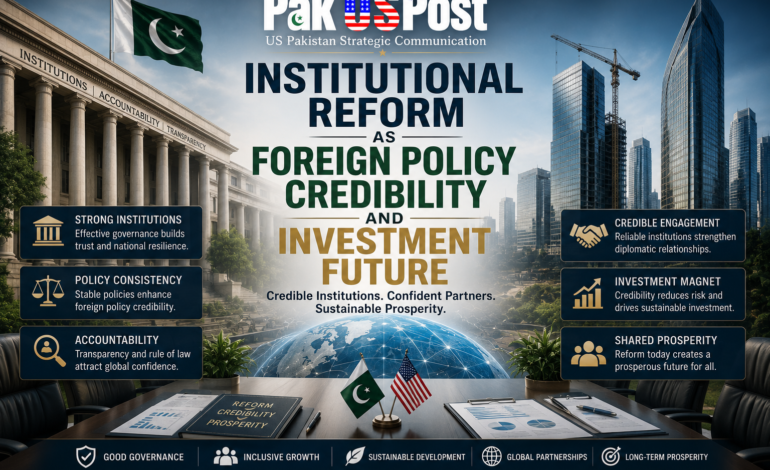
Institutional Reform as Foreign Policy Credibility and Investment Future


In the evolving grammar of international relations, the distinction between domestic governance and foreign policy has become increasingly porous. States are no longer evaluated solely on their external diplomatic conduct or strategic alignments, but also on the internal coherence of their institutions, the predictability of their regulatory environments, and the credibility of their governance systems. Within this emerging paradigm, institutional reform is no longer a purely domestic administrative concern; it has become a central instrument of foreign policy signaling. For Pakistan, this shift carries profound implications, particularly in the context of its relationship with the United States and the broader global investment ecosystem.
Historically, Pakistan’s external engagement strategy has privileged geopolitical positioning over institutional consolidation. Foreign policy has often been conceptualized through the prism of strategic geography, security cooperation, and alliance management, while internal governance structures were treated as separate, technocratic domains. This bifurcation has produced a persistent credibility gap in Pakistan’s international economic reputation. Despite its strategic location and demographic potential, Pakistan continues to be assessed by global investors and financial institutions through the lens of governance risk, policy unpredictability, and institutional fragility. These perceptions, whether fully accurate or partially exaggerated, exert tangible effects on capital flows, investment decisions, and bilateral economic engagement.
In the contemporary global economy, where capital is increasingly mobile yet risk sensitive, institutional credibility has become a decisive determinant of economic integration. Sovereign investment decisions are now shaped not only by macroeconomic indicators but also by deeper structural assessments of legal transparency, regulatory consistency, and bureaucratic efficiency. In this context, governance reform functions as a form of economic diplomacy, signalling to external actors that a state can sustain predictable policy environments and enforcing contractual obligations without arbitrary disruption.
For Pakistan, the integration of institutional reform into foreign policy architecture requires a fundamental rethinking of statecraft. It necessitates the recognition that domestic governance quality directly influences external economic opportunities. Regulatory opacity, fragmented decision-making structures, and inconsistent policy enforcement do not remain confined within national borders; they are transmitted globally through credit rating agencies, investment risk models, and diplomatic assessments. Consequently, institutional inefficiency becomes a form of external liability, shaping how international actors engage with Pakistan across trade, investment, and strategic cooperation.
One of the most critical dimensions of this transformation lies in regulatory reform. The complexity and unpredictability of Pakistan’s regulatory environment have historically deterred long term investment commitments, particularly in sectors requiring large capital deployment and multiyear planning horizons. Simplification of regulatory frameworks, digitization of compliance processes, and harmonization of federal and provincial regulatory regimes are essential prerequisites for improving investor confidence. However, such reforms must go beyond procedural efficiency and address deeper structural issues of discretionary authority and institutional overlap.
Judicial predictability represents another cornerstone of credibility formation. In global investment logic, the enforceability of contracts and the impartiality of dispute resolution mechanisms are as important as market size or labor availability. Delays in adjudication, inconsistent jurisprudence, and perceptions of external influence on legal outcomes significantly elevate perceived investment risk. Strengthening judicial independence, modernizing case management systems, and establishing specialized commercial courts are therefore not merely legal reforms but strategic economic interventions with direct implications for foreign policy effectiveness.
Fiscal governance also plays a decisive role in shaping external perceptions. Persistent fiscal volatility, characterized by unpredictable taxation regimes and ad hoc revenue measures, undermines investor confidence and complicates long term economic planning. A credible foreign policy anchored in institutional reform would require the establishment of transparent fiscal frameworks, predictable taxation policies, and medium-term budgetary planning mechanisms. Such measures would signal macroeconomic discipline and enhance Pakistan’s attractiveness as a destination for foreign direct investment.
Beyond technical governance reforms, institutional credibility is also shaped by the symbolic and communicative dimensions of state behavior. International investors and strategic partners interpret policy consistency, elite consensus, and administrative professionalism as indicators of systemic stability. Frequent policy reversals, bureaucratic fragmentation, and public institutional conflict generate narratives of instability that extend far beyond their immediate context. In this sense, institutional reform is not only about functional efficiency but also about narrative construction within global economic discourse.
When viewed through the lens of Pakistan United States relations, the linkage between institutional reform and foreign policy becomes even more pronounced. The United States, as a major source of global capital and technological innovation, increasingly integrates governance metrics into its economic engagement frameworks. Development finance institutions, private equity actors, and multinational corporations operating within the US ecosystem rely heavily on risk adjusted governance indicators when evaluating potential investment destinations. For Pakistan, improving institutional credibility is therefore directly linked to its ability to attract American investment, expand trade integration, and participate in global value chains.
In recent years, global economic governance has also undergone a significant transformation, with increasing emphasis on environmental, social, and governance criteria in investment decision making. This ESG driven investment paradigm further elevates the importance of institutional reform, as governance quality becomes a measurable and comparable variable in global capital allocation. Countries with stronger institutional frameworks are increasingly favored in sovereign debt markets, climate finance allocations, and infrastructure investment portfolios. Pakistan’s ability to access these emerging financial channels will depend heavily on its progress in institutional modernization.
However, the integration of institutional reform into foreign policy is not merely a technical endeavor; it is fundamentally political. It requires the restructuring of incentives within the state apparatus, the reduction of discretionary power in administrative decision making, and the establishment of accountability mechanisms that operate independently of short term political cycles. Resistance to such reforms is often embedded within existing power structures, making implementation both complex and politically sensitive. Nevertheless, without addressing these internal constraints, external credibility gains are likely to remain limited and reversible.
The developmental implications of successful institutional reform are substantial. Improved governance structures can significantly enhance foreign direct investment inflows, reduce transaction costs for businesses, and increase the efficiency of public resource allocation. Over time, these improvements translate into higher productivity growth, expanded employment opportunities, and greater fiscal stability. Moreover, institutional credibility enhances a country’s ability to negotiate more favorable terms in international financial arrangements, thereby strengthening economic sovereignty rather than diminishing it.
From a foreign policy perspective, institutional reform also enhances strategic autonomy. States with strong governance systems are less vulnerable to external conditionalities and more capable of shaping their own economic trajectories. In contrast, weak institutional environments often result in reactive policy making, where external actors exert disproportionate influence over domestic economic decisions. By strengthening internal governance structures, Pakistan can gradually shift from a position of policy dependence to one of negotiated interdependence.
For policymakers, the central challenge lies in integrating institutional reform into the core logic of foreign policy formulation. This requires the establishment of inter-ministerial coordination mechanisms that align economic governance reforms with diplomatic objectives. It also necessitates the development of performance metrics that link domestic institutional improvements to external economic outcomes, thereby creating measurable feedback loops between governance and diplomacy.
Ultimately, the credibility of any state in the international system is increasingly determined not only by its strategic location or military capability but by the quality of its institutions. In a world where capital, technology, and information flow across borders with unprecedented speed, institutional strength has become a primary currency of global engagement. For Pakistan, recognizing and operationalizing this reality is essential if it seeks to transition from a high-risk perception environment to a credible and competitive emerging economy.
Institutional reform, therefore, is not a peripheral policy concern but a central pillar of foreign policy strategy. It is the bridge between domestic governance and external opportunity, between internal efficiency and global integration, and between perceived instability and projected credibility. The extent to which Pakistan is able to internalize this logic will ultimately determine its trajectory within the evolving global economic and geopolitical order.
A Public Service Message