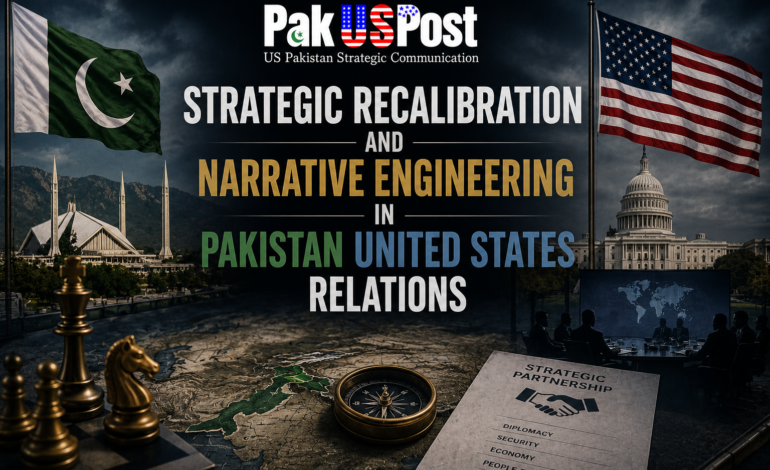
Strategic Recalibration and Narrative Engineering in Pakistan United States Relations


The contemporary architecture of Pakistan–United States relations is no longer anchored in the linear certainties of counterterrorism cooperation or Cold War strategic alignment; rather, it is unfolding within a dense lattice of overlapping crises, transactional diplomacy, and narrative contestation. The emerging discourse is not merely about bilateral engagement but about the construction of Pakistan as a situational pivot state within a fractured global order. This reframing is being actively engineered through diplomatic signalling, economic interdependencies, and crisis mediation, particularly in the context of the evolving Iran conflict and the broader reconfiguration of West Asian geopolitics.
At the forefront of this transformation lies Pakistan’s deliberate repositioning as a mediator between Washington and Tehran. Islamabad’s hosting of high-level engagements between the United States and Iran represents a calculated attempt to transcend its historically reactive foreign policy posture and instead occupy a proactive diplomatic niche. This maneuver is structurally driven by Pakistan’s acute energy vulnerabilities, its precarious macroeconomic position, and the necessity to secure external financial lifelines. Pakistan’s reliance on imported energy, combined with disruptions in regional supply chains, has exposed the fragility of its economic architecture and compelled it to adopt a role that could yield both strategic legitimacy and material dividends.
The United States, for its part, is engaging Pakistan through a prism of selective utility rather than comprehensive partnership. Washington’s current narrative frames Pakistan as a functional intermediary rather than a strategic ally. This is evident in the coexistence of cooperation and suspicion. On one hand, the United States has shown willingness to collaborate on security stabilization and economic engagement. On the other, it continues to position Pakistan within a broader risk framework due to concerns over strategic capabilities and policy ambiguity.
This duality reflects a deeper epistemic shift in American foreign policy, wherein relationships are no longer governed by fixed alliance structures but by issue-specific convergence. Pakistan is thus simultaneously a partner in counterterrorism, a facilitator in regional diplomacy, and a subject of strategic caution. The absence of a coherent overarching narrative has produced a fragmented engagement paradigm, where bilateral ties oscillate between cooperation and distrust without achieving structural consolidation.
A critical dimension of the current narrative construction is economic instrumentalism. Pakistan’s engagement with the United States is increasingly mediated through financial conditionalities, privatization agendas, and selective investment partnerships. Strategic assets and sectors are being positioned within a broader framework of economic diplomacy, reinforcing bilateral ties while aligning with structural reform imperatives. However, this economic alignment is not devoid of asymmetry. External financial frameworks impose stringent requirements that constrain Pakistan’s policy autonomy and generate socio-economic pressures domestically. The United States, as a dominant actor within global financial systems, indirectly influences Pakistan’s economic trajectory, reinforcing a dependency dynamic that coexists with diplomatic engagement.
Simultaneously, the domestic dimension of Pakistan–United States relations is being reshaped by volatile public sentiment. Anti-Americanism, periodically intensified by regional conflicts and geopolitical developments, continues to influence the socio-political fabric. This phenomenon complicates the state’s efforts to project itself as a reliable partner, revealing a disjuncture between elite-level diplomacy and grassroots perceptions. The persistence of this gap underscores the need for a more coherent narrative strategy that aligns domestic discourse with foreign policy objectives.
This dissonance is further amplified by the informational environment, where competing narratives are actively constructed and disseminated. Pakistani strategic discourse emphasizes sovereignty, mediation, and regional stability, while American narratives oscillate between cautious engagement and strategic wariness. The result is a contested epistemic space in which both states attempt to legitimize their policies while managing mutual distrust.
Another salient feature of the evolving relationship is the triangulation of Pakistan between major powers. While engaging with the United States, Pakistan simultaneously deepens its economic and strategic ties with other global actors and maintains complex relations across multiple regions. This multi-vector foreign policy is often perceived externally as strategic ambiguity, yet from Pakistan’s perspective, it constitutes a necessary adaptation to a multipolar world. The challenge lies in reconciling this diversification with external expectations that continue to view alignment through more rigid frameworks.
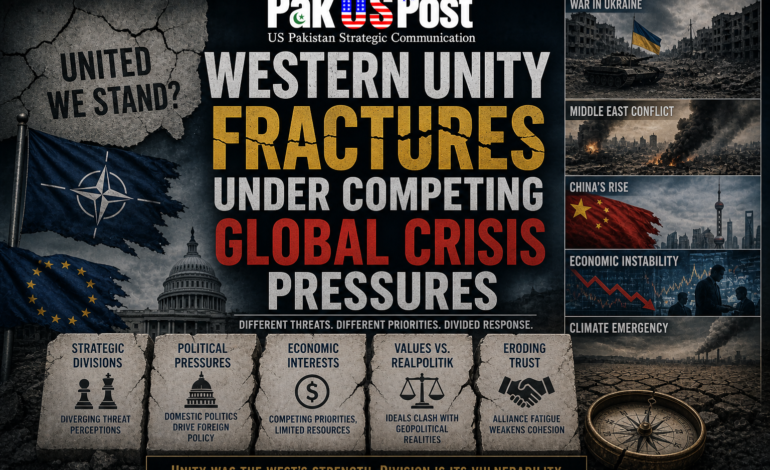
The broader geopolitical context further complicates this dynamic. The ongoing fragmentation of the global order, characterized by energy insecurity, institutional erosion, and great-power competition, has elevated the importance of intermediary states. Pakistan’s geographic location, demographic scale, and strategic capabilities render it a critical node in this evolving landscape. Yet, its internal vulnerabilities, including economic instability, political fragmentation, and governance challenges, limit its ability to fully capitalize on this position.
In this milieu, narrative engineering becomes a central instrument of statecraft. Pakistan seeks to project itself as a stabilizing force, a bridge between adversarial powers, and a responsible stakeholder in regional security. The United States, conversely, frames Pakistan within a risk-managed engagement strategy, emphasizing cooperation where necessary while hedging against potential divergences. These narratives are not merely descriptive; they actively shape policy choices, diplomatic engagements, and international perceptions.
For policymakers, the imperative is to transcend reactive frameworks and construct a coherent strategic vision that aligns narrative with capability. Pakistan must institutionalize its role as a mediator by developing robust diplomatic mechanisms, enhancing economic resilience, and addressing internal governance deficits. This requires a shift from episodic diplomacy to sustained engagement, supported by credible policy frameworks and transparent institutional practices.
Furthermore, Pakistan should leverage its geoeconomic potential by integrating regional connectivity initiatives with broader economic networks, thereby reducing dependence on external financial assistance. Strategic sectors such as energy, technology, and infrastructure must be prioritized to create a sustainable economic base capable of supporting long-term foreign policy objectives.
From the United States’ perspective, a recalibrated approach is necessary to move beyond transactional engagement. Recognizing Pakistan’s evolving role within a multipolar order requires a nuanced strategy that balances security concerns with opportunities for collaboration. This includes supporting economic stabilization efforts, facilitating trade and investment, and engaging in sustained diplomatic dialogue to build mutual trust.
At a systemic level, both states must address the structural asymmetries that underpin their relationship. This entails rethinking the dynamics of global financial governance, fostering more equitable economic partnerships, and promoting development models that mitigate the socio-economic drivers of instability.
In conclusion, Pakistan–United States relations are undergoing a profound transformation shaped by crisis, opportunity, and narrative construction. The current moment is marked by fluidity and strategic uncertainty, yet it also presents the possibility of meaningful redefinition. The challenge lies in translating this potential into durable policy frameworks, coherent narratives, and sustained engagement that can move the relationship beyond episodic cooperation toward a more stable and mutually beneficial equilibrium.
A Public Service Message