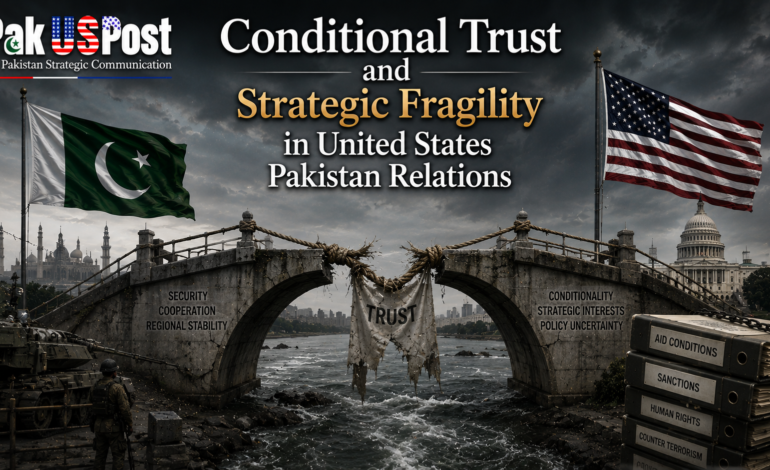
Conditional Trust and Strategic Fragility in United States Pakistan Relations

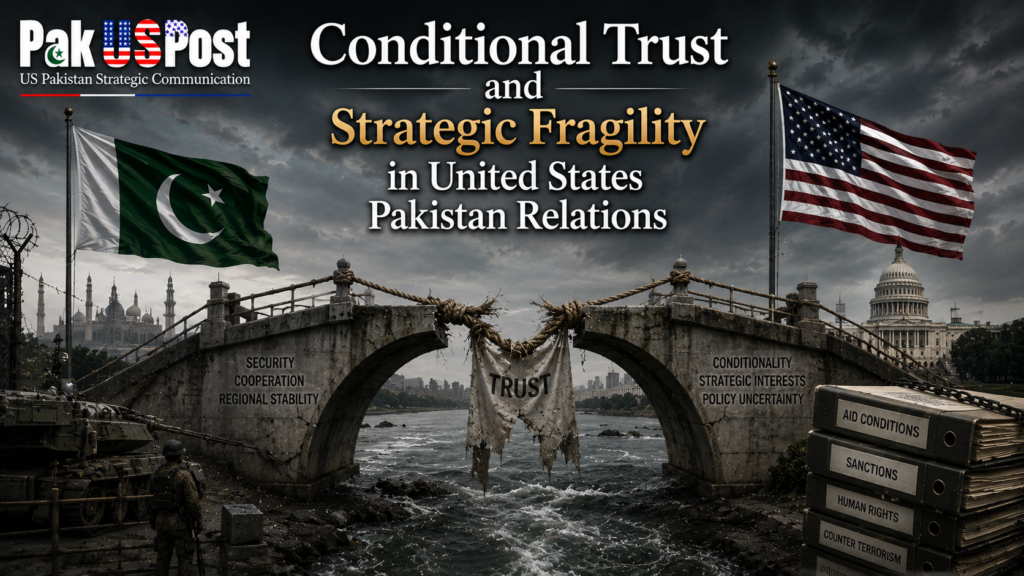
In the contemporary recalibration of global power, the relationship between Pakistan and the United States has entered a phase that is neither rupture nor renewal, but a more ambiguous condition of calibrated proximity governed by episodic necessity rather than institutional permanence. What once resembled a structured, albeit uneven, alliance system anchored in Cold War logic and later counterterrorism imperatives has now mutated into a fluid transactional arrangement, in which trust is no longer a durable asset but a continuously renegotiated outcome of short-term strategic convergence. The underlying architecture of this relationship is increasingly defined by conditionality, wherein cooperation is extended, withdrawn, and reactivated in cycles that reflect shifting American global priorities and Pakistan’s constrained but strategically unavoidable geography.
At the core of this transformation lies a deeper epistemic shift in international relations. Alliances are no longer primarily constructed on the basis of ideological alignment or long-term institutional commitments. Instead, they are increasingly shaped by performance-based evaluations, algorithmic risk assessments, and issue-specific convergence. Within this framework, Pakistan is not evaluated as a fixed partner but as a variable instrument in multiple overlapping theatres, including counterterrorism containment, Afghan stabilization, and broader regional de-escalation architectures. The United States, in turn, operates less as a consistent ally and more as a strategic allocator of attention, deploying engagement selectively where immediate utility is identified.
This conditionality of trust produces a paradoxical diplomatic condition. Pakistan remains strategically indispensable due to geography, connectivity corridors, and its proximity to multiple volatile theatres, yet it is simultaneously excluded from long-term strategic design processes that increasingly privilege India as the principal Indo-Pacific partner. This duality generates a structural imbalance in which Pakistan is repeatedly drawn into crisis management frameworks without being fully integrated into sustained strategic planning architectures. The result is a relationship that is operationally active but institutionally thin, reactive rather than directive, and episodically intense rather than continuously stable.
The most significant hidden risk embedded in this configuration is not overt diplomatic breakdown but gradual strategic marginalization under conditions of continued engagement. In classical alliance theory, exclusion is visible and therefore politically contestable. In the current environment, exclusion is subtle, procedural, and dispersed across multiple policy domains. It manifests through selective intelligence sharing, conditional financial engagement, and the externalization of strategic decision making to other regional partners. Pakistan’s inclusion becomes situational, triggered by crisis rather than embedded in design.
This transformation is further reinforced by the structural reorientation of United States global priorities. The Indo Pacific theatre, technological competition with China, and defense industrial integration with India have collectively redefined Washington’s strategic bandwidth. Within this recalibration, South Asia is no longer treated as a unified strategic space but as a segmented field in which differentiated partnerships are cultivated. India occupies the role of long term systemic balancer, while Pakistan is repositioned as a functional crisis interface, activated primarily in moments of instability. This differentiation is not explicitly declared but operationally evident in defense cooperation trajectories, trade alignments, and intelligence cooperation asymmetries.
Within Pakistan’s strategic establishment, this evolving condition is increasingly recognized not as a temporary fluctuation but as a structural reality. However, the policy response remains constrained by historical memory of alliance cycles, in which Pakistan has oscillated between strategic indispensability and abrupt abandonment. This legacy produces a persistent expectation of cyclical reengagement, even as the underlying global architecture has shifted toward more fragmented and multipolar engagement models. The hidden danger lies in strategic inertia, where policy assumptions continue to reflect outdated alliance logic while operational realities evolve toward conditional engagement frameworks.
Another critical dimension of this transformation is the emergence of what may be described as crisis based utility diplomacy. Pakistan is increasingly integrated into United States strategic planning not as a long term partner but as a functional stabilizer in moments of regional volatility. Afghanistan, maritime security corridors, and episodic Iran related tensions all place Pakistan within a narrow but significant operational envelope. Yet this inclusion is inherently temporary. Once immediate crises subside, strategic attention migrates elsewhere, leaving behind a residual engagement structure that lacks institutional depth.
This pattern produces a form of geopolitical volatility disguised as continuity. On the surface, diplomatic engagement persists, high level visits continue, and communication channels remain open. Beneath this surface, however, there is a progressive thinning of strategic content. The relationship becomes increasingly procedural, driven by short term issue management rather than long term convergence of interests. For Pakistan, this creates a structural dilemma in which diplomatic activity is high but strategic predictability is low.
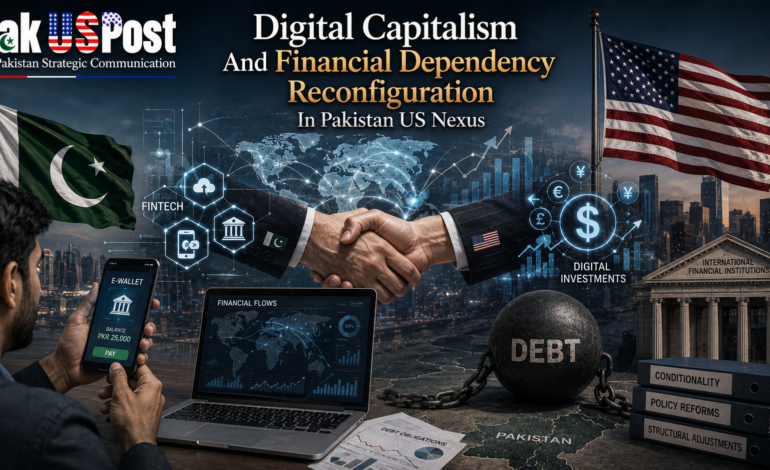
The financial dimension of this conditionality further intensifies asymmetry. Engagement with multilateral financial institutions often operates in parallel with United States strategic preferences, creating a layered system of conditional influence. Economic stabilization packages, reform benchmarks, and compliance frameworks become indirectly tied to geopolitical alignment expectations. While not explicitly coercive, this architecture reinforces the perception that strategic and economic conditionalities are interlinked, thereby reducing policy autonomy in moments of fiscal vulnerability.
The most underexplored risk in this evolving structure is cognitive dependency within policy planning itself. Repeated cycles of engagement and disengagement generate an institutional expectation that external stabilization will eventually return, reducing urgency for structural diversification of strategic partnerships. This creates a subtle form of strategic procrastination, where necessary recalibration is delayed in anticipation of cyclical reengagement. Over time, this weakens the capacity for autonomous strategic positioning in a rapidly fragmenting global order.
At the same time, the United States perspective is equally constrained by internal contradictions. While Pakistan is not central to long term Indo Pacific strategy, it remains unavoidable in short term crisis management. This creates a policy contradiction in which Pakistan is simultaneously deprioritized and repeatedly reactivated. The resulting engagement model is neither abandonment nor alliance but a form of calibrated intermittence, in which strategic attention is distributed unevenly across time rather than space.
For Pakistan’s policy establishment, the critical challenge lies in navigating this intermittence without misinterpreting it as stability. The continuation of diplomatic channels should not be mistaken for continuity of strategic trust. Instead, it reflects a functional necessity embedded in regional geography and crisis geography overlap. Recognizing this distinction is essential for recalibrating long term strategic expectations.
Policy recommendations emerging from this analysis point toward three interrelated imperatives. First, diversification of strategic dependencies is no longer optional but structurally necessary. Reliance on episodic engagement with any single power center increases vulnerability to external recalibration cycles. Second, Pakistan must invest in converting geographic centrality into structured economic and connectivity leverage, thereby shifting from crisis based relevance to corridor based indispensability. Third, institutional memory must be recalibrated to reflect post alliance world realities, where partnerships are networked, layered, and conditional rather than binary and permanent.
The United States Pakistan relationship is therefore entering a phase best described not as decline but as structural redefinition. It is a relationship increasingly governed by conditional logic, asymmetric expectations, and episodic convergence. The hidden risk is not disengagement but entrapment within a cycle of perpetual conditionality, where engagement continues without producing strategic depth.
In this evolving landscape, the central question is not whether trust exists, but whether trust as a category still functions as a stable currency in bilateral relations. Increasingly, it does not. It has been replaced by a more fragmented system of verification, utility, and recalibration. Pakistan’s strategic challenge is to operate within this system without becoming structurally dependent on its unpredictability.
A Public Service Message