Pakistan United States China Balancing Act Under Pressure

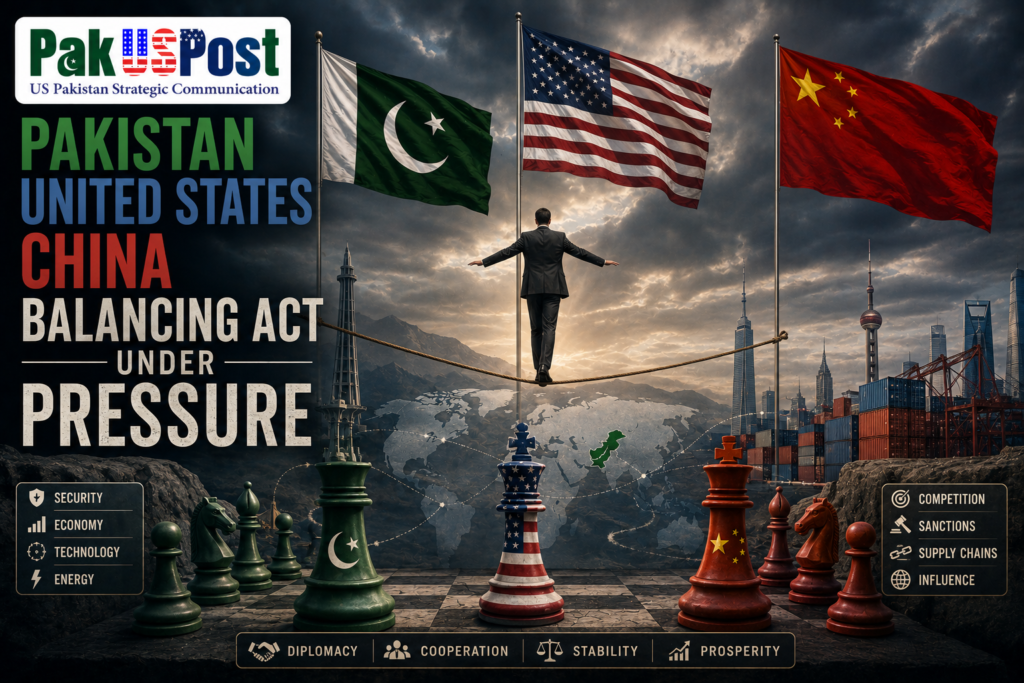
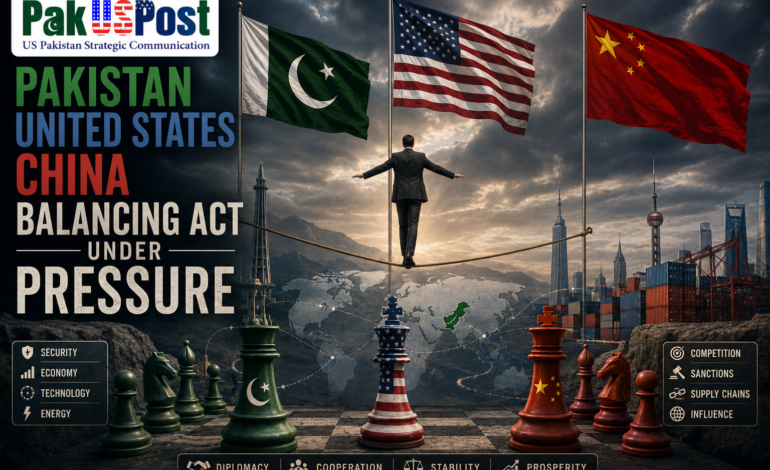
For much of the past two decades, Pakistan’s external statecraft has rested on a delicate but functional paradox: deepening strategic dependency on China while maintaining a working, episodic engagement with the United States. This dual alignment was never formalised as doctrine, yet it operated as an implicit equilibrium shaped by necessity rather than design. China provided infrastructure financing, defence cooperation, and long-term strategic insulation; the United States oscillated between counterterrorism cooperation, crisis mediation, and intermittent economic engagement. The system worked not because it was stable, but because contradictions were compartmentalised.
That compartmentalisation is now under sustained strain. The emerging structure of global competition between Washington and Beijing is no longer limited to military deterrence or diplomatic signalling. It has expanded into the operational architecture of power: semiconductors, digital infrastructure, cloud ecosystems, export controls, critical minerals, maritime logistics, and capital market screening. In this environment, states that previously navigated dual alignments through ambiguity are being pushed toward visibility. Ambiguity itself is becoming a liability.
For Pakistan, the question is not whether it can maintain ties with both powers. It is whether it can continue doing so without each side interpreting the relationship with the other as strategically consequential. The distinction is subtle but decisive. In the earlier era, Pakistan could engage Washington on security assistance and financial stabilisation while advancing infrastructure and connectivity projects with China without either relationship fundamentally contaminating the other. Today, the same overlap is increasingly read through a security lens.
Washington’s evolving posture is shaped by the assumption that technological and strategic ecosystems are inseparable. Telecommunications networks are no longer merely commercial infrastructure; they are potential vectors of intelligence exposure. Port development is not just logistics; it is maritime access. Mineral extraction is not just economic activity; it is supply chain leverage. Financial technology is not just inclusion; it is data governance. Under such conditions, Pakistan’s economic geography is automatically interpreted through a dual-use framework, even when its intent is purely developmental.
This reframing has direct consequences for Islamabad’s diplomatic space. The central challenge is no longer balancing relationships, but preventing sectoral entanglement from spilling across strategic domains. The United States is likely to become increasingly selective in areas of engagement where Chinese capital, technology, or standards are deeply embedded. Conversely, China will monitor any expansion of Pakistani cooperation with Western defence, intelligence, or digital ecosystems for signs of strategic dilution. Pakistan is therefore not managing two relationships in isolation; it is managing the interaction effect between them.
The first sector likely to experience visible political sensitivity is telecommunications and digital infrastructure. The architecture of next-generation connectivity, including 5G deployment, data routing systems, and cloud interoperability, is now central to strategic competition. Any perception of dual supplier dependency in core digital networks will trigger scrutiny from both sides. For Pakistan, this creates a narrowing corridor of technological choice. The issue is not simply vendor selection, but the geopolitical meaning attached to those choices. Digital sovereignty becomes externally interpreted, not domestically defined.
A second sensitive domain is port governance and maritime infrastructure. Pakistan’s geographic position gives it theoretical relevance in regional connectivity frameworks, but ports are increasingly viewed as nodes in broader strategic competition. External stakeholders will assess not only operational control but also long-term access arrangements, financing structures, and potential dual-use implications. Even commercial logistics projects may attract strategic classification if they intersect with competing maritime corridors. This reduces Pakistan’s ability to treat port development purely as an economic proposition.
A third and increasingly important domain is critical minerals and resource extraction, particularly copper, rare earths, and associated processing facilities. As global supply chains fragment, resource geography is becoming strategic geography. The United States is actively seeking diversification away from concentrated supply dependencies, while China seeks to maintain its dominant position in refining and processing. Pakistan’s mineral potential therefore enters a contested analytical space before it even reaches production scale. Investment flows in this sector will likely come with embedded expectations about export destinations, processing partnerships, and downstream integration.
Fintech and digital payment systems constitute a fourth area of sensitivity. Financial architecture is no longer neutral infrastructure. Payment rails, digital banking systems, and cross-border settlement mechanisms are increasingly integrated into sanctions regimes, data governance standards, and regulatory interoperability frameworks. Any attempt by Pakistan to integrate multiple competing financial ecosystems will face friction not only at the technical level but at the compliance and trust level. The risk is not immediate exclusion, but gradual segmentation.
A fifth domain is defence-linked industrial cooperation. While Pakistan’s traditional military relationship with China is well established, any parallel expansion of engagement with Western defence supply chains, maintenance systems, or dual-use industrial collaboration will be closely monitored. The issue is not conventional arms transfers alone, but industrial convergence. As modern defence systems become increasingly software-defined and supply-chain dependent, even indirect participation in parallel ecosystems becomes strategically visible.
These sectoral pressures raise a deeper question: can compartmentalisation still function as a viable doctrine, or has systemic securitisation rendered it obsolete? Historically, compartmentalisation relied on clear boundaries between economic and strategic domains, and between bilateral relationships. Those boundaries are now blurred. Economic infrastructure is strategic infrastructure. Civilian technology is dual-use technology. Financial systems are geopolitical instruments. In such a context, compartmentalisation becomes less a strategy and more a narrative device.
Yet declaring it obsolete would be premature. Compartmentalisation may no longer be fully controllable, but partial segmentation remains possible. The key distinction is between structural compartmentalisation, which assumes stable boundaries, and tactical compartmentalisation, which manages exposure moment by moment. Pakistan’s diplomatic challenge is to shift from the former to the latter without overestimating its capacity to control external perceptions.
This requires a recalibration of policy priorities. First, Pakistan must develop a clearer hierarchy of strategic sectors, distinguishing between core national infrastructure that must remain geopolitically resilient and peripheral sectors where diversification is acceptable. Without such hierarchy, every project becomes a potential strategic liability. Second, transparency in financing structures and regulatory frameworks becomes essential not to eliminate scrutiny, but to manage it predictably. Opacity no longer protects optionality; it increases suspicion.
Third, Pakistan must invest in institutional capacity to understand second-order effects of external alignment. Diplomatic agility is no longer sufficient. Technical expertise in data governance, supply chain compliance, financial regulation, and infrastructure security is now central to foreign policy. Without this capacity, decisions will be made reactively, increasing the likelihood of external misinterpretation.
Fourth, Islamabad will need to develop a narrative architecture that explains its economic engagements in terms of domestic development imperatives rather than strategic alignment signals. In a securitised environment, narrative is not cosmetic; it is structural. However, narrative alone cannot offset material dependencies. It can only reduce misclassification risk at the margins.
The United States, for its part, is unlikely to offer Pakistan a symmetrical strategic partnership in the foreseeable future. Its regional priorities are increasingly concentrated on larger-scale partnerships, technological ecosystems, and maritime security frameworks that do not structurally require Pakistan as a central node. Engagement will therefore be episodic, issue-based, and conditional on broader geopolitical context, particularly crisis management or counterterrorism cooperation.
China, conversely, will remain Pakistan’s most consistent external partner, but its expectations are also evolving. Beijing is increasingly sensitive to the diffusion of its strategic investments into contested technological or financial ecosystems. It will expect greater alignment clarity, even if not formal alignment declaration. This creates asymmetry: Pakistan must be flexible with one partner whose engagement is selective, and consistent with another whose expectations are tightening.
The result is not a collapse of Pakistan’s balancing strategy, but its transformation. The earlier model of equidistant engagement is giving way to a more constrained form of selective convergence. Pakistan is not choosing between Washington and Beijing in binary terms; it is navigating which sectors can safely intersect with which external systems without triggering strategic recalibration by either side.
In practical terms, the next phase of Pakistan’s foreign policy will be defined less by grand alignment and more by granular negotiation. Each sectoral decision will carry embedded geopolitical weight. Each infrastructure project will require external signalling management. Each financial reform will have cross-border interpretive consequences.
The policy implication is clear. Pakistan cannot rely on ambiguity as its primary strategic asset. It must replace ambiguity with calibrated specificity. This does not mean choosing sides, but it does mean accepting that neutrality in highly securitised sectors is no longer automatically recognised as neutral by external powers.
Ultimately, the viability of Pakistan’s dual engagement model will depend on whether it can reduce unintended signalling while increasing institutional clarity. The question is not whether Pakistan can balance China and the United States. It is whether it can do so in a world where balance itself is increasingly measured not by intent, but by infrastructure.
A Public Service Message