Pakistan’s Brain Drain and the State Capacity Threshold

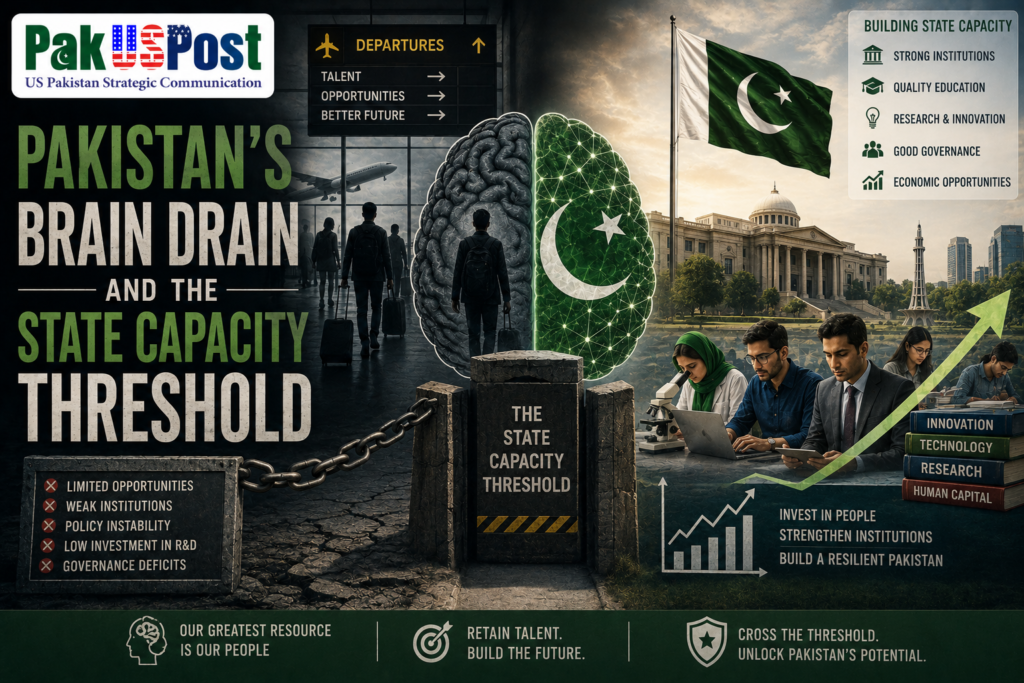
Pakistan’s accelerating outflow of skilled human capital is increasingly difficult to interpret through the familiar vocabulary of remittances, labour mobility, or cyclical migration. What is emerging instead is a structural depletion of institutional capability, in which the departure of doctors, engineers, academics, technologists, and mid-level administrators is not merely an economic adjustment but a slow reconfiguration of the state’s operational capacity. The question is no longer whether migration benefits households through income transfers, but whether sustained outward mobility is eroding the minimum functional density required for governance itself.
For decades, migration was treated as a stabiliser. It absorbed labour market pressure, provided foreign exchange inflows, and created transnational linkages that partially insulated the economy from domestic shocks. The Gulf migration wave of earlier decades, followed by broader global mobility into North America and Europe, was widely interpreted as an economic safety valve. Yet the composition of migration has changed in ways that fundamentally alter its systemic consequences. The contemporary cohort increasingly consists of high-skill professionals whose departure directly affects institutional performance in sectors that are already structurally under-resourced.
Hospitals lose consultants and specialists faster than they can be replaced. Universities experience faculty shortages that degrade research output and postgraduate training capacity. Public administration loses mid-career professionals who carry procedural memory and policy continuity. The technology sector loses engineers who would otherwise form the backbone of digital governance and private sector scaling. Even journalism and think tank ecosystems experience attrition that weakens policy discourse. The cumulative effect is not linear; it is compounding, because institutional capacity depends not only on numbers but on density, mentorship chains, and tacit knowledge transfer.
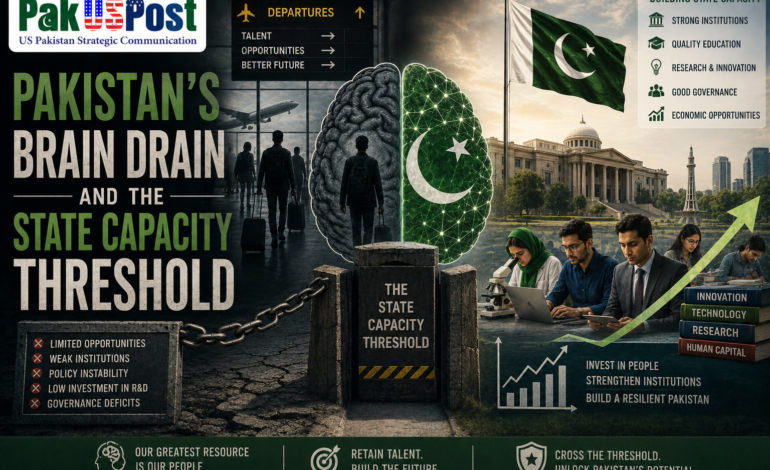
This raises a more uncomfortable proposition. Pakistan may be approaching a threshold at which emigration ceases to be a buffer and becomes a multiplier of institutional fragility. Below this threshold, outward migration can coexist with state functionality, as inflows of remittances and return migration partially offset losses. Beyond it, however, the system begins to lose the ability to regenerate competence internally. The critical variable is not total population loss but the erosion of the skilled middle layer that sustains bureaucratic and professional continuity.
The dynamics of this process are deeply intertwined with governance performance. Migration decisions are rarely driven by income differentials alone. They are shaped by perceptions of institutional reliability, meritocratic predictability, professional dignity, and social mobility. When health systems are overburdened, when universities lack research infrastructure, when administrative systems are perceived as politicised or inefficient, and when career progression appears disconnected from merit, the incentive to exit intensifies. In this sense, brain drain is not an external shock but an endogenous response to institutional stress.
The United States occupies a central position in this migration architecture, not only as a destination but as a normative reference point. Its universities, technological ecosystems, and professional certification systems define global benchmarks for competence. For Pakistani professionals, migration is often framed not simply as relocation but as entry into a system perceived to offer stability, recognition, and institutional coherence. This comparative asymmetry creates a persistent gravitational pull that domestic reforms must contend with.
Yet the United States is also indirectly implicated in the consequences of this mobility. Its immigration system selectively absorbs high-skill talent, while its universities and firms benefit from global human capital arbitrage. At the same time, it engages with Pakistan as a strategic partner in security, climate, and economic domains. This duality creates an underexplored policy space in which migration is simultaneously a private decision, a global labour market outcome, and a geopolitical factor influencing state capacity differentials.
The fiscal consequences of sustained brain drain are often underestimated. Tax administration systems depend on skilled auditors, data analysts, and policy designers. When these roles are vacant or underfilled, compliance weakens, leakage increases, and fiscal space contracts. Similarly, public health systems become more expensive per unit of service delivered when specialist ratios decline. Universities, when deprived of research-active faculty, lose not only teaching quality but also their ability to generate policy-relevant knowledge. The state, in effect, becomes more expensive to operate precisely as its capacity to generate revenue weakens.
This creates a paradoxical dynamic in which emigration both relieves and deepens fiscal stress. Remittances, which remain a significant component of Pakistan’s external inflows, provide household-level stability and foreign exchange liquidity. However, they do not directly compensate for institutional depletion. Indeed, remittance-driven consumption can sometimes mask structural weaknesses by sustaining demand without strengthening productive capacity. The result is a divergence between macroeconomic stability indicators and micro-institutional fragility.
The technological dimension of brain drain is particularly consequential in the current global environment. As governance increasingly relies on digital infrastructure, data systems, and algorithmic regulation, the loss of technical talent directly affects state modernisation capacity. Digital identity systems, tax automation, land record digitisation, and regulatory platforms require sustained technical expertise. When such expertise migrates, states become dependent on external consultants or fragmented internal capacity, both of which reduce institutional autonomy.
In the academic sector, the implications are equally profound. Universities are not merely teaching institutions; they are knowledge production systems that underpin policy innovation. When faculty migration accelerates, postgraduate supervision declines, research output contracts, and international collaboration weakens. This creates a feedback loop in which weaker academic ecosystems further incentivise outward migration among students and early-career academics, perpetuating a cycle of depletion.
The healthcare system reflects an even more immediate manifestation of capacity strain. The migration of specialists and nurses leads to disproportionate burdens on remaining staff, increasing burnout and reducing quality of care. Rural-urban disparities widen as urban tertiary hospitals absorb the limited remaining expertise, leaving peripheral regions increasingly underserved. Over time, this produces not only health inequality but also spatial inequality in state presence itself.
The administrative implications extend into governance architecture. Mid-level bureaucratic roles are often the most critical for policy continuity, as they translate political direction into operational implementation. When such roles are vacated, either through migration or attrition, policy execution becomes inconsistent. Institutional memory is lost, and learning cycles reset repeatedly. This reduces the state’s ability to implement long-term reforms, even when policy intent exists at higher levels.
Against this backdrop, the key analytical question is whether Pakistan can reframe migration not as a binary of loss or gain but as a managed system of circulation. Several middle-income countries have attempted to convert brain drain into “brain circulation” through diaspora engagement strategies, remote work integration, and institutional partnerships. The effectiveness of such strategies depends on whether emigrants remain embedded in domestic institutional ecosystems through research collaboration, advisory roles, or digital participation.
The diaspora dimension is particularly significant. Pakistani professionals abroad represent a large reservoir of financial capital, technical expertise, and institutional exposure. However, diaspora engagement remains fragmented, often driven by individual initiative rather than structured state policy. A more systematic approach would require institutional channels that enable short-term returns, remote advisory contributions, joint research platforms, and professional accreditation reciprocity.
The challenge is that diaspora engagement cannot substitute for domestic institutional strength. It can supplement, but not replace, the presence of functioning domestic systems. Without credible institutions at home, diaspora contributions tend to remain episodic and symbolic rather than structurally transformative. This distinction is critical for policy design.
From a geopolitical perspective, sustained brain drain also affects Pakistan’s bargaining position in international partnerships. States with strong human capital bases are better able to absorb technology transfers, implement regulatory reforms, and negotiate complex economic agreements. Weakening human capital reduces absorptive capacity, which in turn limits the effectiveness of external assistance and investment. In this sense, brain drain is not only a domestic issue but also a factor shaping external dependency.
The United States, as a key partner in education, technology, and migration pathways, is positioned at the centre of any serious attempt to address these dynamics. Academic exchange programmes, professional certification alignment, and joint research initiatives could potentially create partial feedback loops that mitigate institutional loss. However, such mechanisms require Pakistan to maintain a minimum level of domestic institutional credibility, without which cooperation remains asymmetrical.
The policy challenge, therefore, is not to restrict migration, which would be neither feasible nor desirable in a globally integrated labour market, but to recalibrate its relationship with state capacity. This requires a multi-layered strategy. First, domestic institutions must improve retention through merit-based career progression, professional dignity, and improved working conditions. Second, public sector organisations must invest in knowledge continuity systems that reduce dependency on individual personnel. Third, higher education must be restructured to strengthen research ecosystems and reduce faculty attrition. Fourth, migration policy should be complemented by structured diaspora integration frameworks that treat expatriates as extended institutional actors rather than detached economic agents.
There is also a need to reframe public discourse. Migration is often politicised either as a sign of national failure or as an individual success narrative. Both framings are incomplete. The reality is more complex: migration is simultaneously a response to domestic institutional weakness and a contributor to transnational opportunity structures. The policy objective should be to convert this complexity into a managed system rather than a polarised debate.
At a deeper level, the question confronting Pakistan is whether it can sustain state modernisation under conditions of persistent human capital outflow. Modern states rely not only on fiscal resources or political authority but on dense networks of expertise embedded within institutions. If those networks thin beyond a certain threshold, institutional repair becomes progressively more difficult. This is the threshold problem that now demands serious attention.
Pakistan has not yet crossed an irreversible line, but the trajectory is concerning. The compounding nature of skilled migration, combined with uneven institutional reform, suggests that the margin for policy error is narrowing. Without decisive intervention, the state risks entering a phase where it becomes structurally dependent on external expertise to perform internal functions, a condition that limits sovereignty in practical terms even if formal sovereignty remains intact.
The alternative is not closure but recalibration. If managed strategically, migration can remain a source of resilience rather than depletion. But this requires recognising brain drain not as a social phenomenon or economic side effect, but as a core variable in state capacity planning. In an era where governance is increasingly defined by technical competence, institutional density, and knowledge systems, the distribution of human capital becomes a central determinant of national trajectory.
In that sense, the future of Pakistan’s state capacity may depend less on whether people leave, and more on whether the state can learn to function across borders, turning dispersion into extension rather than erosion.
A Public Service Message