
Pakistan US Investment Needs a Disciplined Project Conversion Architecture

Pak US Post must treat the investment relationship with Washington as a problem of conversion rather than courtship. Pakistan has rarely suffered from a complete absence of American commercial interest. The United States remains one of Pakistan’s largest sources of foreign direct investment, while American enterprises already operate across consumer goods, agribusiness, financial services, information technology, healthcare, energy and other commercially significant sectors. Bilateral goods trade reached approximately $7.23 billion in 2024, with the United States absorbing $5.12 billion of Pakistani exports, yet the scale and depth of American productive investment remain disproportionately modest relative to the size of the Pakistani market and the breadth of sectors in which American capital and technology could participate.
The central policy question is therefore more uncomfortable than whether Pakistan can attract another delegation from Washington, secure another memorandum of understanding or announce another prospective investment figure. It is whether the Pakistani state can transform commercial interest into projects that survive due diligence, obtain financing, acquire uncontested land, secure licences, reach financial close, construct facilities, employ workers, generate exports and remit legitimate returns without becoming trapped in administrative attrition. This distinction is fundamental. An announced investment is a political event. A financially closed investment is an economic event. A functioning industrial asset is a strategic asset. Pakistan’s policy architecture has historically been much better calibrated to the first than to the latter two.
The formal investment regime is not inherently hostile to American capital. The Board of Investment describes Pakistan as having a liberal investment framework, with foreign equity of up to 100 percent permitted across most sectors and repatriation of capital, profits and dividends allowed under the applicable foreign exchange framework. The BOI is explicitly mandated to facilitate domestic and foreign investment and to act as an interface between investors, government and the private sector. The Pakistan Business Portal is intended to develop a virtual one stop shop for regulatory information and business procedures. These instruments are useful, but facilitation cannot be confused with execution. A portal can tell an investor which licence is required; it cannot by itself guarantee that the licence will arrive within the period incorporated into the project’s financial model.
That gap between formal entitlement and operational certainty is where American investors encounter Pakistan’s real transaction costs. The United States Commercial Service continues to identify complex and inconsistent regulations, changing taxation policies, weak rule of law, corruption, political uncertainty, security concerns and inadequate intellectual property protection among the difficulties confronting investors. Its latest country assessment also records significant weaknesses in dispute resolution, market competition and insolvency, even while Pakistan performs relatively well on business entry and financial services. The implication for policymakers is consequential. Pakistan has improved the front door to the economy while leaving too many of the corridors behind it administratively congested.
Taxation is a particularly important part of this problem because American corporations do not assess tax merely as a statutory rate. They assess the predictability of the entire tax administration. A project model must incorporate federal income tax, provincial sales taxes on services, customs treatment, withholding obligations, transfer pricing, tax audits, refunds, exemptions and the consequences of regulatory changes during the investment horizon. Historically, foreign investors have complained that federal and provincial tax systems can be difficult to navigate and that assessments and refunds lack sufficient predictability. Pakistan’s participation in international tax cooperation and its adoption of international standards have strengthened the formal framework, but multinational corporations require something more prosaic: an administratively coherent tax environment in which the assumptions used during investment approval remain recognisable when the plant begins production.
Land represents an even more fundamental bankability test. An American corporation considering a manufacturing facility, data centre, logistics hub, pharmaceutical plant or energy project does not regard land acquisition as a ceremonial step following an investment announcement. It is a legal diligence exercise involving title, encumbrances, zoning, environmental approvals, access roads, utilities, local claims, mortgageability and the enforceability of possession. Pakistan has made progress in digitising land records in several provinces, but longstanding title deficiencies and competing claims remain a material concern. The U.S. investment record has itself contained cases in which land promised for a major project became entangled in access and possession problems. A state that presents land as available before independently certifying title transfers the sovereign’s administrative weakness directly into the investor’s risk premium.
Licensing presents a similar difficulty. The problem is not simply the number of permits. It is the possibility that the regulatory sequence is neither fully mapped nor synchronised across federal and provincial authorities. An industrial project may require corporate registration, tax registration, environmental clearance, construction permissions, utility connections, labour registrations, import permissions, sectoral licences and local approvals. Each may be individually reasonable. The cumulative process can nevertheless become commercially irrational if agencies operate according to separate clocks. The recent reform agenda around the Pakistan Business Portal, regulatory registries and the Asaan Karobar framework is therefore potentially important, particularly because the IMF has explicitly stressed the need to streamline business regulations and licensing while improving coordination with provincial governments.
The federal provincial divide requires particularly careful treatment in a Pakistan US investment compact. Investment promotion is substantially federal in diplomatic presentation, but project execution frequently occurs within provincial jurisdictions. Land, labour, environmental regulation, municipal permissions, services and taxation can involve provincial institutions. The result is a peculiar asymmetry. Islamabad can announce an investment in Washington, yet Lahore, Karachi, Peshawar or Quetta may determine whether the project can actually begin construction. A serious investment architecture must therefore prevent federal investment diplomacy from producing provincial implementation liabilities.
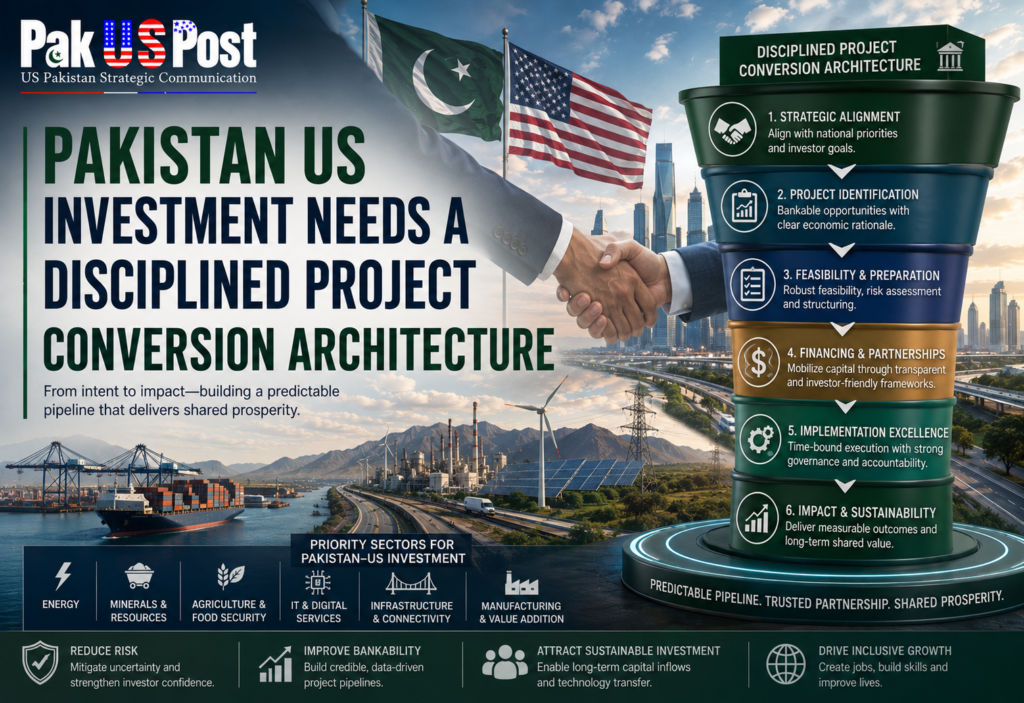
The solution should not be another high level committee. Pakistan already possesses enough committees, facilitation desks and investment conferences to demonstrate political intent. What is missing is an investment conversion mechanism with authority to measure performance against a project’s actual commercial lifecycle. The proposed Pakistan US Investment Conversion Mechanism should therefore operate as a joint public private execution platform under the existing bilateral economic architecture, with the Board of Investment as Pakistan’s institutional anchor and structured participation from the Ministry of Finance, Federal Board of Revenue, State Bank of Pakistan, Securities and Exchange Commission, Ministry of Commerce, relevant provincial investment agencies and designated American private sector representatives.
Every project entering the mechanism should receive a unique Project Conversion Identification Number. That identifier should follow the investment from initial expression of interest to operating asset. The database should record the investor, beneficial ownership, proposed capital expenditure, financing structure, land requirement, technology content, expected employment, export potential, foreign exchange requirements, federal permissions, provincial permissions, environmental obligations, local supplier commitments and anticipated completion date. This would replace the politically convenient but economically ambiguous category of “investment announced” with a measurable sequence of commercial milestones.
The milestone architecture should contain at least six gates: expression of interest, due diligence completed, government approvals completed, financial close, commercial operations and performance verification. No project should be counted as realised investment merely because a memorandum has been signed. A project should move into the investment pipeline only after the investor has demonstrated serious intent and the Pakistani side has confirmed that the regulatory pathway is identifiable. Financial close should become the principal threshold for counting committed capital. Construction should establish whether the commitment has become physical economic activity. Commercial operation should determine whether the project is functioning. Employment, exports, domestic procurement, tax contribution and foreign exchange generation should determine whether the asset is delivering the strategic value claimed when the investment was announced.
This distinction would also improve Pakistan’s negotiating credibility with Washington. American corporations are accustomed to investment committees, internal compliance procedures, environmental and social assessments, sanctions screening, beneficial ownership verification, insurance requirements and board level approval. They do not normally deploy significant capital because a ministerial meeting produced political enthusiasm. Their internal question is whether the host jurisdiction can convert an opportunity into a predictable risk adjusted return. Pakistan should therefore mirror the discipline of the investor rather than attempting to compensate for institutional uncertainty through ceremonial guarantees.
Repatriation is another area where the distinction between law and execution matters. Pakistan’s formal framework permits foreign investors to repatriate profits, dividends and disinvestment proceeds subject to foreign exchange procedures, and the State Bank registers foreign direct investment on a repatriable basis through authorised dealer banks. Yet historical cases involving delayed repatriation have demonstrated that a legal entitlement can become commercially inadequate if several agencies must coordinate before funds can move. The appropriate response is not indiscriminate liberalisation. It is procedural certainty. A Pakistan US project should have a designated authorised dealer bank, a documented repatriation pathway, defined documentary requirements and a service standard for resolving cases that exceed the normal processing period.
Dispute resolution deserves similar treatment. American investors evaluate not merely whether Pakistan has courts and arbitration mechanisms, but whether a dispute can be resolved within a commercially meaningful timeframe and whether an award can ultimately be enforced. The U.S. investment climate record has identified lengthy dispute resolution and weaknesses in enforcement as persistent concerns. Pakistan therefore needs a specialised commercial dispute protocol for strategic foreign investment, with strict case management, professional arbitration capacity and clear mechanisms for enforcing awards. The objective should not be to create privileged justice for American companies. It should be to make commercial justice sufficiently predictable for all productive investors while protecting the sovereign’s legitimate regulatory authority.
The investment mechanism should also introduce a sovereign readiness certificate before Pakistan markets a major project abroad. Such a certificate would confirm that land title has been independently verified, required permits have been mapped, grid or utility capacity has been assessed, customs treatment has been clarified, tax assumptions have been documented, environmental approvals have an identified pathway, security requirements have been assessed and the responsible federal and provincial authorities have formally accepted their respective obligations. This would prevent Washington facing a familiar paradox: a Pakistani project is politically “ready” long before it is legally, financially and infrastructurally ready.
Security should be integrated into this architecture without turning commercial investment into a security bureaucracy. For American companies, especially those operating in energy, telecommunications, cloud infrastructure, pharmaceuticals, mining, logistics and advanced manufacturing, security assessment is inseparable from business continuity. The state should therefore provide risk assessments, designated liaison channels and contingency protocols while preserving commercial confidentiality. Security assurances are most valuable when they are institutionalised and measurable rather than delivered through informal political access.
Pakistan should also abandon the habit of measuring investment diplomacy through headline dollar values. A $1 billion announcement that never reaches financial close has less economic significance than a $150 million facility that becomes operational, employs 2,000 people, purchases from local suppliers and earns export revenue. The Ministry of Investment, the Planning Commission and the State Bank should publish a quarterly Pakistan US Investment Conversion Dashboard showing announced value, due diligence status, approvals completed, financial close, capital actually imported, construction progress, employment created, exports generated, tax contributions and unresolved government actions. Sensitive commercial information can remain confidential, but aggregate performance should be transparent enough to expose whether the conversion machinery is working.
The dashboard should also identify the precise agency responsible whenever a project misses a milestone. Accountability must attach to decisions, not merely to institutions. If land clearance is delayed, the responsible authority should be identifiable. If an environmental approval is pending, the regulatory stage should be visible. If foreign exchange processing exceeds the agreed service standard, the case should automatically escalate. If federal and provincial regulations conflict, the issue should enter a formal intergovernmental resolution track. This would transform facilitation from personal intervention into institutional case management.
The mechanism should have a strategic investment tier for projects with implications beyond immediate capital formation. American participation in critical minerals processing, advanced agriculture, pharmaceuticals, medical technology, cybersecurity, cloud infrastructure, renewable energy, logistics, industrial automation and export manufacturing could deepen Pakistan’s economic resilience while expanding the practical content of the bilateral relationship. The United States Commercial Service already identifies ICT, healthcare, renewable energy, agriculture, minerals and infrastructure among areas with commercial potential. The opportunity is therefore not speculative. The constraint is whether Pakistan can make individual projects sufficiently bankable for American corporate boards to approve them.
For Washington, such a mechanism would also create a more reliable counterpart. American policy should distinguish between diplomatic signalling and commercially actionable opportunities. The U.S. Commercial Service, the U.S. Pakistan Business Council and American business associations in Pakistan can help identify companies with credible investment mandates, but Pakistan should reciprocate by presenting projects with verified land, regulatory maps, financial models and export pathways rather than political brochures. The existing Trade and Investment Framework Agreement provides an established bilateral channel that can be used to institutionalise this work rather than continuously inventing parallel mechanisms.
The deeper strategic concern is that investment failure has consequences beyond missed capital. When an announced project repeatedly fails to materialise, credibility depreciates. Domestic firms infer that politically connected enterprises may possess advantages unavailable to ordinary investors. Foreign corporations revise their country risk assumptions. Banks increase required returns. Suppliers hesitate to build capacity. Skilled workers migrate. The state then becomes more dependent on public financing, short term portfolio flows and episodic bilateral assistance. The investment problem thus becomes a competitiveness problem, and the competitiveness problem eventually becomes a national resilience problem.
Pakistan’s macroeconomic reform programme increasingly recognises this connection. The IMF has repeatedly emphasised that stronger governance, competition, energy reform, regulatory modernisation and a more credible business environment are necessary to attract high impact private investment. Its latest assessments continue to identify excessive regulatory burdens, institutional weaknesses and the need for a stronger private sector environment as central reform priorities. Investment conversion should therefore not be treated as an isolated foreign policy initiative. It should become an operational extension of Pakistan’s broader economic reform programme.
The harder answer to the original question is consequently clear. Pakistan’s principal investment problem is not simply lack of foreign interest. Nor is it adequately described as a shortage of investment promotion. The deeper deficit is the state’s capacity to convert interest into bankable, executable and commercially durable assets. American corporations do not require Pakistan to eliminate every risk. They require the risks to be identifiable, allocable, priced and governed by institutions capable of honouring their own procedures.
A Pakistan US Investment Conversion Mechanism would provide precisely that missing bridge. Its success should be judged not by the number of memoranda signed in Islamabad or Washington, nor by the size of investment figures announced at diplomatic ceremonies, but by how many projects reach financial close, how much capital physically enters Pakistan, how many facilities become operational, how many skilled jobs are created, how much is exported, how much technology is embedded in domestic production and how reliably legitimate returns can leave the country. That is the point at which investment diplomacy ceases to be theatre and becomes state capacity. For Pak US Post, the strategic proposition is therefore straightforward: Pakistan does not need to promise American investors more enthusiasm. It needs to offer them a state architecture capable of converting confidence into capital, capital into industrial assets and industrial assets into durable bilateral economic power.
A Public Service Message