
Pakistan’s Digital Export Gap Is Now a Strategic Liability

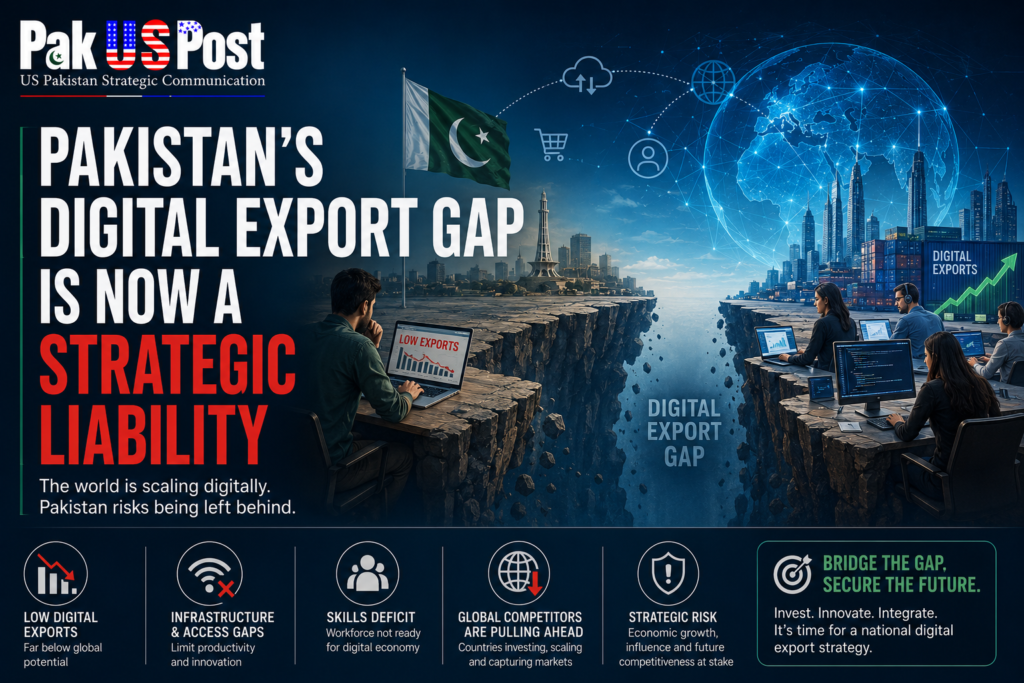
Pak US POST confronts a paradox that is increasingly consequential for Pakistan’s economic security: the country possesses a large and youthful technology workforce, yet remains marginal in the higher strata of the American digital services market where intellectual property, recurring contracts, regulatory assurance and specialised expertise generate substantially greater value than labour arbitrage. Pakistan has demonstrated that it can supply programmers, developers, designers, call centre operators and business process workers to international clients, but that capacity has not yet crystallised into durable commercial influence in the United States. The problem is therefore not simply insufficient exports. It is an institutional deficit in converting human capital into trusted digital capability that American firms can procure repeatedly, scale confidently and integrate into sensitive corporate systems.
The distinction matters because the American technology economy does not purchase talent merely on the basis of numerical availability or competitive hourly rates. It purchases reliability under scrutiny. A Pakistani software engineer competing for a contract involving financial infrastructure, medical information, cloud architecture, artificial intelligence or cybersecurity enters an ecosystem governed by contractual liability, intellectual property assurance, data protection, cyber certification, insurance requirements, procurement rules, tax documentation and reputational risk. A technically capable supplier can therefore remain commercially insignificant if the surrounding jurisdiction does not provide sufficient confidence that proprietary code will remain protected, personal information will be handled lawfully, breaches will be disclosed promptly and contractual obligations will survive institutional disruption.
Pakistan’s export policy has often treated information technology as an extension of services trade, whereas Washington increasingly views digital capability through the interconnected lenses of economic security, trusted supply chains, cyber resilience and technological competitiveness. That divergence has strategic implications for the Pak US relationship. Pakistan should not approach Washington primarily with requests for market access. It should present itself as a jurisdiction capable of meeting defined standards for trusted digital production. The transition requires a regulatory architecture in which the credibility of the Pakistani provider becomes verifiable rather than rhetorical.
Intellectual property represents one of the most important fault lines. American companies considering Pakistani suppliers need assurance concerning source code ownership, trade secrets, software licensing, employee confidentiality, algorithmic assets and the enforceability of contractual restrictions. Formal legislation is necessary but insufficient. What matters commercially is the speed and predictability with which disputes can be resolved. Pakistan could establish specialised commercial benches for technology contracts, supported by judges trained in software licensing, digital evidence, trade secret disputes and international arbitration. The Securities and Exchange Commission of Pakistan, intellectual property authorities, courts and technology regulators should develop a unified protocol for registering and enforcing technology related contractual rights. A Pakistani exporter should be able to demonstrate to an American procurement department, through documentary evidence, precisely how intellectual property disputes would be adjudicated.
Data governance presents an equally consequential barrier. American enterprises increasingly divide suppliers into categories according to the sensitivity of the information they process. A company handling publicly available material faces different requirements from one processing medical records, financial information, employee data or proprietary industrial information. Pakistan therefore needs a risk calibrated framework for cross border data transfers rather than an undifferentiated regulatory regime. The objective should be interoperability with credible international standards while retaining legitimate national safeguards. A bilateral digital trade arrangement could establish recognised categories for personal, commercial, regulated and critical data, alongside contractual safeguards, breach notification procedures, audit rights and minimum technical controls.
Cybersecurity certification could become the principal mechanism for translating Pakistani competence into American procurement eligibility. Government should not attempt to certify every freelancer. It should construct a national accreditation ladder for technology firms based on internationally recognisable security controls, independent audits, incident response capacity, employee access management, encryption practices and business continuity. Pakistani companies seeking American government or major corporate contracts should be able to obtain independently verifiable certification whose validity can be checked electronically by foreign procurement officers. This would convert cybersecurity from an abstract compliance burden into an export credential.
Payment infrastructure remains another underappreciated constraint. A technology exporter may possess clients, engineers and contracts yet still encounter friction in receiving international payments, managing foreign currency, documenting beneficial ownership or satisfying compliance requirements imposed by American financial institutions. Pakistan should establish a dedicated digital export settlement framework through commercial banks and the State Bank of Pakistan, enabling rapid verification of legitimate technology transactions while strengthening anti money laundering controls. Exporters should have access to transparent foreign exchange procedures, predictable repatriation mechanisms and digital documentation compatible with American corporate accounting systems. The objective should be neither deregulation nor administrative permissiveness, but frictionless legitimacy.
Corporate credibility is perhaps harder to legislate. American procurement departments frequently prefer suppliers capable of demonstrating audited accounts, institutional governance, professional liability insurance, documented human resource procedures, continuity arrangements and identifiable senior management. A significant portion of Pakistan’s technology sector remains organised around small firms and individual contractors whose technical capabilities may exceed their corporate maturity. That asymmetry limits their ability to compete for large recurring contracts. Pakistan Software Export Board, commercial banks and industry associations should therefore establish an Export Readiness Programme that helps technology enterprises progress from founder dependent operations to professionally governed companies. Eligibility could be measured through audited financial statements, cybersecurity certification, contract management systems, intellectual property policies, insurance coverage and documented succession arrangements.
The American market also demands a different conception of technological specialisation. Pakistan cannot sustainably compete with India, the Philippines, Eastern Europe or Latin America merely by supplying cheaper developers. The opportunity lies in domains where accumulated expertise, domain knowledge and trusted execution create switching costs for clients. Artificial intelligence engineering is one such field, particularly model evaluation, data engineering, retrieval systems, enterprise automation, machine learning operations and sector specific AI implementation. Cybersecurity provides another opening, especially security operations, vulnerability assessment, threat intelligence, identity management and compliance engineering. Cloud operations, software reliability, enterprise architecture and business process automation could similarly produce recurring contracts rather than episodic assignments.
Digital health deserves particular attention because Pakistan possesses a substantial medical and technological workforce, while American healthcare organisations face chronic pressure to improve administrative efficiency. Pakistani firms could provide software development, medical transcription, coding support, clinical data processing and workflow automation, but expansion into higher value segments would require rigorous compliance with American health information requirements and demonstrable data security. Government should therefore facilitate specialised certification programmes rather than subsidise generic coding courses. The test of public policy should be whether a Pakistani professional becomes eligible for a higher value American contract, not whether another training cohort receives a certificate.
The same principle should govern artificial intelligence. Pakistan should avoid building an export strategy around generic data labelling alone. Annotation can create employment, but its margins are vulnerable to automation and intense international competition. The more durable opportunity lies in progressing from data preparation towards model testing, domain specific evaluation, synthetic data generation, AI safety assessment, enterprise integration and deployment support. Public universities, private technology firms and American partners could establish applied laboratories focused on commercially relevant AI problems. Such laboratories should operate under contractual governance rather than becoming another collection of ceremonial innovation centres.
Venture financing constitutes a further structural weakness. Pakistani technology companies that acquire American customers frequently require capital to establish sales teams, compliance departments and delivery capacity in the United States. Domestic financing is generally inadequate for this stage of internationalisation. A Pak US Digital Investment Facility could therefore be developed with participation from Pakistani financial institutions, diaspora investors, American venture funds and development finance institutions. Its mandate should be narrowly commercial, concentrating on companies that have demonstrable foreign revenue, American customers, defensible intellectual property or validated technology products. Capital should follow evidence of market traction rather than political patronage.
American procurement could provide the most consequential demand side intervention. Pakistan should seek inclusion of qualified Pakistani firms within appropriate American corporate and institutional supplier networks rather than concentrating exclusively on government procurement. A bilateral procurement dialogue could identify sectors in which Pakistani firms can meet security and quality requirements, develop a common vendor due diligence template and create mechanisms through which smaller companies can form compliant consortia. Large American technology companies could also be encouraged to establish supplier development programmes in Pakistan, provided participation remains commercially driven and does not become an opaque incentive arrangement.
The proposed Pakistan US Digital Trade Compact should consequently be constructed as an implementation instrument rather than another diplomatic declaration. Its architecture could contain six operational pillars: mutual recognition of selected professional certifications, secure cross border data transfer rules, reciprocal technology investment facilitation, recognised cybersecurity accreditation, access to American procurement ecosystems and mechanisms connecting Pakistani startups with American capital. Each pillar should carry measurable indicators. Professional recognition should specify which qualifications are accepted and by which institutions. Data provisions should define permissible transfer mechanisms and breach notification periods. Investment provisions should establish licensing and repatriation procedures. Procurement provisions should track contracts secured by Pakistani firms. Capital access should measure investment mobilised, not merely conferences convened.
A bilateral Digital Trade Council should supervise implementation, with representation from Pakistan’s commerce, finance, information technology and foreign affairs institutions, the State Bank, relevant regulators, industry bodies and designated American counterparts. Its secretariat should maintain a live transaction pipeline identifying regulatory obstacles encountered by exporters and assigning each obstacle to a responsible institution with a defined resolution deadline. The council should publish an annual implementation scorecard containing export values, average contract size, recurring revenue, number of certified firms, American clients acquired, intellectual property registrations, cybersecurity certifications, venture capital raised and technology jobs linked to United States contracts. Measurement would make it considerably harder for policy enthusiasm to substitute for commercial performance.
Washington, for its part, has an interest in widening trusted technology supply networks beyond concentrated geographic dependencies. Pakistan cannot expect preferential treatment, but it can offer a combination of engineering talent, English language capability, time zone compatibility, a substantial domestic market and an expanding technology ecosystem. Its proposition becomes more credible when those attributes are embedded within enforceable institutions. American participation should therefore focus on standards, investment, procurement linkages, research partnerships and professional exchange rather than episodic training programmes.
There is also a strategic dimension to reducing Pakistan’s dependence on low margin outsourcing. A country that exports only human hours remains vulnerable to wage competition and technological substitution. A country that exports software architecture, proprietary platforms, cybersecurity expertise, specialised AI systems and digitally embedded business solutions begins to accumulate intellectual capital. That distinction affects not merely export receipts but national technological autonomy. Recurring intellectual value creates firms with stronger balance sheets, skilled managerial cadres, patentable assets and international networks that can eventually support domestic innovation.
The establishment should therefore regard digital trade as an element of economic and technological resilience rather than a narrow commerce portfolio. American technology markets can become a channel through which Pakistan acquires institutional sophistication, corporate governance standards, cybersecurity maturity and access to sophisticated capital. But this opportunity will remain unrealised if Islamabad continues to measure success through the size of its freelancer population or the number of technology incubators established. The relevant indicators are considerably more demanding: average export value per professional, proportion of recurring contracts, share of specialised services, American procurement penetration, intellectual property ownership, compliance accreditation and the volume of capital retained within Pakistani technology companies.
Pakistan does not suffer from a shortage of digital talent. It suffers from an inadequate mechanism for converting talent into trusted, defensible and internationally scalable commercial capability. The Pak US relationship offers a potentially powerful corrective because American market access can impose the standards that domestic policy has struggled to enforce consistently. The objective should not be to make Pakistan another low cost outsourcing destination. It should be to make selected Pakistani firms credible suppliers of complex digital systems whose value persists after the programmer, consultant or contractor has completed the immediate assignment. That requires regulatory interoperability, institutional discipline, financial infrastructure and a procurement strategy designed around trust. If those foundations are constructed deliberately, digital services could evolve from an employment story into a strategic trade asset. If they are not, Pakistan’s expanding technology workforce will remain an impressive demographic statistic without acquiring the commercial leverage that Washington’s digital economy increasingly rewards.
A Public Service Message