
Congressional narratives increasingly shape Pakistan United States strategic engagement

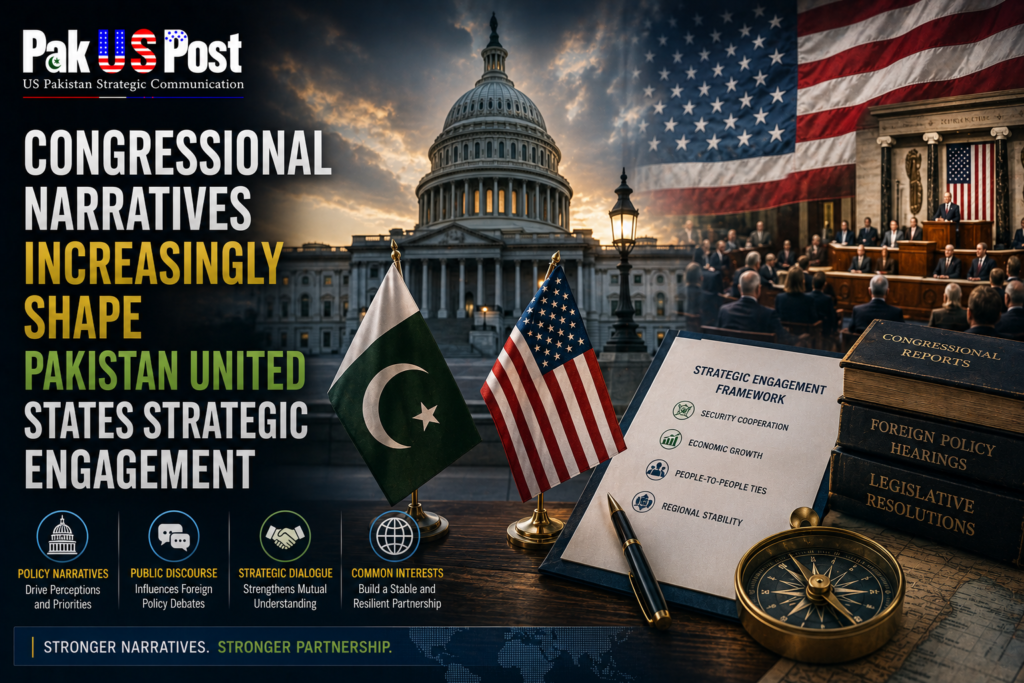
The conventional assumption that relations between Pakistan and the United States are principally determined through executive diplomacy no longer reflects the institutional realities governing Washington’s foreign policy. Presidential administrations continue to establish broad strategic direction, yet Congress has progressively expanded its influence over security partnerships, foreign assistance, technology cooperation, export controls, defence authorisations, financial oversight and democratic governance expectations. Legislative institutions no longer merely endorse executive initiatives. They increasingly define the political boundaries within which every administration formulates policy towards partners, competitors and strategically important regions.
For Pakistan, this transformation carries implications extending far beyond diplomatic protocol. Bilateral stability is becoming progressively dependent upon political narratives evolving inside congressional committees, bipartisan caucuses, oversight mechanisms and legislative research institutions. Decisions affecting military cooperation, educational exchanges, development financing, commercial access, technology licensing and financial compliance increasingly emerge from legislative processes rather than exclusive executive negotiations. Consequently, Islamabad’s strategic calculations require a deeper understanding of congressional behaviour, domestic political incentives and institutional dynamics shaping American foreign policy.
American domestic politics has entered an era characterised less by ideological oscillation than by durable bipartisan convergence regarding strategic competition, technological leadership, supply chain security, democratic resilience and institutional accountability. While partisan disagreements remain highly visible, substantial continuity exists across successive administrations concerning national security priorities. Congressional hearings repeatedly demonstrate that changes in presidential leadership seldom alter long term legislative expectations regarding transparency, governance standards, counterterrorism commitments, regional stability and strategic reliability among international partners.
This evolution reflects structural rather than temporary political developments. Congressional committees possess expanding authority over appropriations, defence authorisations, export licensing, intelligence oversight and sanctions implementation. Their recommendations increasingly influence executive flexibility, particularly where foreign assistance, military cooperation and technology partnerships intersect with domestic political concerns. Congressional staff, policy advisors and legislative research organisations consequently exercise considerable influence upon bilateral policy formation, often outside public attention.
Pakistan therefore confronts a diplomatic environment where relationships with executive agencies alone cannot adequately protect long term national interests. Sustainable engagement increasingly requires institutional familiarity with legislative actors possessing substantial authority over funding allocations, oversight mechanisms and statutory requirements affecting bilateral cooperation.
Congressional narratives frequently emerge through committee hearings addressing regional security, global terrorism, democratic governance, strategic competition and emerging technologies. Testimony presented before congressional committees influences legislative perceptions which subsequently shape budgetary decisions, policy language and diplomatic expectations. Think tanks, academic specialists, retired officials, advocacy organisations and private sector representatives collectively contribute to these hearings, generating interpretative frameworks that frequently outlast individual administrations.
These narratives matter because legislative perceptions become institutional memory. Once particular themes become embedded within congressional discourse, altering them requires sustained evidence, continuous engagement and long term relationship building. Temporary diplomatic initiatives rarely overcome entrenched institutional assumptions. Consequently, Pakistan’s international image increasingly depends upon persistent communication rather than episodic crisis management.
Domestic political discourse within the United States also amplifies the importance of values based foreign policy narratives. Governance quality, institutional accountability, judicial independence, media freedom, electoral transparency and civil society participation regularly appear during congressional deliberations concerning international partnerships. Whether these discussions produce immediate policy changes remains uncertain, yet their cumulative influence shapes legislative attitudes affecting assistance programmes, development partnerships and diplomatic engagement.
Security cooperation illustrates this institutional transition with particular clarity. Previous decades witnessed bilateral security arrangements negotiated predominantly through executive channels responding to immediate geopolitical circumstances. Contemporary congressional oversight has introduced additional layers of accountability encompassing human rights considerations, financial transparency, end use monitoring, procurement standards and institutional reforms. Legislative committees increasingly request comprehensive reporting requirements before authorising defence cooperation or security assistance.
This environment does not necessarily reduce opportunities for bilateral security engagement. Instead, it alters the criteria governing political sustainability. Military cooperation now requires broader institutional legitimacy extending beyond executive calculations. Transparency, documentation and measurable outcomes increasingly determine congressional confidence. Pakistan therefore benefits from strengthening institutional communication capable of demonstrating operational effectiveness, financial accountability and strategic consistency through verifiable evidence.
Technology cooperation presents an equally significant dimension. Congressional attention towards semiconductor supply chains, artificial intelligence, advanced computing, cyber resilience, biotechnology and quantum research reflects wider concerns regarding technological competitiveness. Legislative initiatives increasingly influence export licensing, research collaboration, academic exchanges and investment screening. Consequently, scientific cooperation cannot be analysed separately from congressional policymaking.
Pakistan’s expanding digital economy, higher education institutions and research communities consequently operate within a regulatory environment increasingly shaped by American legislative priorities. Universities, innovation centres and technology enterprises seeking collaboration with American counterparts must understand evolving congressional expectations concerning research security, intellectual property protection, cyber governance and sensitive technologies. Legislative developments affecting advanced technologies increasingly possess international consequences extending well beyond American borders.
Development assistance has similarly evolved under expanding congressional scrutiny. Budget appropriations increasingly incorporate detailed reporting requirements, measurable performance indicators and governance expectations. Congressional committees routinely evaluate programme effectiveness, financial accountability and strategic alignment before approving assistance packages. Development partnerships therefore become subject to continuous legislative evaluation rather than automatic executive renewal.
Pakistan’s domestic institutions must accordingly recognise that development cooperation increasingly requires evidence based performance capable of satisfying congressional oversight expectations. Transparent implementation mechanisms, credible auditing frameworks and measurable policy outcomes strengthen international confidence while simultaneously improving domestic governance capacity. Institutional credibility becomes both a diplomatic asset and a development necessity.
Commercial engagement similarly reflects congressional influence. Legislative debates concerning supply chain resilience, investment security, labour standards, environmental compliance and digital commerce increasingly affect international economic relationships. Trade policy has become closely connected with national security, technological competitiveness and industrial policy. Congressional committees therefore participate actively in shaping commercial frameworks governing strategic partnerships.
For Pakistan, expanding exports and attracting investment consequently require engagement extending beyond executive trade negotiations. Parliamentary delegations, commercial associations, regulatory agencies and business councils require sustained dialogue with legislative stakeholders explaining Pakistan’s economic reforms, industrial capabilities and investment opportunities. Economic diplomacy increasingly demands legislative literacy alongside commercial expertise.
Congressional oversight also shapes financial regulation. Anti money laundering standards, sanctions implementation, financial transparency and international banking compliance frequently receive legislative attention. Congressional debates influence regulatory expectations subsequently affecting correspondent banking, investment confidence and financial market accessibility. Pakistan’s financial institutions therefore operate within a compliance environment indirectly influenced by American legislative developments.
The implications extend towards multilateral institutions as well. Congressional attitudes frequently influence American positions within international financial organisations, development banks and global governance institutions. Legislative priorities concerning governance reforms, transparency standards and institutional accountability therefore possess indirect consequences for countries seeking international financing or technical assistance.
Domestic American politics additionally shapes diplomatic expectations through electoral incentives. Members of Congress respond primarily to domestic constituencies, local economic interests, national security concerns and public opinion. Foreign policy positions frequently reflect these domestic calculations. Consequently, bilateral relationships increasingly intersect with internal political narratives unrelated to immediate diplomatic developments.
Understanding these domestic incentives becomes essential for effective engagement. Congressional representatives from technology intensive districts may prioritise intellectual property protection and research security. Legislators representing manufacturing regions may emphasise supply chain resilience and industrial competitiveness. Others may focus upon educational exchanges, humanitarian cooperation or democratic governance. Effective diplomacy therefore requires differentiated engagement recognising varied legislative priorities rather than assuming uniform congressional perspectives.
Pakistan’s parliamentary diplomacy has not always evolved at comparable institutional speed. Diplomatic engagement frequently remains concentrated within executive institutions despite expanding legislative influence abroad. Parliamentary committees possess opportunities to cultivate structured dialogue with congressional counterparts, yet institutional continuity remains limited. Delegation exchanges often occur without sustained policy follow through, limiting long term relationship development.
Strengthening parliamentary diplomacy requires permanent institutional architecture rather than occasional visits. Dedicated legislative liaison units supporting parliamentary committees could monitor congressional developments, analyse legislative proposals and facilitate regular communication with relevant American counterparts. Such mechanisms would improve institutional awareness while creating channels for continuous policy dialogue independent of executive transitions.
Research capacity similarly deserves substantial enhancement. Effective legislative engagement depends upon evidence based policy analysis addressing congressional concerns through credible documentation rather than rhetorical assurances. Parliamentary research services require specialised expertise covering American legislative procedures, committee jurisdictions, appropriations processes and emerging policy debates. Institutional knowledge enhances diplomatic precision while reducing reactive policymaking.
Think tanks and universities also possess significant contributions. American congressional staff frequently consult independent research institutions when evaluating international developments. Pakistani policy institutes capable of producing rigorous analysis, participating in international conferences and engaging legislative research communities can gradually influence broader policy conversations. Intellectual engagement often precedes diplomatic adjustment.
Diaspora communities represent another underutilised strategic resource. Pakistani Americans contribute across academia, healthcare, entrepreneurship, finance and technology sectors. Their professional networks frequently extend into congressional offices, policy organisations and local political institutions. Structured engagement encouraging informed dialogue rather than episodic advocacy could strengthen mutual understanding while presenting nuanced perspectives regarding bilateral opportunities.
Media narratives similarly interact with congressional perceptions. Committee hearings often reference reporting produced by respected international publications, investigative journalism and specialised policy outlets. Consequently, Pakistan’s strategic communication requires timely dissemination of verified information capable of influencing international discourse before inaccurate assumptions become institutionalised. Reactive public diplomacy seldom reverses established narratives.
Digital communication increasingly magnifies this requirement. Congressional offices operate within information environments characterised by rapid news cycles, social media amplification and continuous policy commentary. Timely factual engagement supported by credible documentation becomes essential for preventing misunderstanding and reducing narrative asymmetries. Strategic communication should therefore integrate diplomatic missions, parliamentary institutions, research organisations and specialised media expertise.
Institutional continuity remains equally important. Congressional membership changes gradually compared with executive administrations. Staff members frequently serve across multiple congressional terms, preserving institutional memory and policy expertise. Relationships cultivated with professional staff therefore possess enduring strategic value. Diplomatic engagement focusing exclusively upon elected representatives overlooks influential institutional actors shaping legislative analysis and policy drafting.
Regional dynamics further reinforce congressional interest. South Asia increasingly intersects with broader legislative discussions concerning Indo Pacific stability, technological competition, maritime security, counterterrorism, energy transition and critical infrastructure protection. Pakistan’s strategic relevance consequently depends upon demonstrating constructive contributions within these wider policy frameworks rather than relying exclusively upon historical security narratives.
Economic transformation offers substantial opportunities in this regard. Pakistan’s demographic profile, expanding digital entrepreneurship, renewable energy potential, agricultural modernisation and manufacturing capabilities provide foundations for mutually beneficial cooperation. Presenting these opportunities through rigorous policy engagement enables congressional stakeholders to appreciate Pakistan beyond conventional security centred frameworks.
Institutional resilience ultimately depends upon diversification. Bilateral relationships anchored exclusively within executive diplomacy remain vulnerable to administrative change, political controversy and shifting strategic priorities. Relationships supported simultaneously through legislatures, universities, commercial institutions, research organisations, provincial governments and civil society possess greater durability. Multiple institutional connections create resilience against political fluctuations while broadening cooperation across diverse sectors.
Policy outreach should therefore become systematic rather than event driven. Annual parliamentary dialogues, committee consultations, academic exchanges, technology forums, regulatory workshops and commercial roundtables could establish predictable mechanisms sustaining communication irrespective of immediate diplomatic circumstances. Institutional regularity strengthens confidence while reducing misunderstanding generated through intermittent engagement.
Pakistan should also expand legislative expertise within diplomatic training. Foreign service officers require comprehensive understanding of congressional procedures, committee structures, appropriations cycles, legislative drafting and political communication. Such knowledge enables more effective engagement with policymakers whose authority increasingly shapes bilateral outcomes.
Domestic coordination likewise deserves improvement. Ministries responsible for foreign affairs, commerce, finance, defence, science and parliamentary affairs frequently engage American counterparts independently. Establishing integrated policy coordination mechanisms ensures consistent messaging while enabling comprehensive responses addressing interconnected legislative concerns. Whole of government coherence strengthens international credibility.
Evidence based diplomacy should become the guiding principle. Congressional institutions respond positively to empirical analysis, transparent documentation and measurable outcomes. Pakistan’s engagement therefore benefits from comprehensive policy briefs, independently verified data, implementation assessments and institutional transparency demonstrating sustained reform efforts rather than aspirational commitments. Credibility accumulates through consistent performance rather than persuasive rhetoric.
Strategic patience remains indispensable. Congressional perceptions develop gradually through repeated interaction, accumulated evidence and institutional familiarity. Sustainable influence rarely emerges through isolated diplomatic initiatives. Instead, long term engagement cultivating trust across multiple political constituencies offers greater prospects for durable bilateral stability.
The future of Pakistan United States relations will therefore depend increasingly upon institutional sophistication capable of navigating America’s complex domestic political landscape. Executive diplomacy will remain indispensable, yet it no longer constitutes the exclusive arena determining bilateral outcomes. Congressional committees, legislative oversight, bipartisan consensus and domestic political discourse have become enduring components of American foreign policy architecture.
Pakistan’s strategic response should reflect this institutional reality through expanded parliamentary diplomacy, enhanced research capacity, evidence based policy outreach, sustained legislative engagement, stronger diaspora partnerships, integrated strategic communication and coordinated governmental planning. Such reforms would not merely improve diplomatic effectiveness. They would strengthen Pakistan’s capacity to engage a changing American political system with greater confidence, resilience and strategic foresight, ensuring that bilateral relations remain anchored in institutional continuity rather than vulnerable to the uncertainties of political transition.
A Public Service Message