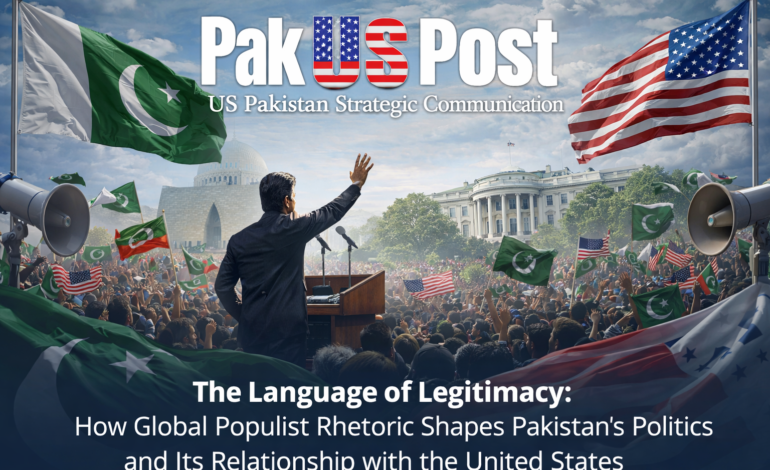
The Language of Legitimacy: How Global Populist Rhetoric Shapes Pakistan’s Politics and Its Relationship with the United States


The global political lexicon has undergone a radical transformation over the past three decades, evolving from a vocabulary that once celebrated democratic norms and reasoned debate to a rhetorical universe dominated by disruption, vilification, and personalization. What once would have been considered political suicide attacking opponents not on the basis of ideas or policies but by casting them as traitors, foreign agents, or existential threats has instead become a normalized political strategy across the world. This transformation, which has been vividly exemplified by figures from Jean‑Marie Le Pen in France to Donald Trump in the United States, has not only reshaped political competition in the West but has also found fertile ground in Pakistan. In the South Asian context, the importation of global populist rhetoric is reshaping the nature of domestic political contestation while simultaneously complicating Pakistan’s relationship with Washington. The intense linguistic polarization between those branded as traitors and those celebrated as saviors is not merely a rhetorical phenomenon; it is actively influencing institutional legitimacy, social cohesion, and strategic partnerships with external actors.
In Western democracies, the rise of populist leaders who weaponize language against their political rivals has transformed the very idea of political legitimacy. Leaders like Le Pen and Trump have demonstrated that aggressively delegitimizing opponents can serve as a pathway to mass mobilization. In these contexts, political attacks often move beyond policy critique to framing opponents as fundamentally unfit to participate in governance. This rhetorical strategy resonates with segments of the electorate that feel marginalized, disillusioned, or threatened by rapid social and economic change. The adoption of such strategies in Pakistan, however, carries unique implications because the country’s political system has historically been defined by a combination of personalist politics, institutional contestation, and military influence. The lines between legitimate dissent, partisan opposition, and existential threat have always been contested in Pakistan, but the infusion of global populist strategies has intensified these debates, turning political discourse into a zero‑sum struggle over national identity itself.
In Pakistan, the political lexicon is increasingly borrowing from this transnational playbook, creating a landscape where opponents are not simply rivals but existential threats to the nation’s stability. The labeling of political figures as mentally unfit or as collaborators with hostile foreign powers is emblematic of this shift. What may have once been relegated to fringe narratives has now entered mainstream political discourse, influenced public opinion and framed institutional debates. These narratives are reinforced by a variety of actors, including media platforms, social media networks, and even state institutions, which sometimes amplify or legitimize accusations of disloyalty or foreign allegiance. Consequently, the political struggle is no longer only about competing policy visions but about determining who has the moral and existential right to participate in governance. This evolution of rhetoric has direct implications for the functioning of democratic institutions and for the ways in which Pakistan navigates its international relationships, particularly with the United States.
The role of the diaspora further complicates this landscape. Pakistani communities abroad have long been politically active, often advocating for democratic reform, human rights, or policy changes in their home country. However, in recent years, some segments of the diaspora have engaged in what can be termed “pro‑America” activism, leveraging their access to foreign policymakers to influence domestic political outcomes. This form of activism intersects with the previously dominant “anti‑America” mobilization within Pakistan, creating a complex dynamic in which foreign engagement becomes a tool for internal political contests. The paradox is striking: while some domestic factions use anti‑US rhetoric to consolidate power, other groups actively court Washington to advance their political interests. This duality reflects a broader trend in which the United States is simultaneously invoked as both an adversary and a savior, depending on the political perspective of the actors involved. Such contradictions further erode the clarity of Pakistan’s foreign policy objectives and challenge the United States in navigating a bilateral relationship that is heavily influenced by domestic political contestation.
The linguistic arms race between “traitors” and “saviors” carries significant strategic implications. When rhetoric supplants reasoned debate, political actors may prioritize symbolic victories over institutional strengthening. Consequently, the mechanisms that allow for coherent governance such as parliamentary processes, judicial review, and bureaucratic accountability are weakened by constant delegitimization. Moreover, political discourse that frames dissent as existential threat reduces the space for compromise, which is essential in pluralistic societies. As a result, decision-making increasingly occurs in reactive modes, responding to perceived threats to legitimacy rather than proactively addressing governance challenges. In this environment, foreign policy becomes an arena for rhetorical competition rather than strategic calculation, with potential partners such as the United States subject to the pressures of domestic legitimacy struggles.
The implications for Pakistan’s relationship with the United States are profound. Historically, bilateral relations have been shaped by strategic convergence rather than ideological alignment, encompassing security cooperation, counterterrorism initiatives, economic assistance, and regional stability concerns. However, when domestic political factions treat the United States as a tool for internal legitimacy battles, the relationship becomes entangled in domestic polarization. For example, lobbying by diaspora groups or political factions to condition aid or policy support on internal political outcomes places Washington in the difficult position of navigating domestic Pakistani politics, often without the clarity needed for consistent policy. This entanglement risks transforming the bilateral relationship from a strategic partnership into a transactional battlefield in which domestic actors weaponize foreign support to achieve partisan goals.
Simultaneously, American politics itself is experiencing a rhetorical and ideological shift, creating further uncertainty for Pakistan. The tension between liberal internationalism and the ascendancy of Trumpian nationalism reflects a broader American identity crisis. Washington’s oscillation between affirming global norms and pursuing unilateral transactional gains sends inconsistent signals to Pakistan. On the one hand, American policymakers may emphasize democratic governance, human rights, and rule of law in public discourse, while on the other hand, they may pursue deals or agreements with authoritarian or semi-authoritarian regimes when strategic interests dictate. This duality complicates the task for Pakistani leaders who seek to align domestic narratives with foreign policy imperatives. Domestic actors, observing these inconsistencies, often selectively invoke American rhetoric to bolster their own legitimacy, further intensifying polarization.
The normalization of vilification and delegitimization within Pakistan’s political culture has tangible consequences for institutional trust. When opponents are framed not merely as competitors but as existential threats, political discourse ceases to function as a forum for negotiation and becomes a battlefield over national identity. Such a dynamic erodes confidence in the impartiality and legitimacy of institutions that are meant to mediate political competition. The judiciary, the bureaucracy, and even the military may be drawn into rhetorical battles, either as participants or as targets, complicating their ability to perform neutral and stabilizing roles. Consequently, domestic political polarization increasingly threatens the coherence of governance structures and constrains the state’s capacity to formulate and implement coherent foreign policy strategies.
Furthermore, this evolution in political language has implications for Pakistan’s credibility on the global stage. International partners, including the United States, evaluate Pakistan not only on strategic considerations but also on indicators of governance, political stability, and institutional robustness. When domestic rhetoric becomes extreme, portraying political opponents as traitors or existential threats, it signals a fragility within the political system that may discourage sustained foreign investment or complicate diplomatic engagement. Washington, while primarily motivated by strategic and security interests, remains sensitive to perceptions of legitimacy and stability. Therefore, the domestic rhetorical climate can directly influence the strategic calculus of external actors and, by extension, the options available to Pakistan in bilateral and multilateral engagements.
An additional dimension to consider is the role of social media and the digital information environment in amplifying these dynamics. Platforms such as Twitter, Facebook, and Instagram have become central to political mobilization in Pakistan, providing both a megaphone for political elites and a forum for mass participation. While social media can democratize political engagement, it also facilitates the rapid dissemination of polarizing and dehumanizing rhetoric. Political messaging that casts opponents as existential threats spreads quickly, often outpacing efforts at moderation or fact-checking. This acceleration of rhetoric exacerbates domestic polarization and creates feedback loops in which public opinion, elite discourse, and policy outcomes reinforce one another in a mutually intensifying cycle.
The phenomenon of diaspora lobbying further complicates this feedback loop. Unlike domestic audiences, diaspora communities often engage with the United States through formal political channels, including think tanks, congressional offices, and lobbying organizations. Their advocacy can influence foreign policy, particularly when framed in terms of democratic norms, human rights, or strategic alignment. However, when these advocacy efforts are closely linked to partisan disputes within Pakistan, they introduce an external dimension to domestic conflicts, compelling the United States to navigate politically sensitive terrain without becoming overtly entangled. This dynamic can result in cautious or inconsistent responses from Washington, further destabilizing the transactional foundations of the bilateral relationship.
The cumulative effect of these factors is a high-risk environment in which political rhetoric shapes both domestic cohesion and international engagement. Pakistan’s political discourse is increasingly constrained by globalized populist vernacular, where language itself becomes a strategic tool in power struggles. The question arises as to what constitutes a tipping point a “step too far” where rhetoric ceases to be a tool of political competition and becomes a destabilizing force that irreversibly damages institutional legitimacy or foreign relations. Such a tipping point might manifest as a situation in which key state institutions are delegitimized, social trust collapses, and external partners are forced to reassess engagement. It could also arise when domestic actors weaponize foreign relationships to settle internal disputes, compelling Washington to choose between principles and pragmatism in ways that might exacerbate internal divisions.
In navigating this complex environment, Pakistani leaders face the dual challenge of managing domestic polarization while safeguarding strategic partnerships. Mitigating the influence of globalized populist rhetoric requires fostering a political culture that prioritizes institutional respect, reasoned debate, and the ethical use of language. This does not imply the elimination of contestation, which is essential for democracy, but rather the promotion of a discourse that distinguishes between legitimate political opposition and existential threat. Institutional reforms, media accountability, and civil society engagement can help create a framework in which political competition occurs within boundaries that preserve both governance and strategic coherence.
Moreover, Pakistan must develop strategies to engage external actors, particularly the United States, in ways that reinforce, rather than undermine, domestic legitimacy. This entails clear communication about policy priorities, consistent messaging across political factions, and efforts to decouple domestic partisan disputes from bilateral strategic engagement. By doing so, Pakistan can preserve the benefits of strategic partnership with Washington without allowing domestic political rhetoric to compromise national interests.
In conclusion, the importation of global populist rhetoric into Pakistan has reshaped political discourse in ways that extend far beyond domestic competition. By framing opponents as existential threats and simultaneously leveraging foreign relationships for internal legitimacy, Pakistani political actors have created a highly polarized environment that challenges institutional resilience and complicates strategic partnerships with the United States. The linguistic arms race between “traitors” and “saviors” threatens not only social cohesion but also the transactional clarity of Pak-US relations, requiring careful navigation by policymakers and political leaders. Reclaiming a discourse grounded in democratic norms, institutional respect, and strategic clarity is essential if Pakistan is to maintain both domestic stability and credible engagement on the international stage. In an era defined by the convergence of domestic polarization and global populist rhetoric, language itself has become a strategic instrument, shaping perceptions, alliances, and the very contours of national legitimacy. Pakistan’s ability to manage this dynamic will determine not only the health of its democracy but also the effectiveness of its engagement with the world’s most consequential strategic partner, the United States.
A Public Service Message