
The Dehumanization Dividend: How Rhetoric Shapes Domestic Politics and International Perception in Pakistan

The power of language in politics cannot be overstated, and few rhetorical devices have proven as consequential and corrosive as dehumanization. From the propaganda campaigns preceding the Holocaust to the incendiary radio broadcasts that fueled the Rwandan genocide, history demonstrates that language which compares individuals or groups to animals, vermin, or existential threats not only shapes public perception but also lays the groundwork for systematic exclusion, discrimination, and violence. The process of dehumanization operates at both psychological and social levels. It lowers moral barriers to mistreatment, cultivates fear, and creates the perception that certain groups exist outside the moral and civic boundaries of society. While much of the global discourse around dehumanization focuses on Western societies, Pakistan provides a compelling case study of how this phenomenon manifests along sectarian, ethnic, and institutional fault lines, and how it intersects with the country’s geopolitical standing. Understanding the strategic consequences of dehumanizing rhetoric is therefore essential for evaluating both domestic cohesion and Pakistan’s ability to engage credibly with the international community, including the United States and Europe.
The genealogy of dehumanizing rhetoric is long and globally instructive. In Nazi Germany, Jews were referred to as rats or vermin, language that was crucial in normalizing public indifference to persecution and eventually in facilitating mass genocide. In Rwanda, Tutsi were labeled cockroaches in media broadcasts, creating a psychological framework that made mass slaughter appear not only acceptable but necessary. These examples illustrate that dehumanization is rarely an isolated or purely symbolic act. It is a deliberate political and social strategy used to consolidate power, justify exclusion, and enforce compliance through fear. Scholars of political violence, propaganda, and populism have repeatedly emphasized that the use of dehumanizing language is not incidental; it is central to the architecture of illiberal political systems and has long-term consequences for social trust, institutional legitimacy, and international perception.
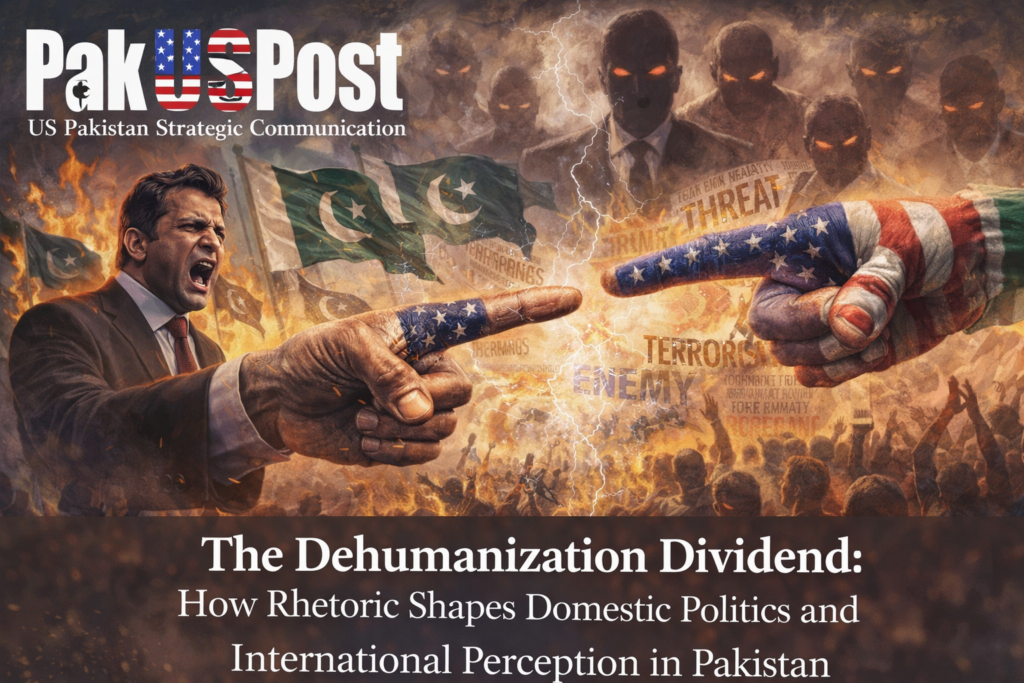
In Pakistan, dehumanizing rhetoric intersects with multiple historical and contemporary fault lines, most notably sectarianism, religious identity, and institutional legitimacy. The Ahmadiyya community, constitutionally declared non-Muslim and frequently subject to discriminatory legislation and social exclusion, has long been the target of dehumanizing narratives. Public discourse often frames the community as inherently anti-Islamic or morally corrupt, situating its members outside the ethical and civic boundaries of the state. Such language does more than marginalize a community; it legitimizes legal, social, and political exclusion and constrains the ability of institutions to protect the rights of all citizens equally. Similarly, political opponents are frequently depicted as agents of foreign powers, whether India, the Taliban, or other adversaries. This branding transforms political dissent into a matter of existential threat, creating a climate in which opposing viewpoints are equated with betrayal and national insecurity. In both cases, rhetoric becomes a mechanism for consolidating power, enforcing loyalty, and suppressing pluralism.
The strategic consequences of dehumanizing discourse in Pakistan are multifaceted. Domestically, such rhetoric erodes trust in institutions. When significant segments of the population are characterized as enemies of the state, the legitimacy of democratic processes is undermined, and the space for constructive dialogue is severely limited. Political actors prioritize symbolic victories over systemic reforms, often responding to perceived threats to legitimacy rather than focusing on governance, policy, or development. This environment fosters polarization, mistrust, and conflict, weakening the very fabric of society. It also creates cycles of retaliation, where rhetoric begets suspicion, and suspicion begets further rhetorical escalation. The longer this cycle continues, the more entrenched divisions become, and the harder it is to reestablish consensus or institutional cohesion.
Internationally, dehumanizing rhetoric has significant implications for Pakistan’s diplomatic credibility. Partners such as the United States and the European Union evaluate states not only on their strategic or security interests but also on indicators of governance, rule of law, and human rights. When domestic discourse normalizes the depiction of minorities, sectarian groups, or political opponents as existential threats, it undermines Pakistan’s ability to project moral authority in global forums. This is particularly salient when Pakistan seeks to critique Islamophobia, human rights abuses, or the marginalization of Muslims in Western countries. The boomerang effect is evident: a state that cannot address exclusionary and dehumanizing discourse internally finds its international criticisms discounted as hypocritical. The ability to advocate for human rights abroad is contingent upon credibility at home, and in this sense, rhetoric becomes both a domestic and international strategic instrument.
The digital information environment amplifies the consequences of dehumanizing rhetoric. Social media platforms such as Twitter, Facebook, and Instagram allow for rapid dissemination of political messages, often without editorial oversight or accountability. In Pakistan, these platforms serve as powerful megaphones for political elites, religious authorities, and grassroots activists alike. Messages that cast opponents as traitors or religious minorities as threats spread widely and quickly, often outpacing corrective interventions by civil society or state institutions. The viral nature of digital content means that dehumanizing rhetoric can shape public perception, reinforce polarization, and influence political behavior at unprecedented speed. Furthermore, the algorithmic structures of these platforms often amplify emotionally charged content, reinforcing echo chambers and further intensifying divisions.
The diaspora also plays a complex role in this landscape. Pakistani communities abroad frequently engage in political advocacy, lobbying policymakers in the United States and Europe to advance reforms or influence policy at home. While this advocacy can be constructive, it also risks amplifying domestic narratives of moral and existential threat. When diaspora groups emphasize anti-corruption, human rights, or democratic norms, they are often acting in good faith. However, when they participate in partisan campaigns that frame domestic political opponents as existential threats, they contribute to the internationalization of Pakistan’s internal conflicts. This phenomenon places external actors in the difficult position of navigating politically sensitive terrain while being indirectly drawn into domestic legitimacy battles. For the United States, such dynamics complicate bilateral engagement, as Washington must weigh strategic priorities against the perception of interference or favoritism in Pakistan’s domestic political arena.
The historical context of dehumanization in Pakistan further illustrates its embeddedness in political strategy. Sectarian violence, military interventions, and politically motivated purges have often been accompanied by public rhetoric that delegitimizes targeted groups. The labeling of political parties as proxies of foreign powers, the portrayal of dissenting journalists as traitors, and the stigmatization of minority communities all serve to frame political or social opposition as not only undesirable but inherently dangerous. In this sense, dehumanizing discourse functions as a tool of both political consolidation and social control, allowing actors to justify extraordinary measures and maintain authority. However, the long-term cost is the erosion of institutional integrity, democratic accountability, and societal trust.
The implications for democratic governance are profound. Democracies rely on the premise that all citizens, regardless of their affiliations, have a stake in the political system and are entitled to protection under the law. Dehumanization disrupts this premise by creating a moral hierarchy of citizenship, in which some groups are deemed more legitimate or deserving than others. When a substantial portion of the populace is rhetorically excluded from the moral and political community, the very foundation of democratic legitimacy is weakened. This dynamic not only constrains the effectiveness of governance but also shapes electoral behavior, policy priorities, and institutional decision-making. Political actors may exploit fears and grievances to mobilize support, but such tactics come at the expense of social cohesion and long-term stability.
Furthermore, dehumanizing rhetoric interacts with regional and global geopolitical narratives. Pakistan’s critics in India, the United States, and Europe often highlight instances of sectarian violence, religious discrimination, or political repression as evidence of systemic flaws. When domestic discourse normalizes dehumanization, it strengthens the ability of external actors to challenge Pakistan’s moral authority and complicates diplomatic engagement. Conversely, Pakistan’s attempts to highlight Islamophobia in the West or human rights abuses elsewhere are weakened if similar issues persist domestically. This asymmetry creates a persistent credibility gap, illustrating that the strategic consequences of rhetoric extend far beyond immediate political gains.
Addressing the challenges posed by dehumanizing rhetoric requires a multifaceted strategy. Politically, leaders must cultivate a discourse that emphasizes inclusion, respect for diversity, and recognition of the humanity of all citizens. Legal and institutional reforms are essential to ensure that discriminatory rhetoric does not translate into policy or governance failures. Media literacy initiatives, civil society engagement, and educational reforms can help create a culture in which political contestation occurs through reasoned debate rather than moral exclusion. Moreover, the state must actively counter narratives that portray minorities or political opponents as existential threats, reinforcing the principle that all citizens are entitled to protection and participation.
The strategic benefits of countering dehumanization are significant. A political culture that respects human dignity strengthens social cohesion, enhances institutional credibility, and supports sustainable governance. Internationally, Pakistan gains moral authority and diplomatic leverage, allowing it to advocate more effectively for the protection of its interests and the rights of Muslims worldwide. By demonstrating a commitment to inclusive governance at home, Pakistan can engage more credibly with global partners on issues of human rights, religious freedom, and democratic norms. In this sense, the management of domestic rhetoric becomes a vital component of both national strategy and foreign policy.
The challenge is compounded by the persistence of structural inequalities and historical grievances. Dehumanizing rhetoric thrives in contexts of social tension, economic disparity, and political competition. Efforts to mitigate its impact must therefore be accompanied by broader initiatives aimed at addressing underlying sources of division, including economic marginalization, educational inequities, and political disenfranchisement. Only by addressing both the rhetorical and structural dimensions of exclusion can Pakistan create a sustainable environment in which political contestation strengthens rather than undermines social cohesion.
In conclusion, dehumanizing rhetoric in Pakistan is more than a matter of political style; it is a strategic tool with profound implications for domestic politics and international perception. By framing opponents and minorities as threats to national identity, political actors consolidate power, enforce loyalty, and suppress dissent. However, these gains come at the cost of institutional legitimacy, social trust, and diplomatic credibility. The boomerang effect of domestic dehumanization undermines Pakistan’s ability to engage in moral and normative debates on the international stage, weakening its position in negotiations, alliances, and global discourse. Addressing this challenge requires political leadership committed to inclusive rhetoric, institutional reforms that protect all citizens, and a societal culture that values dialogue over demonization. By reclaiming the language of politics from the corrosive forces of dehumanization, Pakistan can strengthen both its democracy and its standing in the global arena. In an era defined by the contestation of ideas and the influence of narrative power, rhetoric is both a weapon and a tool; how it is wielded will determine the trajectory of Pakistan’s domestic cohesion and its international credibility. The dehumanization dividend, once considered a tactical advantage in domestic politics, has long-term costs that extend far beyond national borders. Recognizing this reality is essential for safeguarding Pakistan’s strategic, political, and moral interests in the twenty-first century.
A Public Service Message