Hormuz Signallingg and the Quiet Mutation of Maritime Power

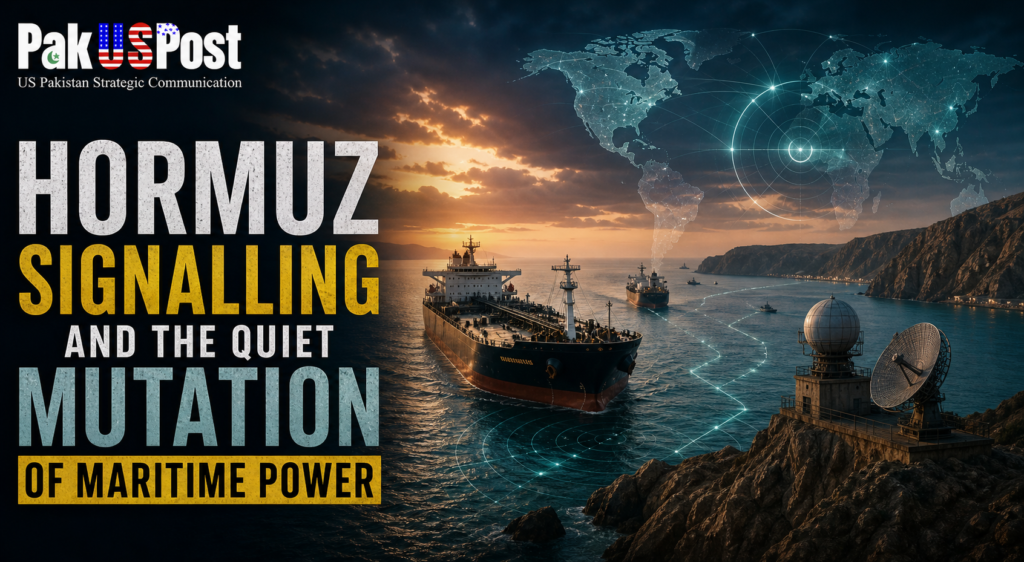
The passage of a Russian linked superyacht through the Strait of Hormuz would once have been dismissed as an anecdotal curiosity within the routines of global shipping, yet in the altered grammar of contemporary geopolitics it acquires the density of a signal embedded within the evolving architecture of hybrid maritime power. The incident unfolds not as an isolated episode but as part of a wider strategic environment shaped by Red Sea insecurity, Gulf militarisation, sanctions evasion networks, and the gradual erosion of Western monopoly over the governance of sea lanes. In this context, the vessel becomes less a luxury object and more a carrier of meaning, moving through a corridor that remains indispensable to global energy flows while being increasingly contested by multiple and often ambiguous actors.
The maritime domain is no longer governed solely by the visible calculus of fleets and firepower. It is increasingly structured by ambiguity, legal elasticity, and symbolic assertion. Grey zone strategies have shifted from peripheral instruments to central tools of statecraft. These strategies operate below the threshold of overt conflict yet above the plane of routine commercial activity, exploiting the gaps between civilian and military categories, between legality and legitimacy, and between presence and provocation. The Russian association with the vessel introduces an additional layer of complexity, particularly in the context of the ongoing confrontation between Russia and Western alliances following the war in Ukraine. Moscow’s evolving posture reflects a transition from direct confrontation toward dispersed, deniable, and commercially masked engagements that allow it to maintain relevance without escalating into open conflict.
The strategic significance of the Hormuz transit lies not in any immediate operational threat but in the precedent it establishes. Chokepoints have historically been conceptualised as spaces of control where dominant naval powers could enforce order through surveillance and deterrence. However, deterrence presumes clarity, attribution, and predictable escalation pathways. Hybrid incursions disrupt this architecture by introducing actors and platforms that do not fit established categories. A superyacht is not a warship, yet its politically linked presence complicates assumptions of neutrality. Interdicting such a vessel would carry legal and diplomatic risks, thereby exposing the limitations of enforcement mechanisms that depend on clearly defined thresholds.
Media narratives surrounding the incident illustrate the fragmentation of global interpretive frameworks. Western outlets, operating within institutional logics that prioritise stability, have largely framed the episode as incidental, thereby reinforcing perceptions of continued control. In contrast, alternative media ecosystems across parts of Asia and the Middle East interpret the transit as evidence of shifting power balances and declining Western dominance in maritime governance. Digital platforms amplify these divergences, as algorithmic dynamics privilege polarising interpretations, transforming a single event into multiple competing narratives. This informational fragmentation is itself a component of hybrid strategy, where perception becomes a domain of contestation alongside physical space.
For policymakers engaged in Pakistan United States strategic discourse, the implications extend well beyond the Gulf. Pakistan’s maritime geography, anchored by Gwadar and integrated into broader regional connectivity frameworks, situates it within the same evolving matrix of vulnerabilities and opportunities. The lesson is not merely that chokepoints are contested but that contestation now operates through methods that evade traditional metrics of power. Naval capacity alone cannot ensure maritime security if adversaries or competitors can exploit legal ambiguity and symbolic signalling to undermine deterrence. What is required is a multidimensional approach that integrates legal expertise, information strategy, and advanced surveillance technologies with conventional naval capabilities.
The incident also intersects with the broader transformation of global energy politics. As the transition toward alternative energy sources proceeds unevenly, the strategic value of oil chokepoints becomes paradoxical. Dependence on specific routes may gradually decline, yet the concentration of remaining flows increases their sensitivity to disruption. In such an environment, even minor signalling events can influence market perceptions and risk calculations. The presence of a politically connected vessel in Hormuz therefore resonates beyond the maritime domain, affecting insurance premiums, commodity pricing, and diplomatic risk assessments.
Russia’s behaviour within this context reflects strategic adaptation rather than dominance. Constrained by economic sanctions and military commitments, it has increasingly relied on indirect methods of influence, leveraging private actors, commercial networks, and symbolic gestures to maintain strategic visibility. The superyacht episode can thus be interpreted as a low cost signalling mechanism, a means of asserting presence in a region where direct confrontation would be strategically prohibitive. It exemplifies a broader shift in international relations in which states seek to achieve strategic effects without triggering escalatory responses, operating within a space that blurs the boundaries between peace and conflict.
Regional actors further complicate this evolving landscape. Gulf states, while formally aligned with Western security frameworks, have demonstrated increasing strategic autonomy, engaging with multiple global powers including China and Russia. Their media narratives tend to balance caution with pragmatism, acknowledging changing risks without amplifying instability. Iran, meanwhile, continues to view the Strait as both a transit route and a strategic lever, historically employing its own grey zone tactics to influence maritime dynamics. The presence of additional ambiguous actors within this space contributes to a layered security environment in which attribution becomes difficult and responses require careful calibration.
From a theoretical perspective, the episode underscores the transition from a rules based maritime order to a negotiated one. International legal frameworks such as the United Nations Convention on the Law of the Sea provide guidelines for navigation, yet their effectiveness depends on enforcement by states whose capacities and interests are increasingly divergent. Hybrid strategies exploit this divergence, testing the boundaries of legality without clearly violating them. The result is a persistent condition of ambiguity in which power is exercised through interpretation as much as through force.
Within the Pakistan United States policy framework, the challenge lies in aligning strategic priorities within this shifting environment. The United States remains committed to safeguarding global commons, yet its resources are distributed across multiple theatres of competition. Pakistan, positioned at the intersection of South Asia, the Middle East, and Central Asia, must navigate complex relationships while safeguarding its economic and maritime interests. The Hormuz episode highlights the necessity of incorporating nontraditional dimensions of security into policy planning, including legal strategy, information management, and economic resilience.
In conclusion, the transit of a Russian linked superyacht through the Strait of Hormuz is emblematic of a broader transformation in maritime power. It reveals the limitations of traditional deterrence in the face of hybrid strategies, highlights the fragmentation of global media narratives, and underscores the need for adaptive policy frameworks capable of operating within ambiguity. For Pakistan United States strategic discourse, it offers both a warning and an opportunity, a warning that established assumptions about maritime control are eroding, and an opportunity to develop more nuanced approaches that integrate multiple dimensions of power into a coherent and forward-looking strategy.
A Public Service Message