
Waste Biomaterials and the Future of Regenerative Global Medicine Industry

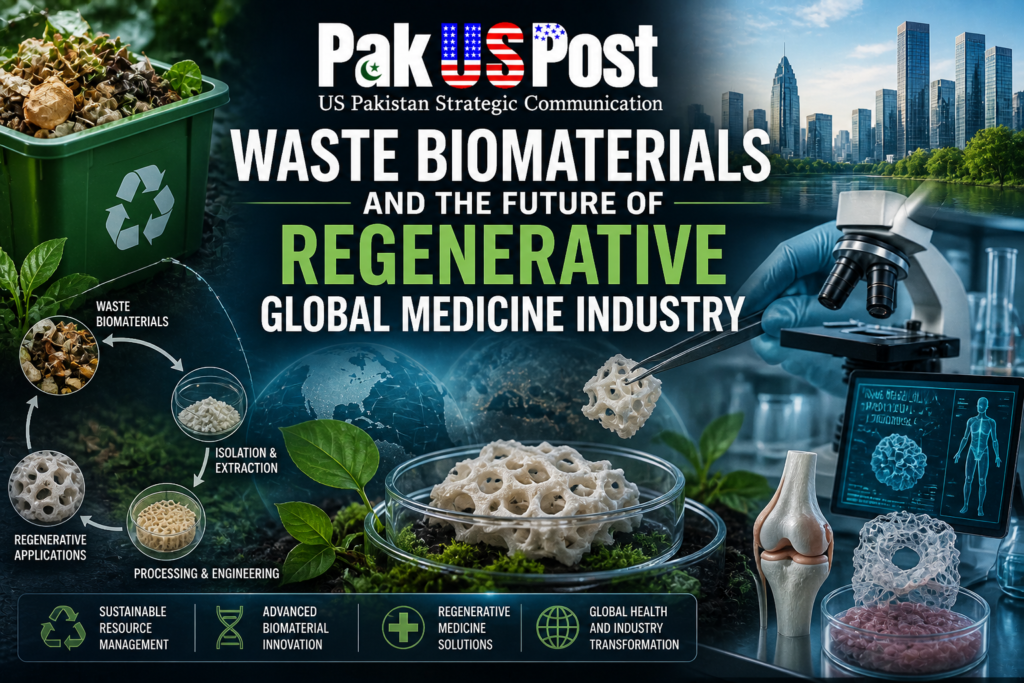
The transformation of agricultural residues into biomedical materials is quietly becoming one of the most consequential yet underreported shifts in the global science and technology landscape. What once belonged to the vocabulary of waste management, rural byproducts, and environmental disposal is now entering the lexicon of regenerative medicine, advanced materials engineering, and strategic industrial policy. The idea that date pits, rice husks, coconut shells, and other organic remnants of agricultural economies can be re-engineered into scaffolds for artificial bones or composite biomaterials signals not just technological ingenuity but a redefinition of value itself in the twenty first century bioeconomy.
At first glance, this appears to be a triumph of sustainability thinking, a circular economy narrative finally realized in material form. Yet beneath this optimistic framing lies a far more complex set of ethical, industrial, and geopolitical tensions. The conversion of biological waste into human implantable material forces a confrontation with questions that are not merely scientific but civilizational. Who owns the transformation of matter from refuse to regenerative tissue support systems. Who certifies its safety across borders. Who captures the intellectual property embedded in its molecular redesign. And perhaps most critically, who becomes the primary supplier of biological matter in a global system increasingly dependent on engineered life compatible materials.
Recent advancements in biomaterials science have demonstrated that carbon rich agricultural waste can be processed into hydroxyapatite composites and porous scaffolding structures that mimic bone morphology. Laboratories in East Asia, parts of Europe, and North America have been particularly active in exploring these pathways, driven by both medical demand and sustainability mandates. The medical logic is straightforward. Bone injuries, degenerative diseases, and trauma cases require grafts or substitutes that are biocompatible, structurally resilient, and increasingly patient specific. Traditional materials such as titanium alloys or synthetic polymers, while effective, carry limitations in integration with biological tissue and long term adaptability. Bio derived materials promise a more seamless interface between human biology and engineered structures.
However, the industrial logic behind this transition is more expansive than clinical necessity alone. The global biomaterials market is increasingly shaped by the convergence of healthcare innovation, defense medical logistics, and environmental sustainability commitments. In this convergence, agricultural waste becomes not an environmental burden but a strategic input into high value manufacturing ecosystems. Countries with large agrarian economies are therefore positioned not merely as food producers but as potential raw material suppliers for biomedical supply chains.
This reclassification carries profound implications for economies such as Pakistan, where agricultural residues are abundant but largely underutilized in high technology value chains. The country produces significant volumes of crop waste from rice, wheat, sugarcane, and date farming systems, yet these materials are typically burned, discarded, or used in low value applications such as fuel or animal feed. In a global system where the same materials are being reimagined as precursors for bone regeneration scaffolds or drug delivery matrices, the asymmetry in value extraction becomes stark.
The Pakistan United States policy space adds another dimension to this emerging field. The United States remains a leader in biomedical innovation, regulatory frameworks, and intellectual property generation, while Pakistan occupies a position of raw material abundance and nascent research capacity. Without strategic alignment in research partnerships, technology transfer agreements, and bioindustrial policy frameworks, there is a risk that value addition will remain externalized. Pakistan may supply the biological inputs while the United States and other advanced economies capture the downstream value in medical devices, patents, and clinical applications.
Yet the issue is not simply one of economic imbalance. It is also one of epistemic authority. The transformation of waste into biomedical material requires complex validation systems involving toxicology, long term implantation studies, immune response modeling, and regulatory certification. These systems are currently dominated by institutions in the Global North. As a result, the definition of what constitutes safe, ethical, and clinically viable biomaterials is largely shaped outside the geographies where the raw inputs originate. This creates a subtle but powerful form of scientific dependency, where material origin is decentralized but epistemic control remains centralized.
Ethically, the conversion of agricultural waste into human implantable materials raises questions that extend beyond conventional bioethics. Traditional bioethical frameworks focus on informed consent, patient safety, and clinical efficacy. However, waste derived biomaterials introduce a new layer of ethical complexity rooted in supply chain opacity and ecological displacement. If agricultural residues are redirected toward biomedical industries, what are the opportunity costs for local energy systems, soil regeneration cycles, or rural economies that depend on these materials for alternative uses. Moreover, if such materials become commodified within global healthcare markets, how are the originating communities acknowledged or compensated within value chains that are often opaque and fragmented.
There is also an emerging concern regarding what might be termed ethical materialism. The idea that matter itself carries ethical trajectories depending on its transformation pathway. Agricultural waste, in its original context, is part of ecological cycles of decomposition and renewal. When it is converted into biomedical scaffolding, it enters a different ontological regime, one governed by clinical durability, regulatory compliance, and human bodily integration. This shift raises philosophical questions about whether the reclassification of matter into medical use alters its ethical status or simply its economic function.
Industrial actors, particularly in biotechnology and advanced manufacturing sectors, argue that such concerns are secondary to the urgent need for scalable, cost effective, and sustainable medical materials. They point to the rising global burden of orthopedic conditions, aging populations, and increasing trauma cases resulting from urbanization and conflict zones. In this framing, waste derived biomaterials are not an ethical dilemma but a humanitarian necessity. The ability to produce affordable bone grafts from abundant agricultural residues is presented as a democratization of medical access, particularly for low and middle income countries.
Yet even within this optimistic narrative, power asymmetries remain embedded. The intellectual property governing the conversion processes, molecular engineering techniques, and clinical application protocols is increasingly concentrated within a small set of multinational biotech firms and research institutions. These entities are often located in jurisdictions with strong patent protection regimes, allowing them to control pricing, distribution, and licensing of technologies derived from globally sourced biological inputs. The result is a paradox in which material abundance in one region translates into technological scarcity in another.
From a geopolitical perspective, this dynamic is becoming increasingly relevant as states begin to recognize biomaterials as strategic assets. Just as rare earth minerals became central to technological competition in the previous decade, biological feedstocks may become similarly strategic in the coming years. Agricultural waste, once considered economically negligible, may acquire geopolitical significance as a foundational input into next generation healthcare systems, defense medical readiness, and regenerative industrial design.
In this context, the United States and its partners are likely to intensify efforts to secure supply chains, standardize regulatory frameworks, and consolidate research leadership. China, similarly, is investing heavily in bio manufacturing ecosystems that integrate agricultural efficiency with advanced materials science. The European Union is pursuing regulatory leadership through sustainability and safety standards that may effectively function as non tariff barriers to entry for emerging producers. Within this triangular competition, countries like Pakistan risk being positioned as peripheral suppliers unless they actively develop domestic capacity in biomaterials research and development.
The policy challenge for Pakistan is therefore not merely one of participation but of positioning. Engaging with the United States and other advanced economies in this domain requires more than bilateral cooperation. It requires the development of domestic scientific ecosystems capable of understanding, adapting, and innovating within biomaterials science. This includes investment in interdisciplinary research spanning materials engineering, biomedical science, agricultural technology, and regulatory policy. Without such integration, Pakistan’s role may remain confined to upstream supply without downstream influence.
At the same time, there is an opportunity to reframe agricultural waste not as a liability but as a strategic asset within national innovation policy. This would require a shift in industrial planning, where agricultural policy, environmental management, and health innovation are no longer treated as separate domains but as interconnected components of a single bioeconomic strategy. Such a shift would also necessitate new forms of public private partnership, research funding mechanisms, and international collaboration frameworks.
The broader intellectual narrative being constructed globally around waste derived biomaterials is one of sustainability, circularity, and medical innovation. Yet beneath this narrative lies a quieter transformation of global value chains, knowledge hierarchies, and geopolitical dependencies. The future of regenerative medicine may not be defined solely by breakthroughs in laboratories but by the political economy of material sourcing, ethical governance, and technological ownership.
In this unfolding landscape, agricultural waste is no longer waste in any traditional sense. It is becoming a medium through which biology, industry, and geopolitics intersect. Whether this transformation leads to more equitable global health systems or reinforces existing asymmetries will depend on how emerging economies position themselves within the rapidly evolving architecture of regenerative global medicine.
A Public Service Message