
PUBLIC HEALTH GOVERNANCE AND THE LIMITS OF BEHAVIORAL STATE POWER

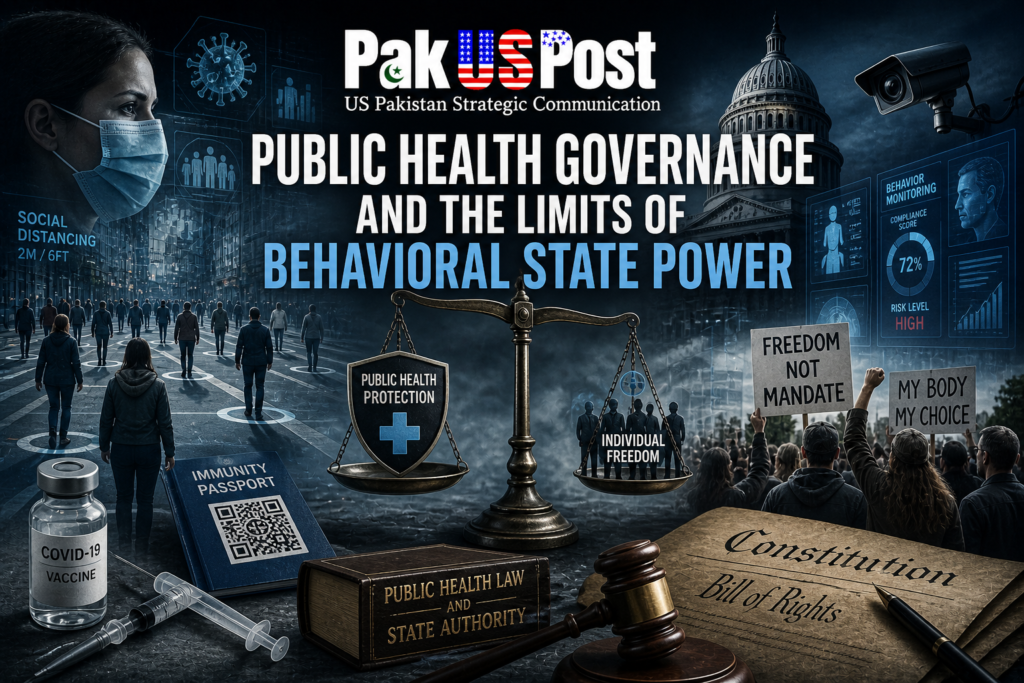
The contemporary expansion of public health governance into domains of individual behavior marks one of the most consequential yet underexamined transformations in modern statecraft. What was once a narrowly defined sector concerned with disease control and healthcare delivery has increasingly evolved into a comprehensive framework for regulating lifestyle, consumption patterns, and even psychological conduct. From tobacco taxation and sugar regulation to digital addiction controls and surveillance-based wellness systems, the state is steadily extending its reach into the intimate architecture of personal choice. The central policy question is no longer whether public health regulation is necessary, but how far it can expand before it begins to destabilize the political and social legitimacy upon which it depends.
This transformation has been accelerated by multiple converging forces. The COVID-19 pandemic normalized emergency health governance at an unprecedented scale, granting states expanded authority over mobility, labor, and social interaction. Simultaneously, rising global burdens of non-communicable diseases such as diabetes, cardiovascular illness, and obesity have reframed health outcomes as consequences of behavioral governance failure rather than purely biomedical issues. Technological systems have further enabled this shift, allowing governments to collect, analyze, and act upon granular data regarding individual habits, dietary patterns, and digital consumption behavior.
At the policy level, this creates a new governance frontier where public health is no longer reactive but preemptive. States increasingly attempt to shape behavior before illness manifests, using taxation mechanisms, advertising restrictions, digital nudges, and regulatory bans. Tobacco control policies, once limited to warning labels and restricted sales, now extend into outright prohibition in some jurisdictions. Similar trajectories are visible in sugar regulation debates, alcohol restrictions, and emerging discussions around ultra-processed food taxation and algorithmic control of digital engagement platforms.
Yet this expansion of behavioral governance introduces a fundamental tension between collective welfare optimization and individual autonomy. Liberal democratic systems are structurally dependent on the principle that personal freedom is bounded but protected. As states increasingly intervene in lifestyle choices, they risk redefining the social contract from one of rights-based autonomy to one of health-conditioned compliance. This shift raises difficult questions about legitimacy, particularly in societies where institutional trust is uneven and enforcement capacity is limited.
The impact dimension of this evolution is deeply stratified across global regions. In high-income economies, behavioral regulation is often embedded within sophisticated institutional ecosystems involving insurance incentives, corporate wellness programs, and data-driven health monitoring systems. In contrast, developing economies face a more coercive version of the same trend, where regulatory enforcement is less mediated by incentives and more reliant on legal restriction and informal compliance mechanisms. This divergence creates a global inequality in how public health governance is experienced and contested.
From a Pakistan–US Post analytical perspective, these differences are particularly significant. In Pakistan, public health governance operates within a complex environment of informal markets, limited regulatory reach, and strong cultural heterogeneity. Behavioral regulation policies, if imported without contextual adaptation, risk generating resistance, evasion, or parallel informal economies. In the United States, by contrast, behavioral governance is increasingly mediated through insurance systems, workplace policies, and digital platforms that subtly shape individual choices without overt coercion. The result is two distinct models of the same underlying governance logic, one explicit and regulatory, the other implicit and infrastructural.
The long-term systemic implication of this convergence is the emergence of what can be described as a behavioral state. In such a configuration, governance is not only concerned with law enforcement or economic regulation but with the continuous shaping of population-level behavior through integrated policy, technology, and data systems. Health outcomes become metrics of governance success, and citizens are evaluated not only as legal subjects but as behavioral profiles.
This evolution carries both potential benefits and structural risks. On one hand, improved regulation of harmful consumption patterns can significantly reduce long-term healthcare costs, increase life expectancy, and enhance productivity. On the other hand, excessive behavioral intervention risks generating political backlash, informal market expansion, and erosion of trust in public institutions. The balance between these outcomes is highly sensitive to cultural context, governance legitimacy, and institutional transparency.
An additional dimension concerns the convergence of public health governance with digital surveillance infrastructures. The integration of health tracking devices, mobile applications, and biometric monitoring systems enables unprecedented visibility into population behavior. While this can improve early disease detection and resource allocation, it also raises concerns about data privacy, algorithmic bias, and potential misuse of health data for non-medical purposes such as employment screening or insurance discrimination.
Globally, the trajectory of public health governance is increasingly influenced by the logic of risk management rather than treatment. States are shifting from reactive healthcare systems to predictive behavioral systems that seek to eliminate risk factors before they manifest as illness. This introduces a technocratic dimension to governance where policy decisions are increasingly data-driven, algorithmically informed, and statistically optimized. However, such systems are not neutral; they reflect embedded assumptions about acceptable behavior, normality thresholds, and societal priorities.
The policy challenge, therefore, is to construct governance frameworks that balance three competing imperatives: health optimization, individual autonomy, and institutional legitimacy. Overemphasis on any one dimension risks destabilizing the others. Excessive autonomy without regulation can lead to public health crises; excessive regulation can lead to political resistance; excessive technocratic optimization can lead to democratic deficit.
One possible policy direction is the development of participatory public health governance models, where behavioral regulation frameworks are co-designed with community input, ensuring cultural sensitivity and legitimacy. Another is the establishment of transparent limits on data usage in health monitoring systems to prevent overreach into non-health domains. Additionally, states may need to differentiate between high-risk behaviors that justify coercive intervention and low-risk lifestyle choices that should remain within the domain of personal autonomy.
For countries like Pakistan, the strategic priority lies in avoiding uncritical adoption of external behavioral governance models while simultaneously strengthening domestic public health capacity. This requires investment not only in healthcare infrastructure but also in institutional design capable of balancing regulation with social acceptance. For the United States, the challenge lies in ensuring that technologically advanced behavioral systems do not outpace democratic accountability mechanisms.
Ultimately, the expansion of public health governance represents a broader shift in state power itself. It signals a transition from governance of populations through law and economics to governance of individuals through behavior and data. Whether this transition produces healthier societies or more constrained ones will depend on the institutional boundaries that global and national systems choose to establish today.
A Public Service Message