
Governance Optics and Legitimacy Politics in United States Policy Circles

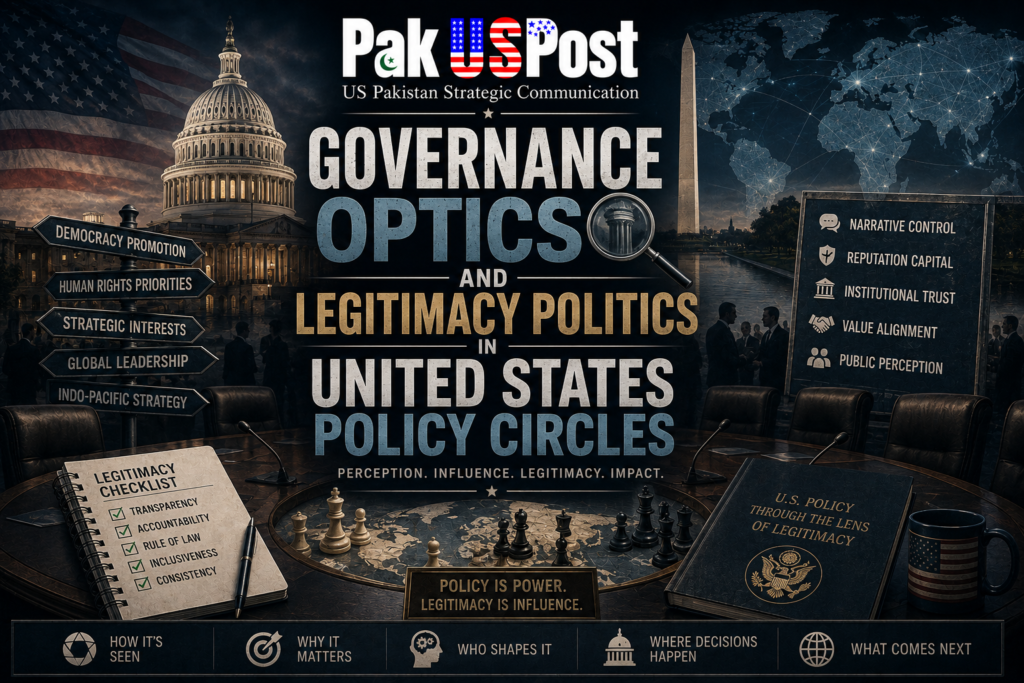
In the contemporary evolution of United States foreign policy thought, governance has gradually ceased to be a neutral descriptor of institutional functionality and has instead acquired the character of a strategic instrument embedded within a broader architecture of global hierarchy construction. What is increasingly observable in Washington policy circles is not merely an interest in how states govern themselves, but a deeper epistemic inclination to evaluate governance as a proxy for alignment reliability, ideological compatibility, and long term partnership viability. In this transformed environment, legitimacy is no longer an internal constitutional question for sovereign states alone; it has become an externally interpreted variable that shapes access to diplomatic capital, security cooperation, and economic engagement.
For Pakistan, this shift has produced a persistent condition of interpretive asymmetry. The state is frequently evaluated not through the granular complexity of its institutional evolution, nor through the pressures of its geographic and security environment, but through a condensed narrative framework in which governance performance is abstracted into simplified indicators of democratic consolidation, civil military balance, and electoral transparency. These indicators, while not irrelevant, become politically loaded when detached from contextual realities and reinserted into strategic discourse as instruments of conditional engagement.
Within United States policy ecosystems, particularly those situated in think tanks, congressional advisory networks, and foreign policy bureaus, governance optics function as a filtering mechanism. This mechanism determines not only the tone of engagement with partner states but also the intensity of trust, the elasticity of strategic commitments, and the durability of institutional partnerships. The result is a layered system in which states are not merely categorized by capabilities, but by perceived legitimacy trajectories. In this schema, Pakistan often occupies a paradoxical position: simultaneously indispensable due to its geography, security relevance, and regional connectivity, yet persistently encumbered by narrative frames that foreground governance fragility.
This tension has historical depth but contemporary intensity. The post 2001 security environment initially positioned Pakistan as a frontline partner in counterterrorism cooperation, where governance concerns were partially subordinated to operational imperatives. However, as United States strategic priorities shifted towards Indo Pacific competition and long term technological rivalry with China, governance discourse regained prominence as a criterion of strategic prioritisation. In this recalibration, Pakistan’s diplomatic leverage became increasingly mediated through evaluative judgments about institutional stability and political predictability.
Such a transformation has significant implications for diplomatic practice. Pakistan’s engagement with the United States can no longer rely solely on transactional security relevance or episodic cooperation frameworks. Instead, it must operate within a more complex narrative economy in which legitimacy is both a perception and a policy determinant. The challenge lies not in conforming to externally imposed governance templates, but in reshaping the interpretive framework through which governance itself is understood.
A critical misreading in many policy formulations is the assumption that governance is a static attribute. Governance in states like Pakistan is a dynamic negotiation between institutional capacity, historical legacies, demographic pressures, and regional security constraints. The compression of this dynamic into simplified evaluative metrics produces distortions that affect policy outcomes. These distortions are then amplified through media ecosystems and policy discourse, reinforcing cyclical perceptions of instability that may not fully correspond to structural realities.
In Washington, the governance narrative is also deeply intertwined with domestic political culture. The language of democracy promotion, institutional accountability, and rule based order is not merely external policy vocabulary but also an extension of internal normative identity. This dual function creates an environment in which foreign policy judgments are partially moralised, and legitimacy assessments acquire ethical overtones. For Pakistan, this means that diplomatic engagement must operate not only in the realm of strategic negotiation but also within the symbolic domain of normative alignment.
Yet this does not imply that Pakistan is structurally condemned to narrative subordination. Rather, it suggests that diplomatic agency must be reconfigured to engage with the architecture of perception itself. One of the central strategic tasks is to shift the discourse from episodic governance critique to systemic contextualisation. Pakistan’s institutional challenges must be situated within broader themes of postcolonial state formation, regional security volatility, economic constraint structures, and climate induced governance stress. Without such reframing, governance discourse remains analytically incomplete and strategically skewed.
At the same time, there is an emerging recognition within certain segments of United States policy analysis that over reliance on governance based conditionality can produce unintended strategic blind spots. In regions of high geopolitical volatility, excessive prioritisation of normative benchmarks may lead to under engagement with states that remain structurally significant despite internal political fluctuations. This tension between normative aspiration and strategic necessity is increasingly visible in South Asia policy debates.
Pakistan occupies the centre of this tension. Its geographic location at the intersection of South Asia, Central Asia, and the Middle East renders it a persistent variable in regional stability equations. Its role in Afghan connectivity, maritime security dynamics in the Arabian Sea, and potential energy transit corridors ensures that it cannot be strategically bypassed. However, the translation of this structural relevance into consistent diplomatic leverage remains constrained by governance narratives that frame the state through episodic instability rather than systemic significance.
To address this imbalance, Pakistan’s diplomatic strategy must evolve beyond reactive narrative defence and towards proactive narrative construction. This involves articulating governance not as a static claim of institutional perfection, but as a process of adaptive resilience under conditions of persistent external and internal pressure. Such a framing would allow policymakers in Washington to reinterpret governance not as a binary metric of success or failure, but as a continuum of institutional negotiation.
Moreover, Pakistan must invest in epistemic infrastructure that bridges policy analysis, academic research, and strategic communication. The absence of coherent narrative transmission channels has often allowed external interpretations to dominate perception formation. By cultivating sustained intellectual engagement with United States policy institutions, Pakistan can insert greater analytical depth into governance discourse and reduce the dominance of simplified evaluative frames.
Another critical dimension involves rethinking the relationship between governance and strategic cooperation. Rather than allowing governance assessments to function as preconditions for engagement, there is a need to reposition governance as a shared domain of policy experimentation. In areas such as climate resilience, urban governance innovation, digital infrastructure development, and public sector reform, Pakistan and the United States could potentially co construct governance models that are contextually adaptive rather than normatively prescriptive.
Such an approach would transform governance from a unilateral evaluative lens into a collaborative field of knowledge production. It would also allow Pakistan to reposition itself not as an object of governance assessment but as a participant in governance evolution. This shift is subtle but strategically significant, as it alters the directionality of legitimacy discourse.
Ultimately, the politics of legitimacy in United States policy circles is not fixed but continuously negotiated. It is shaped by shifting strategic priorities, evolving global competitions, and internal ideological debates. Pakistan’s challenge is to ensure that it remains an active participant in this negotiation rather than a passive subject of its outcomes. This requires intellectual clarity, diplomatic consistency, and narrative discipline.
In a global environment increasingly defined by perception driven geopolitics, governance optics will continue to play a decisive role in shaping diplomatic hierarchies. However, optics are not immutable. They are constructed, contested, and recalibrated over time. For Pakistan, the task is to engage this construction process with strategic sophistication, transforming governance from a limiting narrative into a platform for renewed diplomatic agency.
A Public Service Message