
India Centrality and Pakistan Diplomatic Recalibration

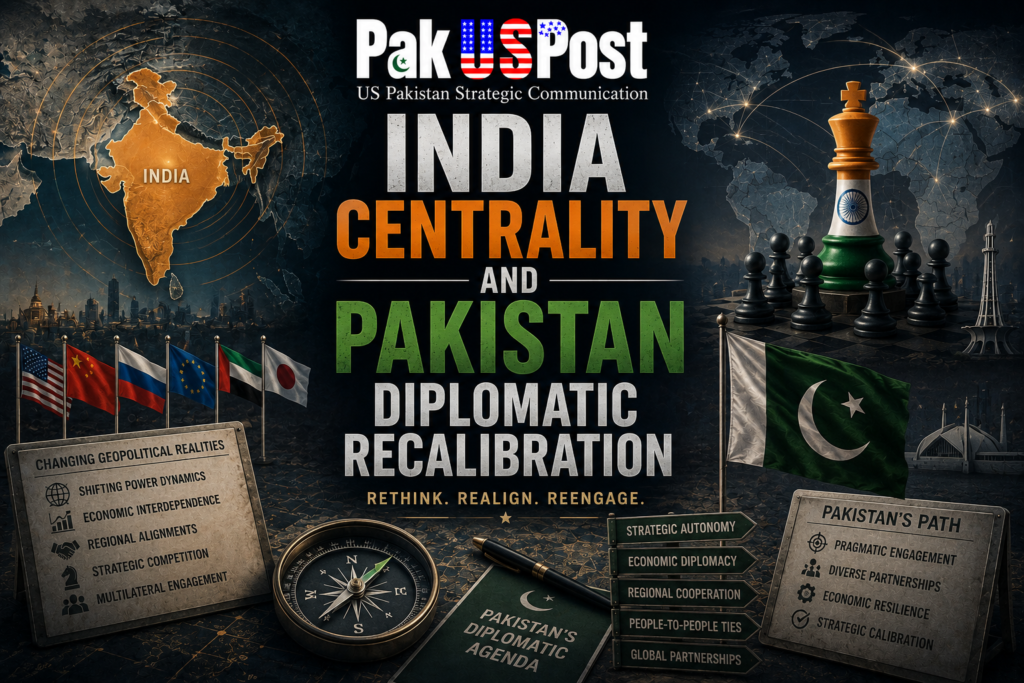
In the evolving architecture of United States foreign policy toward South Asia, a marked reorientation has occurred over the past decade in which India has been elevated from a regional partner to a structural pillar within broader Indo Pacific strategy. This recalibration is not episodic or personality driven but embedded in a deeper convergence of economic scale, technological alignment, and shared strategic anxiety regarding China’s rise. Within this emerging hierarchy, Pakistan’s diplomatic positioning has undergone a relative contraction, not necessarily in absolute relevance but in perceived strategic centrality.
The privileging of India in Washington policy imagination is anchored in a multiplicity of reinforcing logics. First, India’s demographic scale and expanding consumer market render it a natural candidate for long term economic engagement in an era where supply chain diversification away from East Asia has become a policy priority. Second, its integration into global technology ecosystems, particularly in digital services, artificial intelligence talent pools, and semiconductor supply chain aspirations, aligns with United States industrial policy recalibration. Third, and perhaps most decisively, India is increasingly perceived as a geopolitical counterweight within the Indo Pacific theatre, where balancing China has become the organizing principle of strategic design.
This convergence has produced a structural asymmetry in South Asia policy architecture. Pakistan, once central to United States regional engagement during Cold War alignments and the post 2001 counterterrorism phase, now occupies a more episodic role defined largely through crisis management, security stabilization in Afghanistan adjacent dynamics, and nuclear risk containment frameworks. The shift is not merely functional but narrative in nature, as Pakistan is increasingly filtered through a security centric lens, while India is framed through a developmental and systemic partnership lens.
This divergence in narrative framing has profound diplomatic consequences. In Washington’s policy discourse, India is increasingly embedded within long horizon strategic imaginaries, whereas Pakistan is often positioned within short horizon risk mitigation cycles. This temporal asymmetry matters as much as the substantive policy content, because long horizon framing naturally attracts investment, institutional depth, and strategic patience, while short horizon framing produces reactive engagement patterns.
Yet it would be analytically incomplete to interpret this shift as irreversible structural exclusion. Rather, it reflects a recalibration of strategic priorities that remains open to reinterpretation under changing global conditions. The rise of multipolar instability, intensifying regional conflicts, and renewed emphasis on connectivity corridors across Eurasia and the Middle East have reopened analytical space in which Pakistan’s geographic and strategic relevance may be rearticulated.
The challenge for Pakistan lies in moving beyond defensive diplomatic posturing and toward a deliberate strategy of counter narrative construction grounded in functional indispensability rather than comparative identity politics. Competing with India on identical metrics of economic scale or technological depth is neither realistic nor strategically necessary. Instead, Pakistan’s diplomatic recalibration must rest on differentiation rather than imitation.
One of the most underutilized dimensions of Pakistan’s strategic geography is its position as a connective interface between South Asia, Central Asia, Western China, and the Arabian Sea. In an era where connectivity corridors, energy transit routes, and logistical diversification have become central to global economic security thinking, Pakistan occupies a latent but significant infrastructural role. However, this potential remains under articulated within United States policy discourse, which tends to prioritize maritime Indo Pacific frameworks over continental connectivity architectures.
Recalibrating this perception requires a deliberate reframing of Pakistan not as a peripheral security concern but as a structural connector within emerging Eurasian trade and energy flows. This does not imply alignment with any singular geopolitical bloc, but rather articulation of Pakistan’s multi vector connectivity potential in ways that intersect with global economic resilience interests.
Another dimension of recalibration involves rethinking Pakistan’s relationship with Afghanistan in post withdrawal regional dynamics. While this space remains politically sensitive, it also constitutes a critical node in any long term regional stability framework. The United States, despite its military disengagement, retains enduring interest in preventing state collapse, extremist resurgence, and humanitarian destabilization in the region. Pakistan’s proximity and historical involvement position it as an unavoidable interlocutor in any sustainable stabilization architecture. However, this role must be articulated through institutional frameworks rather than ad hoc crisis mediation.
At the same time, Pakistan must address the perception gap that emerges from inconsistent narrative signalling. In contrast to India’s relatively coherent and sustained global messaging strategy, Pakistan’s diplomatic narrative has often appeared fragmented, reactive, and crisis driven. This inconsistency allows external actors to define Pakistan’s strategic identity rather than Pakistan actively shaping it.
A recalibrated diplomatic approach would require investment in long term strategic communication infrastructure, including policy research institutions with global visibility, sustained engagement with United States academic and policy ecosystems, and integration of economic diplomacy with geopolitical messaging. The objective is not rhetorical amplification but analytical repositioning within policy discourse.
It is also necessary to recognize that United States policy toward South Asia is not monolithic. While India centric strategic thinking dominates high level geopolitical framing, there remain multiple sub layers of policy formulation where Pakistan continues to retain relevance. These include nuclear stability dialogues, counterterrorism cooperation frameworks, climate vulnerability assessments, and regional humanitarian coordination mechanisms. The task is to prevent Pakistan’s identity from collapsing entirely into a security only category, and instead expand its representational scope across economic, environmental, and connectivity domains.
Furthermore, the India Pakistan asymmetry must be understood not as a zero sum condition but as a differentiated strategic ecosystem. The more productive analytical approach is not to seek parity with India within United States strategic imagination, but to establish parallel relevance through distinct functional domains. Strategic centrality is not singular; it is distributed across issue specific architectures.
For instance, in climate governance and water security, Pakistan occupies a frontline vulnerability position that intersects with global climate adaptation priorities. In digital governance experimentation, emerging economies like Pakistan offer laboratories of policy innovation under constraint conditions. In urbanization pressures, demographic transitions, and informal economic structuring, Pakistan presents empirical complexity that is increasingly relevant to global development discourse.
However, these domains must be strategically curated into coherent diplomatic narratives rather than isolated policy facts. Without narrative integration, functional relevance remains invisible in high level strategic discourse.
The broader transformation of United States South Asia policy thus reflects a shift from episodic engagement to structured hierarchy formation. Within this hierarchy, India occupies a central tier, while Pakistan oscillates between secondary strategic relevance and episodic crisis engagement. The challenge for Pakistan is not merely to contest this hierarchy, but to complicate it through insertion of alternative strategic logics.
In practical terms, this requires three parallel shifts. First, a move from security centric diplomacy to multi dimensional strategic engagement. Second, a transition from reactive narrative defense to proactive narrative construction. Third, a repositioning of geographic identity from periphery to connectivity hub within broader Eurasian and maritime intersections.
Ultimately, diplomatic recalibration is not about reversing India’s rise in United States strategic imagination, which is structurally entrenched, but about ensuring that Pakistan does not become narratively invisible within that imagination. Visibility, in contemporary geopolitics, is itself a form of power. The ability to be conceptually present within policy discourse often determines access to strategic consideration, even in asymmetric environments.
Pakistan’s diplomatic future within United States policy architecture will therefore depend less on competing for centrality and more on redefining the meaning of relevance itself. In a world increasingly governed by overlapping regional systems rather than singular hierarchies, such redefinition is not only possible but necessary.
A Public Service Message