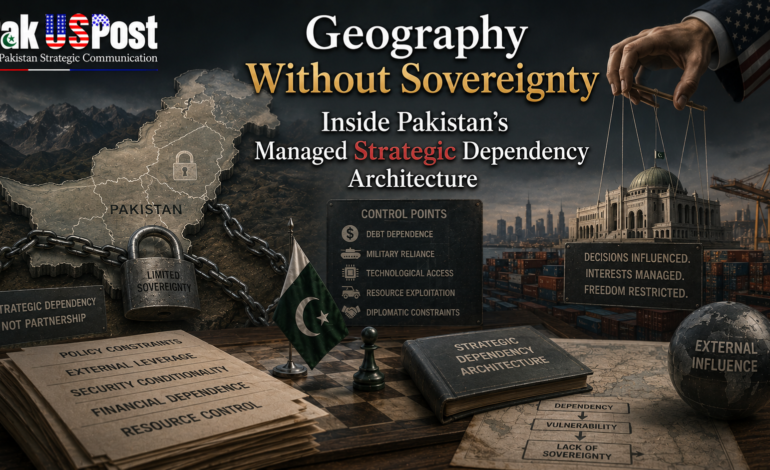
Geography Without Sovereignty Inside Pakistan’s Managed Strategic Dependency Architecture

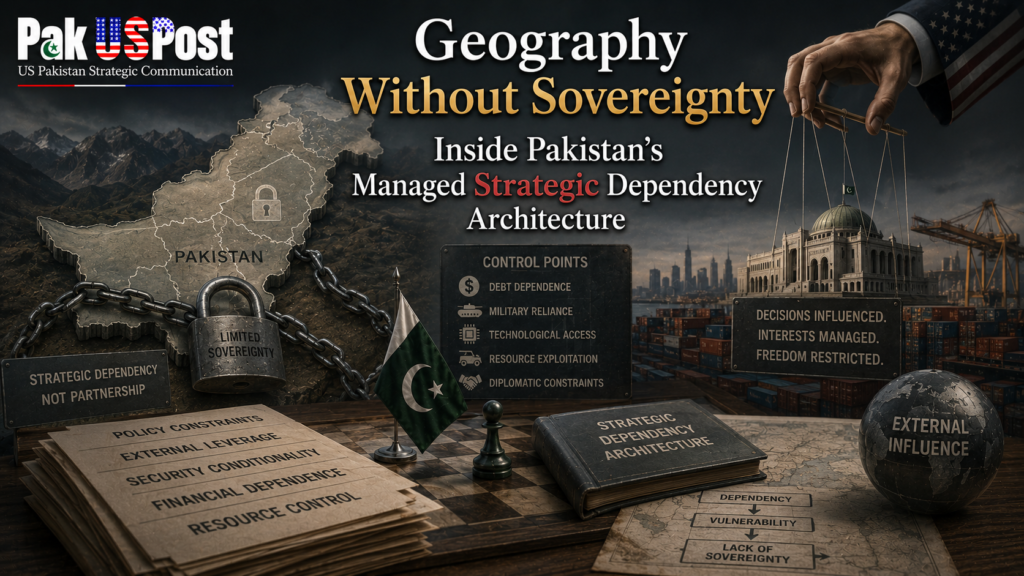
Pakistan’s strategic class increasingly confronts a paradox that has become impossible to conceal beneath ceremonial diplomacy, televised patriotism, or temporary geopolitical relevance. The state remains geographically indispensable yet institutionally vulnerable, diplomatically visible yet economically constrained, militarily consequential yet structurally dependent upon external financial engineering. In the contemporary geopolitical order, Pakistan is no longer merely negotiating alliances. It is negotiating survival within an increasingly fragmented international system where sovereignty itself has become conditional, transactional, and periodically outsourced through debt instruments, security arrangements, and crisis diplomacy.
The post American withdrawal phase from Afghanistan initially appeared to provide Islamabad with a rare strategic opening. Many within the security establishment interpreted the transition as confirmation that geography still determines power in Eurasian politics. Yet the anticipated strategic dividends never fully materialized. Instead, Pakistan entered another cycle of economic turbulence, inflationary distress, institutional fragmentation, and externally conditioned stabilization. The illusion of strategic victory dissolved into a harsher reality. Geography can create relevance, but geography alone cannot produce sovereign leverage when the internal architecture of governance remains fractured.
This contradiction now defines Pakistan’s position within the evolving global order. International actors continue to engage Islamabad not because Pakistan has successfully institutionalized power, but because instability itself has become geopolitically useful. Fragile states positioned along strategic corridors increasingly function as pressure valves, intelligence theatres, logistical hubs, and diplomatic intermediaries within great power competition. Pakistan’s relevance, therefore, emerges less from consolidated national capability and more from its utility within wider geopolitical anxieties involving China, Iran, Afghanistan, the Gulf, Central Asia, maritime competition, and transnational militancy.
The danger for Islamabad lies in confusing tactical indispensability with strategic autonomy. External powers often sustain fragile frontline states only to the extent necessary for regional equilibrium. Once immediate utility declines, those same states encounter abandonment, pressure, or financial disciplining. Pakistan has experienced this cycle repeatedly across successive geopolitical eras. During the anti Soviet jihad, the post September security order, counterterrorism cooperation, and more recently the recalibration surrounding China’s regional rise, Islamabad acquired temporary significance without securing durable economic transformation or institutional modernization.
The deeper concern now emerging inside policy circles is that Pakistan’s dependency architecture has evolved beyond economics into something more systemic. International financial institutions no longer merely influence fiscal policy. They indirectly shape governance sequencing, subsidy frameworks, taxation structures, energy pricing mechanisms, privatization trajectories, and macroeconomic stabilization priorities. Simultaneously, external security partnerships shape counterterrorism doctrines, regional alignments, intelligence cooperation, and strategic signaling. This cumulative process gradually narrows the state’s autonomous policy space.
What appears externally as diplomacy increasingly resembles managed navigation through overlapping dependency networks. Beijing offers infrastructural depth but demands strategic reliability. Washington seeks selective cooperation while maintaining broader containment priorities in Asia. Gulf monarchies provide liquidity support yet increasingly expect investment guarantees, regulatory concessions, and geopolitical synchronization. Multilateral lenders insist upon structural reforms that often intensify domestic political volatility. Pakistan consequently operates within intersecting pressure systems where every external partnership carries embedded conditionalities.
This environment has produced an elite strategic culture heavily conditioned toward short term stabilization rather than long term statecraft. Policymaking increasingly revolves around preventing immediate collapse instead of constructing durable sovereignty. Emergency financing replaces developmental planning. Tactical balancing substitutes for coherent doctrine. Diplomatic activity becomes reactive rather than agenda setting. Under such conditions, strategic institutions inevitably prioritize crisis management because the political system itself remains trapped in perpetual emergency.
The consequences are visible across governance structures. Civilian continuity remains weak. Bureaucratic coherence fluctuates according to political transitions. Economic ministries frequently operate under external fiscal constraints. Provincial fragmentation complicates national coordination. Electoral polarization undermines policy consistency. Meanwhile, public trust in institutional legitimacy continues to erode amid inflationary pressures, energy crises, and widening inequality. These domestic fractures significantly weaken Pakistan’s ability to negotiate from a position of strategic confidence internationally.
Foreign actors understand this vulnerability with increasing sophistication. International diplomacy toward Pakistan now often combines financial assistance with calibrated political signaling. External powers rarely need direct coercion when institutional fragility itself creates compliance incentives. The modern mechanism of influence operates less through overt intervention and more through calibrated dependency management. Access to loans, investment guarantees, debt restructuring, security cooperation, or diplomatic legitimacy can subtly shape national decision making without formal infringement upon sovereignty.
The Pakistani establishment recognizes these pressures but frequently interprets them through traditional security lenses rather than systemic institutional analysis. Strategic thinking within sections of the state continues to prioritize kinetic threats while underestimating structural vulnerabilities emerging from economic fragility, technological dependency, governance erosion, informational manipulation, and demographic stress. Yet contemporary geopolitical competition increasingly targets institutional resilience rather than territorial conquest.
This shift explains why economic instability now carries strategic implications comparable to conventional security threats. Persistent inflation weakens public cohesion. Currency instability undermines investor confidence. Debt dependence reduces diplomatic flexibility. Youth unemployment fuels social volatility. Digital disinformation intensifies polarization. Together, these conditions gradually erode national resilience from within. No state can sustain strategic autonomy externally while simultaneously experiencing institutional exhaustion internally.
The United States increasingly approaches Pakistan through this prism of managed stabilization rather than transformational partnership. Washington’s primary concerns now involve nuclear security, counterterrorism containment, regional crisis prevention, and balancing China’s expanding influence. The era of expansive strategic investment in Pakistan has largely ended. American engagement remains selective, cautious, and transactional. This does not signify irrelevance. Rather, it indicates that Pakistan is now viewed primarily as a state whose instability must be managed rather than a state whose transformation must be funded.
China, meanwhile, interprets Pakistan through a different but equally pragmatic framework. Beijing values connectivity, maritime access, regional influence corridors, and strategic depth against Indian competition. Yet Chinese policymakers increasingly exhibit concerns regarding political instability, militant violence, bureaucratic inconsistency, and debt sustainability. The original optimism surrounding corridor diplomacy has gradually encountered the realities of governance dysfunction and security volatility. Chinese patience remains significant, but it is not unlimited.
This dual pressure from Washington and Beijing creates a difficult balancing environment for Islamabad. Pakistan seeks to maintain strategic flexibility between competing power centers, yet limited economic capacity constrains independent maneuverability. The danger is that balancing without sufficient institutional strength eventually degenerates into simultaneous dependence upon multiple rival actors. Such a condition can produce diplomatic paralysis during periods of intensified global confrontation.
The Gulf dimension further complicates this landscape. Saudi Arabia and the United Arab Emirates increasingly prioritize investment driven engagement rather than unconditional financial rescue. Their expectations involve regulatory reforms, strategic coordination, and long term economic concessions. Pakistan’s traditional assumption that Islamic solidarity guarantees perpetual assistance has weakened under the pressures of transactional geopolitics. Gulf capitals now calculate risk exposure with far greater precision.
Within this broader context, Pakistan’s internal political polarization represents an underestimated strategic liability. Competing elite factions increasingly internationalize domestic conflicts by seeking implicit external validation. Political legitimacy becomes indirectly linked with perceptions of foreign approval, neutrality, or displeasure. This phenomenon weakens national coherence because domestic actors begin interpreting international relationships through partisan frameworks. Foreign policy consequently loses institutional continuity and becomes vulnerable to internal power struggles.
The media environment amplifies these distortions. Strategic communication inside Pakistan often oscillates between triumphalist nationalism and crisis alarmism, leaving limited space for sober institutional debate. Public discourse focuses excessively upon symbolic sovereignty while avoiding deeper conversations regarding economic restructuring, governance reform, educational modernization, or technological competitiveness. Emotional narratives frequently substitute for strategic realism.
This disconnect creates a dangerous illusion. States do not preserve sovereignty merely through rhetorical defiance. Sovereignty ultimately depends upon institutional competence, economic productivity, social cohesion, and technological adaptation. Without these foundations, geopolitical visibility becomes cosmetic. Pakistan risks becoming internationally relevant but domestically hollow, a condition where external actors continue engaging the state while internal resilience steadily deteriorates.
The hidden risk confronting the establishment therefore extends beyond conventional security calculations. The greater danger is gradual systemic exhaustion. States rarely collapse suddenly. More often they experience prolonged erosion whereby institutions continue functioning symbolically while effectiveness steadily declines. Economic crises become normalized. Governance dysfunction becomes procedural. Strategic ambiguity becomes permanent. Under such conditions, the state survives formally but loses substantive autonomy incrementally.
Another underappreciated threat involves demographic pressure. Pakistan’s expanding youth population represents either a strategic asset or a destabilizing force depending upon economic absorption capacity. Persistent educational decline combined with limited employment opportunities creates fertile conditions for ideological radicalization, criminal economies, digital extremism, and anti institutional sentiment. No security doctrine can indefinitely contain demographic frustration without corresponding economic transformation.
Climate vulnerability introduces another strategic variable often marginalized within traditional policy frameworks. Water stress, agricultural disruption, urban migration, and environmental degradation increasingly intersect with national security. External powers are already incorporating climate resilience into geopolitical calculations. States unable to manage ecological instability may encounter intensified dependence upon international financial and humanitarian mechanisms, further reducing sovereign flexibility.
Technological dependency constitutes an additional layer of vulnerability. Pakistan remains heavily reliant upon external digital infrastructure, surveillance technologies, financial systems, cyber architecture, and artificial intelligence platforms. Future geopolitical competition will increasingly revolve around data control, technological sovereignty, cyber resilience, and informational dominance. Without indigenous technological capability, Pakistan risks strategic marginalization within emerging digital power hierarchies.
The establishment must therefore recognize that twentieth century geopolitical doctrines cannot adequately address twenty first century vulnerabilities. Military capability remains essential but insufficient. The decisive battles of the future will involve institutional endurance, economic resilience, technological adaptation, narrative credibility, and social cohesion. States incapable of integrating these dimensions will remain vulnerable regardless of conventional strategic assets.
Pakistan’s policy elite must also reconsider the long standing assumption that perpetual geopolitical tension automatically enhances national leverage. Controlled instability may temporarily increase diplomatic attention, but prolonged volatility discourages investment, weakens governance, and accelerates capital flight. International actors increasingly prefer predictable partners over strategically dramatic ones. In an era of global economic uncertainty, stability itself becomes a geopolitical commodity.
This reality demands a fundamental recalibration of Pakistan’s national security paradigm. Economic security must be elevated to the center of strategic planning rather than treated as a secondary civilian concern. Institutional modernization should be viewed as a security imperative. Educational reform must be linked with geopolitical competitiveness. Bureaucratic efficiency should be recognized as an instrument of sovereignty.
The military establishment retains significant organizational capacity compared with many civilian institutions. However, long term national resilience requires stronger civilian governance rather than perpetual substitution. Excessive centralization of strategic decision making within narrow institutional circles may generate operational efficiency in the short term but ultimately weakens democratic legitimacy and policy adaptability. Sustainable sovereignty requires institutional depth across the entire state architecture.
For policymakers inside Islamabad, the immediate priority should involve reducing structural overdependence through calibrated diversification. Economic partnerships must expand beyond emergency financing frameworks toward productive industrial cooperation. Export capacity requires urgent enhancement. Tax reform must address elite capture. Energy dependency should be strategically reduced through long term planning rather than temporary subsidy adjustments.
Equally important is the reconstruction of diplomatic doctrine. Pakistan must transition from reactive balancing toward selective strategic prioritization. Not every geopolitical crisis requires maximal engagement. Diplomatic visibility should serve national interests rather than symbolic prestige. Mediation roles must align with institutional capability. Strategic ambiguity, while occasionally useful, cannot permanently substitute for coherent foreign policy architecture.
The relationship with Washington requires pragmatic realism devoid of both romanticism and hostility. The United States will remain influential within global finance, technology, security, and diplomacy regardless of multipolar transitions. Simultaneously, engagement with China remains indispensable for infrastructural development and regional connectivity. Pakistan’s challenge is not choosing between powers but preventing excessive dependency upon any single geopolitical axis.
Internally, strategic communication requires profound reform. State narratives should prioritize institutional confidence rather than perpetual siege psychology. Public discourse must gradually shift from emotional nationalism toward developmental patriotism emphasizing education, productivity, scientific advancement, and governance reform. National resilience cannot emerge solely through symbolic mobilization.
There is also a need for institutional honesty regarding the scale of existing vulnerabilities. Denial may preserve temporary political comfort but ultimately weakens strategic preparation. Mature states confront weaknesses directly because acknowledgment enables adaptation. Pakistan’s policymaking culture often treats criticism as disloyalty rather than as an opportunity for corrective reform. This mentality inhibits institutional learning.
The wider international system is itself entering a period of fragmentation. American dominance is contested but not collapsed. China’s rise is significant but constrained. Europe faces internal strategic anxieties. The Middle East is recalibrating through transactional diplomacy. Global institutions exhibit declining authority. In such an environment, middle powers face both opportunity and danger. States with strong institutions may leverage multipolarity advantageously. Fragile states risk becoming arenas for competitive influence.
Pakistan currently stands between these two trajectories. Its geography guarantees continued relevance, but geography alone cannot indefinitely compensate for institutional weakness. The central strategic question is whether the state can transform relevance into resilience before external pressures intensify further.
The answer will depend less upon rhetorical sovereignty and more upon structural reform. History demonstrates that nations rarely achieve durable autonomy through geopolitical maneuvering alone. Sovereignty ultimately emerges from internal competence. States capable of governing effectively acquire negotiating power externally. States trapped in perpetual dependency eventually confuse survival with strategy.
Pakistan’s future therefore hinges upon whether its ruling institutions can abandon the psychology of emergency management and embrace the discipline of long term state building. The challenge is not merely resisting foreign influence. The deeper challenge is constructing a national architecture resilient enough that external influence no longer determines the rhythm of domestic survival.
That transformation requires strategic patience, institutional humility, economic realism, and political courage. Without it, Pakistan may continue oscillating between moments of geopolitical indispensability and cycles of internal vulnerability, remaining globally relevant while progressively losing substantive control over its own trajectory.
A Public Service Message