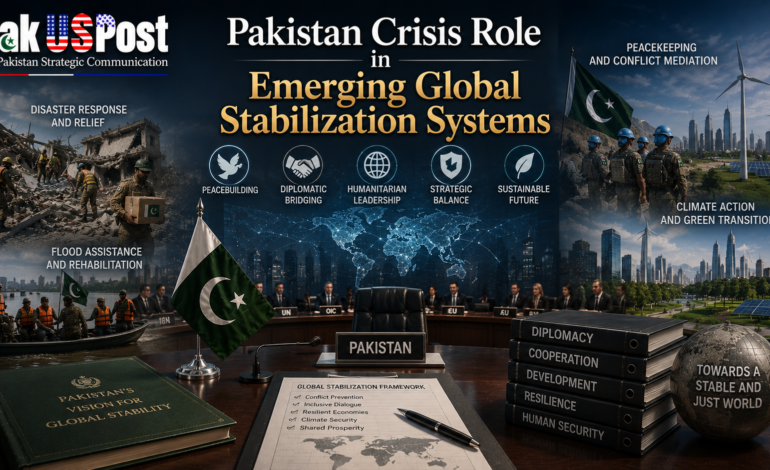
Pakistan Crisis Role in Emerging Global Stabilization Systems

By: Shafaqat Ali Qureshi
In the evolving architecture of international security governance, the classical distinction between allies, adversaries, and neutral actors is increasingly giving way to a more fluid and operational categorization, in which states are evaluated according to their functional utility within crisis containment ecosystems. Within this shifting paradigm, Pakistan has acquired a distinctive position as a recurrent stabilization interface, periodically activated within broader United States and allied risk management frameworks that extend across South Asia, the Middle East, and the maritime corridors of the Arabian Sea.
This repositioning does not reflect a formal reclassification of Pakistan’s alliance status, but rather an incremental absorption into what may be described as preventive stabilization logic. In this logic, states are not integrated as full spectrum strategic partners but are instead engaged as situational nodes within distributed security networks designed to mitigate escalation, absorb shocks, and contain spillover effects from adjacent conflict zones. Pakistan’s geographic adjacency to Afghanistan, proximity to Iran, and maritime interface with critical energy routes places it within this architecture by structural necessity rather than diplomatic design.
The defining characteristic of this arrangement is its episodic nature. Engagement intensifies during periods of regional volatility, particularly in moments of Afghan instability, Iran related escalation cycles, or maritime security disruptions in the broader Indian Ocean system. During such phases, Pakistan becomes a critical coordination point for intelligence exchange, logistical facilitation, and diplomatic signaling. However, once immediate crisis pressure subsides, strategic attention shifts elsewhere, and engagement returns to a lower intensity baseline. This cyclical pattern produces a form of strategic intermittency that is often misinterpreted as continuity.
The hidden risk embedded within this configuration lies in its asymmetry of agency. While Pakistan is repeatedly drawn into crisis management roles, it is rarely positioned as a co architect of the frameworks within which such crises are managed. Instead, its role is largely operational, defined by proximity and necessity rather than design authority. This creates a structural condition in which Pakistan participates in stabilization processes without substantially influencing their doctrinal foundations or long term institutional architecture.
At the level of global security transformation, this reflects a broader shift away from alliance centric security systems toward modular crisis response networks. Traditional alliances were designed to deter threats through long term commitments, formal obligations, and integrated planning. In contrast, contemporary stabilization systems are increasingly ad hoc, flexible, and geographically dispersed. They rely on temporary convergence among multiple actors who may not share long term strategic objectives but align temporarily in response to specific risks.
Within this emerging system, Pakistan functions as what can be analytically described as a preventive stabilization node. This designation implies neither subordinate status nor formal alliance membership, but rather a functional role within which geographic positioning, logistical access, and regional connectivity become strategic assets activated during periods of instability. The challenge inherent in this role is that it does not automatically translate into sustained strategic influence or institutional integration.
The most significant consequence of this arrangement is the normalization of reactive geopolitics. In such a model, strategic relevance is not derived from the ability to shape long term regional order, but from the capacity to absorb, mitigate, or temporarily stabilize crisis conditions generated elsewhere. While this may enhance short term diplomatic visibility, it risks entrenching a cycle in which Pakistan’s international engagement is repeatedly defined by external crises rather than internal agenda setting capacity.
From a policy perspective, this dynamic raises fundamental questions about strategic agency. If a state is consistently integrated into crisis management frameworks without equivalent participation in structural decision making, its role risks becoming functionally instrumental rather than strategically autonomous. Over time, this can produce a condition of dependency on crisis relevance, where international attention is contingent upon instability rather than stability.
The United States perspective within this system is driven by its own evolving strategic calculus. As global commitments become increasingly distributed across multiple theatres, Washington has moved toward a model of burden distribution and situational engagement. Rather than maintaining continuous deep engagement in every region, it activates partnerships selectively where immediate risk mitigation is required. Pakistan, due to its geography and historical involvement in adjacent conflict systems, naturally becomes part of this selective activation pattern.
However, this pattern introduces an inherent contradiction. While Pakistan is operationally indispensable during crises, it remains structurally peripheral during strategic design phases. This duality produces a fragmented engagement model in which tactical cooperation is periodically intense, but strategic integration remains limited. The result is a relationship that is operationally functional but strategically incomplete.
The implications for Pakistan’s establishment level policy thinking are significant. Continued reliance on crisis based relevance risks embedding a structural dependency on external volatility. In such a configuration, stability paradoxically reduces strategic visibility, while instability increases it. This inversion of incentives creates a distorted engagement structure in which long term national interest may not align with short term diplomatic activation cycles.
To address this imbalance, Pakistan faces the challenge of transforming its role from crisis adjacency to structural integration within regional order building processes. This requires a deliberate shift from reactive stabilization participation to proactive institutional design. Instead of being primarily a point of crisis absorption, Pakistan must position itself as a contributor to the architecture of prevention itself, particularly in domains such as regional connectivity, maritime governance, and economic corridor integration.
Such a transition, however, is not solely dependent on external recognition. It requires internal consolidation of institutional capacity, policy coherence, and long term strategic planning. Without these elements, attempts to reposition Pakistan within global stabilization systems will remain constrained by the same episodic logic that currently defines its role.
Another hidden risk lies in the potential for strategic overstretch. As Pakistan becomes repeatedly involved in multiple overlapping crisis theaters, there is a danger that its diplomatic bandwidth becomes disproportionately allocated to external stabilization demands, at the expense of domestic institutional strengthening and long term economic restructuring. This imbalance can weaken the very foundations required to sustain meaningful strategic agency.
In conclusion, Pakistan’s integration into emerging crisis containment and preventive stabilization systems reflects both opportunity and constraint. It underscores the enduring relevance of its geography and diplomatic accessibility, while simultaneously revealing the limitations of a role defined primarily by episodic crisis engagement. The central strategic question is whether Pakistan can evolve from being a functional stabilization node to becoming a co architect of regional security architecture.
The answer to this question will determine whether its future role in global systems is characterized by reactive participation or by structural influence within the evolving grammar of international stability governance.
A Public Service Message