India Constraint and Structural Limits in United States Pakistan Ties

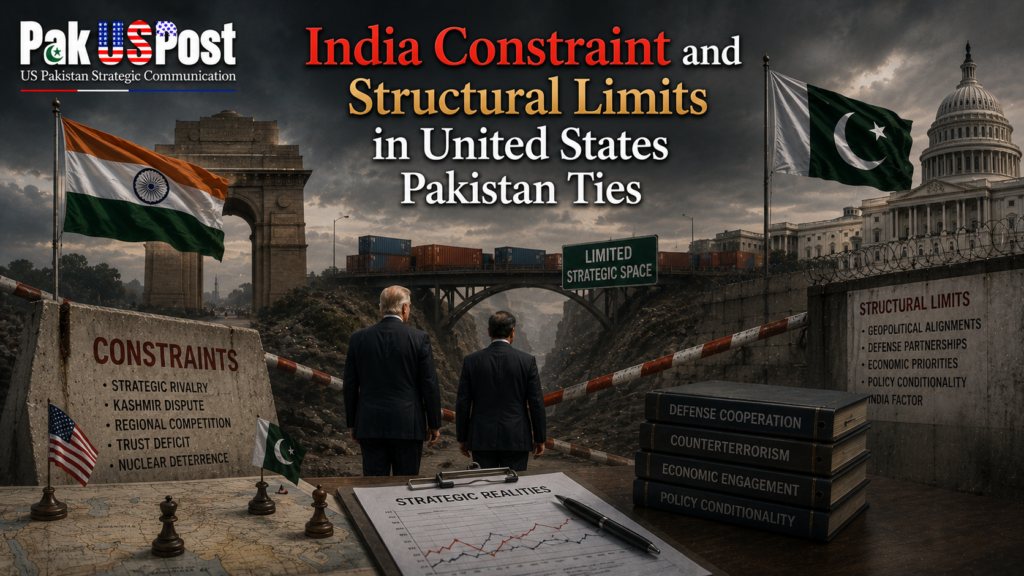
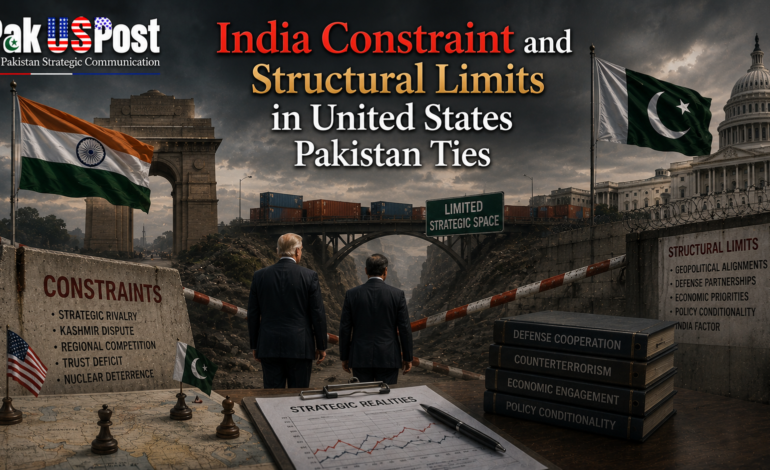
The recalibration of United States engagement in South Asia has increasingly acquired a triangular configuration in which India functions not merely as a bilateral partner of Washington but as a structural determinant of the permissible boundaries of United States Pakistan relations. This evolving geometry is not formally codified in treaty language, yet it is operationally embedded in defense cooperation priorities, technological partnerships, intelligence sharing asymmetries, and the broader Indo Pacific strategic imagination that now dominates American foreign policy thinking.
At the surface level, the United States continues to maintain functional engagement with Pakistan, particularly in domains of counterterrorism coordination, regional stabilization, and crisis management in adjacent theatres. However, beneath this operational continuity lies a deeper stratification of strategic value attribution, in which India occupies the role of long term systemic partner, while Pakistan is positioned within a more contingent framework of episodic utility. This differentiation is not merely rhetorical but is reflected in the architecture of defense procurement, joint technological development, and intelligence interoperability frameworks that increasingly privilege New Delhi.
The hidden structural constraint emerging from this configuration is not overt exclusion but calibrated asymmetry. Pakistan is not removed from the strategic map; rather, it is incorporated in a manner that is carefully bounded by the requirements of United States India convergence. This produces a diplomatic environment in which the expansion of one relationship implicitly limits the depth of the other. In effect, India operates as a ceiling variable within the equation of United States Pakistan normalization, defining the upper limits of possible strategic intimacy.
This triangular arrangement is reinforced by the broader transformation of United States global strategy toward Indo Pacific centrality. The reorientation of American strategic doctrine toward maritime competition, supply chain security, and technological decoupling from China has elevated India as a pivotal node in long term balancing architectures. Within this framework, India’s demographic scale, market potential, and defense modernization trajectory are interpreted as strategic assets, while Pakistan’s relevance is increasingly filtered through its geographic proximity to instability zones rather than as a core partner in systemic balancing.
The implications of this shift are particularly pronounced in defense and intelligence domains. While tactical cooperation with Pakistan persists, especially in counterterrorism monitoring and regional risk containment, the depth of intelligence sharing remains structurally constrained. Similarly, defense engagement is characterized by selective interaction rather than integrated partnership. In contrast, United States India defense relations have expanded into co production frameworks, advanced technology transfer discussions, and interoperability planning across multiple domains.
This asymmetry generates what may be described as strategic compression for Pakistan, wherein engagement is maintained but within narrowing parameters. The compression is not sudden or visible; it is incremental, embedded in bureaucratic processes, policy prioritization cycles, and shifting allocation of diplomatic attention. Over time, this produces a cumulative effect in which Pakistan’s strategic elasticity within United States policy frameworks gradually diminishes.
From Pakistan’s perspective, this evolving structure presents a dual challenge. On one hand, complete disengagement from the United States is neither feasible nor strategically desirable, given the enduring relevance of financial institutions, security cooperation mechanisms, and global diplomatic influence channels. On the other hand, reliance on episodic engagement exposes Pakistan to structural volatility, where shifts in United States India relations indirectly recalibrate the intensity and scope of United States Pakistan interaction.
The silent constraint imposed by the India factor is therefore not merely bilateral but systemic. It reflects a broader reordering of global alliances in which states are no longer evaluated in isolation but as components within larger strategic ecosystems. In such ecosystems, strengthening one node often entails the relative deprioritization of another. Pakistan’s strategic challenge lies in navigating this zero sum perception environment without becoming structurally marginalized.
Another dimension of this constraint lies in technological stratification. As United States India cooperation deepens in emerging technologies such as artificial intelligence, space systems, and digital infrastructure, Pakistan faces increasing difficulty in accessing comparable levels of technological integration. This technological divergence further reinforces strategic asymmetry, as future military and economic power will be increasingly determined by digital and informational capabilities rather than conventional force structures alone.
Within establishment level policy analysis, there is growing recognition that this structural ceiling is unlikely to be reversed in the near term. The convergence of United States India interests is rooted in long term geopolitical calculus rather than short term tactical alignment. Consequently, Pakistan’s room for strategic expansion within this triangle is inherently constrained unless alternative balancing architectures are developed.
This does not imply strategic irrelevance for Pakistan, but rather a redefinition of relevance itself. Pakistan remains critical in crisis stabilization contexts, particularly in relation to Afghanistan, regional security spillovers, and maritime geography. However, this relevance is episodic rather than structural, and therefore cannot substitute for deep alliance level integration.
The policy implications of this triangular constraint are significant. First, Pakistan must recognize that reliance on reactivation cycles of United States engagement will not produce sustained strategic equilibrium. Second, diversification of strategic partnerships is not merely an option but a structural necessity in order to mitigate the effects of asymmetrical triangulation. Third, Pakistan must invest in transforming its geographic centrality into economic and infrastructural centrality, thereby shifting its role from crisis adjacency to connectivity integration.
At the same time, it is important to avoid analytical fatalism. Structural constraints do not eliminate agency; they redefine its contours. Pakistan retains the ability to influence regional dynamics through selective diplomacy, economic corridor development, and calibrated engagement with multiple power centers. The key challenge lies in converting reactive positioning into proactive agenda setting within regional frameworks.
In conclusion, the India factor in United States Pakistan relations functions less as an explicit barrier and more as an embedded structural parameter that defines the outer boundaries of engagement. It shapes not only what is possible but also what is imaginable within policy frameworks. The hidden risk for Pakistan is not exclusion from United States engagement, but gradual normalization of asymmetry as a permanent condition. The strategic task, therefore, is to operate within this constraint while continuously expanding the range of alternative diplomatic and economic horizons available beyond it.
A Public Service Message