
Iran Regional Shift and Pakistan Strategic Realignment


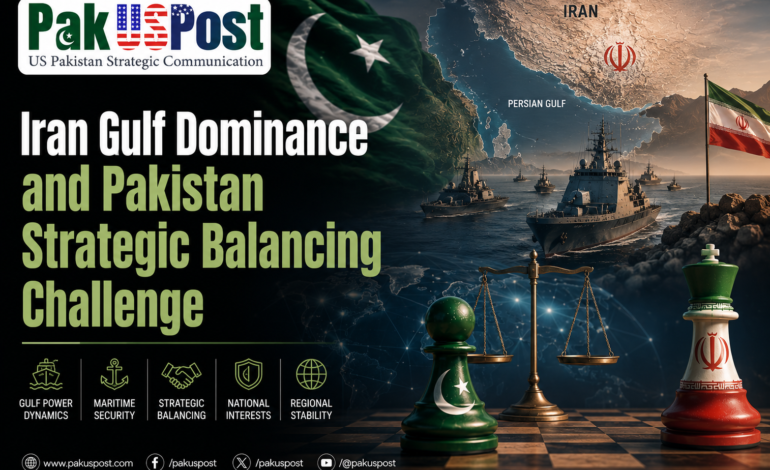
The hypothetical withdrawal of the United States from the Middle East, combined with a scenario in which Iran consolidates influence over the Strait of Hormuz and extends strategic leverage toward Bab-el-Mandeb, would mark a profound restructuring of regional order with direct consequences for Pakistan’s national security architecture, diplomatic balance, and internal stability. For Islamabad, such a transformation would not be an external geopolitical adjustment but a systemic shift that compresses its strategic space between competing regional blocs, intensifies western frontier sensitivities, and recalibrates long-standing alliances with Gulf states, China, Russia, and the United States.
In the immediate phase of such a scenario, Pakistan’s western border environment would become significantly more complex. The Pakistan-Iran frontier, already characterized by porous terrain, informal cross-border economies, and intermittent security incidents, would likely experience heightened strategic attention from both state and non-state actors. A more assertive Iranian regional posture would inevitably alter local power dynamics in border regions, particularly in Balochistan, where long-standing grievances, underdevelopment, and insurgent narratives intersect with external influence opportunities. The risk is not necessarily conventional military escalation, but rather an intensification of asymmetric pressures, including cross-border facilitation networks, ideological spillovers, and intelligence competition in peripheral zones.
Pakistan’s internal cohesion would therefore become partially linked to external regional dynamics. Any escalation of Iran-Gulf rivalry would risk reverberation inside Pakistan’s sectarian and political landscape, where historical sensitivities require careful state calibration. The state’s traditional approach of compartmentalizing external alliances while maintaining internal religious neutrality would face renewed stress. Information flows, digital influence operations, and transnational ideological messaging would become more significant instruments of indirect pressure, requiring a shift in how internal security is conceptualized.
On the eastern front, the broader strategic environment would also shift. India, already embedded in a deepening strategic partnership with the United States through Indo-Pacific frameworks, would likely interpret American reorientation away from the Middle East as an opportunity to consolidate influence across multiple theatres. A more India-centric US strategic posture in Asia would strengthen India’s defence modernization, maritime reach, and diplomatic leverage in Gulf energy markets. For Pakistan, this creates a dual containment pressure environment where western instability linked to Iran intersects with eastern strategic competition anchored in Indo-Pacific alignments.
At the same time, Pakistan’s relationship with Gulf Arab states would enter a phase of recalibration. Saudi Arabia and the United Arab Emirates, facing a more assertive Iran, would likely seek to diversify their security partnerships and reinforce internal defence capabilities. Pakistan, historically a key security partner and labor-exporting state for the Gulf, would find itself under increased expectation pressure. Financial dependencies through remittances, investment flows, and deferred oil payment arrangements would deepen Gulf leverage over Islamabad’s diplomatic positioning. However, Pakistan’s ability to overtly align in any Gulf-Iran confrontation would remain constrained due to its own western border sensitivities and need for regional neutrality.
China’s role in this evolving environment would become structurally more central. Beijing’s strategic interest in maintaining uninterrupted energy flows from the Gulf, ensuring stability of maritime trade routes, and securing overland connectivity through Pakistan would intensify its engagement with both Iran and Pakistan. In such a configuration, Pakistan would increasingly function as a connectivity corridor state within a broader Eurasian integration framework. However, this enhanced centrality would also come with reduced diplomatic flexibility, as expectations from Beijing regarding alignment on regional issues could increase. The China-Pakistan economic and security nexus would therefore deepen, but also become more strategically binding.
Russia’s incremental engagement in Middle Eastern diplomacy and its broader alignment with China and Iran in certain strategic theatres’ would further contribute to a multipolar regional structure. In such an environment, Pakistan would operate in a diplomatic system characterized not by binary alliances but by overlapping and sometimes competing spheres of influence. This would require a level of diplomatic agility that exceeds traditional alliance-based foreign policy models.
From a policy standpoint, Pakistan would face three primary strategic pathways. The first is strict strategic neutrality, where Islamabad avoids formal alignment with any emerging bloc and maintains functional bilateral relations with all major actors. While this preserves flexibility, it risks reducing credibility during high-intensity regional polarization, where neutrality is often interpreted as passive positioning rather than active statecraft.
The second pathway is a calibrated continental tilt toward China and Iran, leveraging geographic contiguity, energy interdependence, and potential overland connectivity. This could reduce exposure to maritime chokepoint vulnerabilities and Gulf volatility, while strengthening integration into emerging Eurasian trade and energy corridors. However, such a shift carries risks of financial exposure to Western systems, potential reduction in Gulf remittances leverage, and increased scrutiny from traditional Western financial institutions.
The third pathway is continued multi-vector hedging, maintaining simultaneous engagement with the Gulf, China, Russia, and residual United States channels. This reflects Pakistan’s historical diplomatic behavior, but in a more polarized and high-stakes environment, hedging becomes more difficult to sustain without significant economic and institutional resilience. The margin for ambiguity shrinks when regional alignments become more ideologically and strategically defined.
A calibrated national doctrine would therefore require integration of three core principles. First, economic insulation through diversification of energy routes, strategic reserves, and reduced dependency on single chokepoints. Second, border stabilization through socio-economic integration of peripheral regions, particularly in Balochistan, to reduce external penetration vulnerabilities. Third, diplomatic elasticity that preserves engagement across competing blocs without crossing thresholds that trigger sanctions, isolation, or strategic exclusion.
Institutionally, Pakistan’s security establishment would need to expand its analytical framework beyond traditional kinetic threat assessment. Future instability would increasingly emerge through hybrid mechanisms involving energy markets, financial flows, maritime risk premiums, and information operations. This necessitates a convergence of economic intelligence, geopolitical analysis, and internal security planning into a unified strategic architecture.
In conclusion, the hypothetical Iranian rise in a post-American Middle East does not simply alter regional balance; it compresses Pakistan’s strategic environment into a more volatile and interconnected system. The primary challenge for Islamabad would not be alignment with any single power centre but preservation of strategic autonomy in an increasingly constrained geopolitical space. Success would depend on adaptive diplomacy, internal cohesion, and the ability to absorb external shocks without allowing them to translate into internal fragmentation.
A Public Service Message