
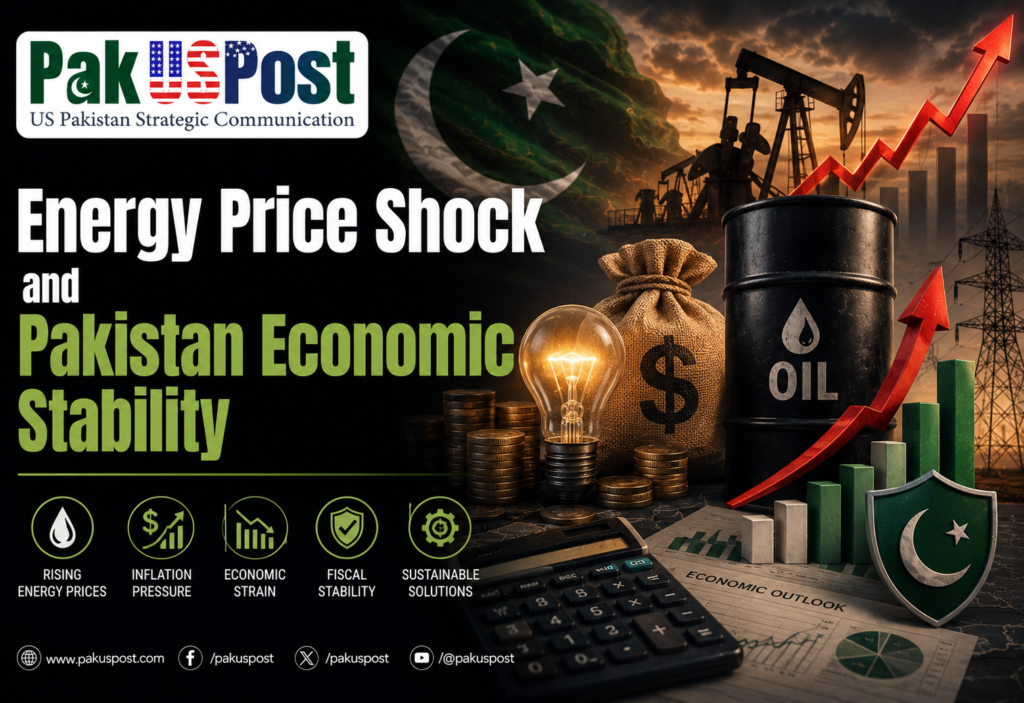
Energy Price Shock and Pakistan Economic Stability

A sudden restructuring of the Middle Eastern security order following a United States withdrawal, coupled with expanded Iranian influence over the Strait of Hormuz, would trigger one of the most severe external economic stress tests for Pakistan in its modern history. The country’s economic structure, already characterized by persistent current account deficits, narrow export base, and high import dependence, would face a compounded shock transmitted through global energy markets, shipping risk premiums, and currency volatility. In such a scenario, Pakistan’s vulnerability would not be cyclical but structural, embedded in its dependence on imported hydrocarbons and external financing cycles.
Pakistan imports the majority of its crude oil and refined petroleum products, with a significant portion of shipments passing through maritime routes exposed to Hormuz-related risk perception. Even without physical disruption of supply, the perception of Iranian strategic leverage over this chokepoint would introduce a persistent geopolitical risk premium into global oil pricing. This premium would not be temporary; it would likely become structural as markets internalize the probability of intermittent disruptions, insurance cost escalation, and shipping rerouting. For Pakistan, this translates into a sustained upward shift in import costs rather than a one-time shock.
In a moderate price environment where global crude stabilizes around eighty dollars per barrel, Pakistan would experience manageable but widening pressure on its external account. The trade deficit would expand, and the rupee would come under steady depreciation pressure. Inflation would remain elevated but within policy-controllable bounds if external financing remains accessible. However, in a higher stress scenario where oil reaches one hundred twenty dollars per barrel, the macroeconomic balance begins to deteriorate more rapidly. Foreign exchange reserves would decline at an accelerated pace, forcing tighter monetary policy and import compression measures that would slow economic growth.
In an extreme scenario approaching one hundred eighty dollars per barrel, the economic system would move toward crisis mode. Pakistan’s external financing gap would widen beyond conventional stabilization capacity, even with multilateral support. Import rationing, administrative controls, and emergency fiscal measures would become likely policy responses. Inflation could transition from demand-driven to structurally embedded, driven by persistent supply-side constraints and currency depreciation.
The transmission mechanism of this external shock operates through several interconnected channels. The most immediate is the balance of payments channel. Higher oil import costs directly increase the trade deficit, requiring greater foreign exchange outflows. Given Pakistan’s limited export elasticity in the short term, the adjustment burden falls disproportionately on reserves and external borrowing. As reserves decline, market confidence weakens, leading to speculative pressure on the rupee.
Currency depreciation then feeds into domestic inflation through imported goods pricing. Pakistan’s inflation basket is highly sensitive to energy and food imports, both of which are directly or indirectly linked to global fuel prices. This creates a feedback loop where external price shocks translate into internal price instability, reducing real incomes and weakening consumption demand.
The fiscal system adds another layer of vulnerability. Higher energy costs increase subsidies, circular debt accumulation, and public sector liabilities. If tariffs are not adjusted in line with costs due to political constraints, the energy sector deficit expands. If tariffs are adjusted, inflation accelerates, creating a politically sensitive trade-off between fiscal sustainability and social stability. This structural tension has historically constrained Pakistan’s macroeconomic policy space and would become more acute under sustained oil volatility.
Industrial competitiveness would also deteriorate. Export-oriented sectors such as textiles, leather, and agro-processing rely heavily on energy inputs. Rising production costs would reduce margin competitiveness in global markets, particularly against regional peers with more diversified energy structures. This would limit Pakistan’s ability to offset import costs through export growth, reinforcing external imbalance.
Remittance flows, while relatively resilient, would not be immune to indirect effects. Gulf economies, which host a large portion of Pakistan’s overseas workforce, are themselves sensitive to oil price volatility and regional instability. While higher oil prices can increase Gulf fiscal revenues in the short term, prolonged instability or strategic uncertainty may dampen investment cycles and labor demand growth. This introduces medium-term uncertainty into one of Pakistan’s most critical external inflow channels.
In response, Pakistan would require a multi-layered economic adjustment strategy. In the short term, the establishment of strategic petroleum reserves becomes essential. Current storage limitations constrain Pakistan’s ability to absorb price volatility. Expanding reserve capacity through public-private partnerships would provide a critical buffer against short-term supply and price shocks, allowing for smoother fiscal adjustment.
Monetary policy would need to focus on exchange rate stabilization while avoiding excessive contraction that could deepen recessionary pressure. The State Bank of Pakistan would likely need to adopt a more active reserve management strategy, potentially diversifying into non-dollar currency holdings where feasible, although such diversification carries its own constraints given IMF program frameworks and global settlement structures.
In the medium term, diversification of energy supply routes becomes central. Greater engagement with Central Asian energy corridors, regional electricity trade frameworks, and overland gas pipeline projects would reduce dependency on maritime chokepoints. However, these alternatives require long gestation periods and stable regional cooperation frameworks, which may not align with immediate crisis timelines.
The Iran-Pakistan energy linkage dimension could also re-emerge under shifting geopolitical conditions. Energy trade normalization with Iran, including gas pipeline completion or barter-based arrangements, may become economically attractive under high oil price environments. However, such options would need to be balanced against external financial constraints and potential exposure to secondary sanctions regimes.
China’s financial and infrastructural role would become increasingly significant in mitigating external shock transmission. Currency swap arrangements, yuan-based trade settlements, and energy financing through Chinese-led institutions could provide partial insulation from dollar-centric volatility. Nevertheless, such mechanisms cannot fully replace access to global capital markets, which remain essential for long-term external sustainability.
Long-term structural reform remains the most critical requirement. Pakistan must reduce the energy intensity of its growth model. This includes investment in renewable energy, electrification of transport systems, industrial efficiency upgrades, and reduction of transmission losses in the power sector. Without structural transformation, each external shock will continue to translate into macroeconomic instability.
Ultimately, the convergence of geopolitical instability and energy market volatility exposes a fundamental reality. Pakistan’s economic fragility is not solely a function of external shocks but of internal structural dependence on imported energy and external financing cycles. In such an environment, resilience is not achieved through short-term stabilization alone but through sustained reconfiguration of the economic model toward diversification, efficiency, and reduced external vulnerability.
A Public Service Message