Institutional Fatigue and Policy Credibility in United States Governance


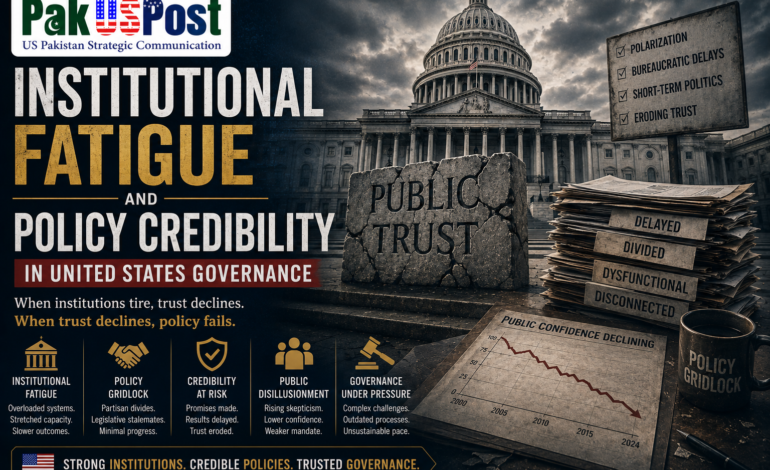
The United States enters the middle of the decade with an increasingly visible strain between its external expectations and internal administrative capacity. The tension is not episodic, nor can it be reduced to electoral cycles or temporary partisan deadlock. It reflects a deeper structural condition in which the machinery of governance, once characterized by procedural resilience and predictable coordination, is now marked by uneven execution, fragmented authority, and recurrent delays in policy consolidation. For external observers, particularly in South Asia and within Pakistan’s policy establishment, this condition is not merely a domestic American concern; it is a variable that shapes the credibility, timing, and durability of U.S. commitments abroad.
At the core of this condition lies a transformation in the nature of institutional coherence. The federal architecture of the United States, historically designed to balance power while preserving functional continuity, now exhibits signs of what analysts increasingly describe as administrative diffusion. Authority is dispersed across agencies that often operate with overlapping mandates, while inter-agency coordination mechanisms struggle to maintain synchrony in policy implementation. This is further complicated by heightened judicial intervention in policy domains that were previously considered administrative in nature, creating a multi-layered governance environment in which decision-making is continuously negotiated rather than decisively executed.
The legislative branch, meanwhile, operates under conditions of intensified polarization that extend beyond ideological disagreement into procedural obstruction. The consequence is not simply slower lawmaking, but a redefinition of policy temporality itself. Fiscal packages, regulatory reforms, and foreign policy authorizations are increasingly subject to protracted negotiation cycles, during which external commitments may be announced but remain operationally incomplete for extended periods. For partner states and allied governments, this creates a structural ambiguity: commitments made in Washington do not always translate into immediately executable policy instruments.
This divergence between announcement and implementation has particular relevance for foreign policy credibility. In previous decades, the United States was often perceived as a system capable of aligning executive intent with bureaucratic execution in relatively short timeframes. That perception is now increasingly moderated by the recognition that domestic institutional friction can delay, dilute, or reconfigure external policy objectives after they are publicly articulated. The result is a more cautious international reception of U.S. initiatives, especially in regions where policy predictability is considered essential for strategic planning.
In the South Asian context, and particularly from the vantage point of Pakistan’s strategic community, this evolving dynamic introduces a recalibration of expectations. Bilateral engagement frameworks that were once structured around assumptions of U.S. policy continuity are now being reassessed through the lens of domestic American volatility. Aid flows, security cooperation mechanisms, and regulatory coordination channels are no longer interpreted as linear instruments but as contingent processes subject to domestic recalibration in Washington.
One of the most significant dimensions of institutional fatigue is the increasing complexity of fiscal governance. Debt ceiling negotiations, budgetary standoffs, and appropriations delays have become recurrent features of the U.S. policy cycle. While these mechanisms are constitutionally embedded, their repeated activation as points of political contestation has introduced uncertainty into federal spending patterns. For external partners, this translates into unpredictability in program funding, development assistance timelines, and multilateral contribution schedules.
At the administrative level, federal agencies face their own set of constraints. Workforce attrition in specialized technical domains, combined with difficulties in recruitment and retention, has reduced institutional bandwidth in certain policy areas. Regulatory agencies tasked with overseeing emerging technologies, financial systems, and infrastructure modernization often operate under conditions of resource asymmetry relative to the complexity of their mandates. This gap between responsibility and capacity contributes to implementation lag, where policy design outpaces execution capability.
Judicialization of policy further complicates the landscape. Courts are increasingly called upon to adjudicate disputes that intersect with administrative authority, effectively transforming elements of governance into prolonged legal processes. While judicial review remains a foundational feature of American constitutional structure, its expanded reach into regulatory and executive domains has introduced additional layers of procedural delay. For external observers, this creates an environment in which policy outcomes are not solely determined by executive intent or legislative approval, but also by litigation trajectories that can extend over years.
The implications for technological governance are particularly pronounced. Artificial intelligence regulation, digital platform oversight, and data governance frameworks are all areas in which the United States seeks to maintain global leadership. Yet domestic institutional fragmentation slows the development of unified regulatory regimes, creating gaps between policy ambition and operational coherence. This has consequences not only for domestic innovation ecosystems but also for international regulatory alignment, where partner states often look to Washington for normative guidance.
For Pakistan, these developments carry both strategic and operational implications. On a strategic level, reliance on U.S. policy predictability as a stabilizing variable in foreign policy planning becomes increasingly untenable. This does not imply disengagement, but rather a shift toward adaptive engagement strategies that account for variability in implementation timelines. On an operational level, institutions engaged in bilateral cooperation must develop internal mechanisms capable of absorbing delays, recalibrating expectations, and maintaining continuity in the absence of immediate external alignment.
The broader question concerns how institutional fatigue affects global perceptions of American reliability. It is not that the United States lacks capacity or resources; rather, the coordination of those resources has become more contested and less linear. This distinction is critical, as it suggests that the issue is not decline in absolute terms, but rather a transformation in governance velocity and coherence. For external actors, this requires a shift from assumption-based engagement to scenario-based planning.
Within Washington, there is growing recognition of these challenges, although consensus on remedies remains limited. Proposals for institutional reform often encounter structural constraints, as any attempt to streamline governance must navigate constitutional boundaries, political incentives, and entrenched bureaucratic interests. Consequently, reform discourse tends to focus on incremental adjustments rather than systemic redesign, which in turn limits the scale of potential improvement.
From a policy perspective, one of the more viable pathways involves enhancing inter-agency coordination through formalized integration mechanisms that reduce duplication and improve execution alignment. Similarly, investment in administrative capacity, particularly in technical and regulatory domains, could mitigate some of the existing implementation gaps. However, such measures require sustained political commitment that is itself subject to the same institutional pressures they seek to address.
For external partners such as Pakistan, adaptation becomes the operative principle. This involves diversifying diplomatic channels, strengthening multilateral engagement frameworks, and reducing overdependence on single-vector policy expectations. It also requires a more sophisticated reading of U.S. domestic politics as a determinant of foreign policy behavior, rather than treating it as an external variable separate from strategic calculation.
Ultimately, institutional fatigue in the United States is not a terminal condition but a transitional one. It reflects the strain of governing an increasingly complex society through institutional frameworks designed for a different historical moment. The challenge is whether these frameworks can evolve without losing their coherence. For the international system, and for South Asian policymakers in particular, the answer to this question will shape not only bilateral relations with Washington, but also the broader architecture of global policy coordination in an era where internal governance capacity has become a key determinant of external credibility.
A Public Service Message