India Variable and the Structural Limits of Pakistan United States Engagement

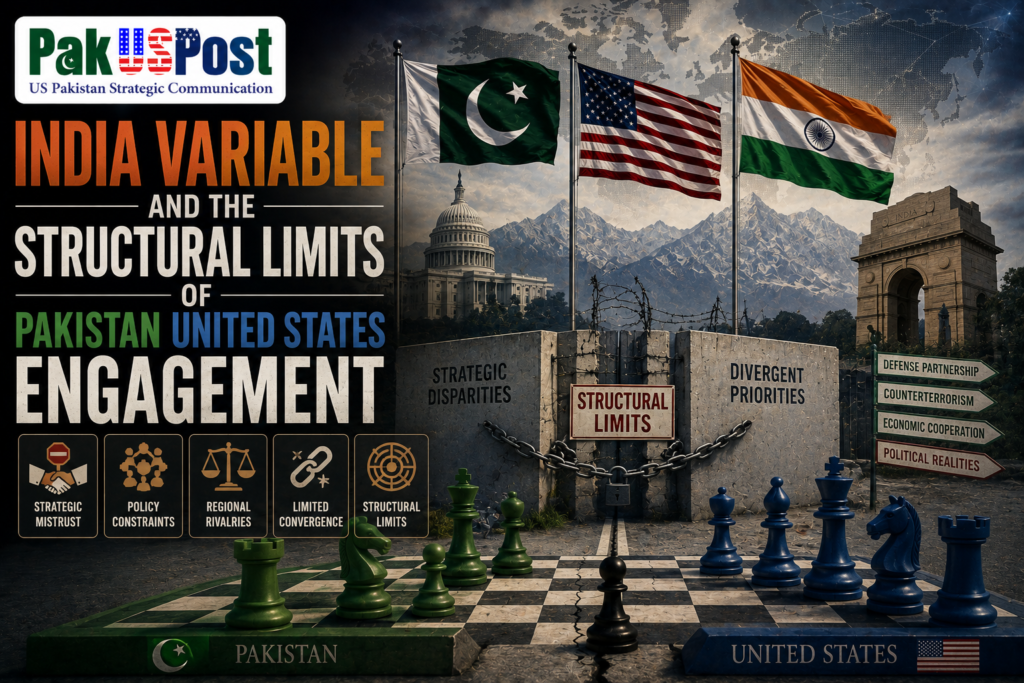
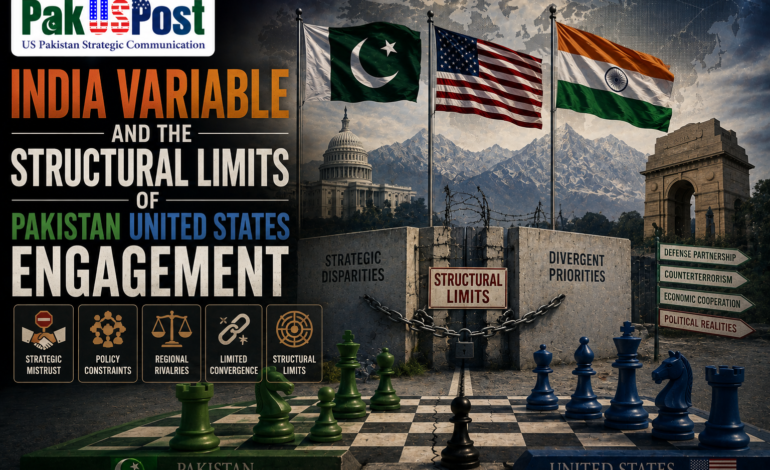
The evolution of Pakistan United States relations is often narrated through a bilateral lens that overemphasises episodic cooperation and underestimates structural geometry. The relationship is increasingly shaped by a third variable that is neither fully acknowledged in diplomatic rhetoric nor entirely absent from strategic calculus: India. This variable is not simply a competing partner of the United States; it is now a central organising axis of Washington’s Indo Pacific framework. As a result, Pakistan’s engagement with the United States is no longer determined solely by its own diplomatic performance, but by its position within a wider regional architecture that privileges scale, technological integration, and long-term strategic convergence.
This shift has not been formally codified in any single policy document, yet it is visible across defence cooperation patterns, technology transfer regimes, investment flows, and strategic signalling. The United States increasingly views South Asia not as a balanced bilateral triangle but as a hierarchical strategic landscape in which India occupies the role of primary partner, while Pakistan is positioned as a conditional interlocutor, relevant in specific functional domains such as counterterrorism, crisis de-escalation , and regional stability management. This asymmetry is not accidental; it is structural.
The implications for Pakistan are profound. The traditional assumption that Islamabad can expand its policy space with Washington through improved diplomatic competence, economic reform, or selective strategic alignment is no longer sufficient on its own. Competence matters, but it operates within constraints defined by Washington’s long term strategic investment in India’s rise as a counterweight to China. In this configuration, Pakistan is not excluded, but it is deprioritised in comparative terms. The ceiling of engagement is therefore externally determined before it is domestically negotiated.
To understand this dynamic, one must distinguish between two layers of United States foreign policy in South Asia. The first is transactional and crisis driven. This includes counterterrorism cooperation, intelligence sharing, financial stabilisation efforts, and episodic diplomatic interventions during India Pakistan tensions. The second is structural and forward looking. This includes defence industrial collaboration, advanced technology ecosystems, supply chain integration, and Indo Pacific maritime strategy. Pakistan remains intermittently relevant in the first layer, but is largely peripheral to the second.
The divergence between these two layers produces a persistent asymmetry in expectations. Pakistan often engages Washington with reference to immediate strategic concerns, including security guarantees, crisis mediation, or economic relief. The United States, however, increasingly responds through the lens of long-term regional architecture in which India is the primary anchor. This mismatch generates periodic frustration on both sides, but it is not easily resolvable through diplomatic recalibration alone.
The India variable operates not only as an external constraint but also as a filter through which Pakistan’s requests are evaluated. For example, proposals for advanced technology access, defence cooperation expansion, or sensitive infrastructure investment are assessed not in isolation but in relation to their potential impact on United States India strategic convergence. Even commercially framed engagements are subject to latent strategic screening if they intersect with domains where India is positioned as a key partner.
Telecommunications is one such domain. As India becomes a major hub for global digital manufacturing and software services, the United States is increasingly sensitive to the integrity of digital ecosystems across South Asia. Pakistan’s telecommunications infrastructure, vendor choices, and data governance frameworks are therefore not evaluated purely on technical grounds but also on interoperability and trust considerations within a broader Indo Pacific digital architecture. This does not imply exclusion, but it does imply conditional inclusion.
Another domain is defence cooperation. While Pakistan retains relevance in conventional military diplomacy, particularly in counterterrorism and regional stability contexts, the scale and depth of United States defence engagement with India have fundamentally altered comparative baselines. India is now embedded in advanced co development initiatives, intelligence sharing frameworks, and defence industrial partnerships that extend far beyond traditional arms sales. In this context, Pakistan’s defence relationship with Washington is structurally capped by design, not by episodic policy disagreement.
The technology sector further illustrates this asymmetry. As the United States seeks to build resilient supply chains in semiconductors, artificial intelligence, and critical software infrastructure, India is increasingly positioned as a trusted node in this ecosystem. Pakistan, lacking comparable scale and integration, is not part of this strategic architecture. This absence is not necessarily punitive; it is structural. However, it has second order effects on investment flows, innovation partnerships, and digital regulatory alignment.
Water security, border stability, and regional crisis dynamics constitute a different category of interaction. Paradoxically, these areas preserve Pakistan’s relevance despite structural asymmetry. The persistent risk of escalation between India and Pakistan ensures that Washington retains a baseline level of strategic attentiveness toward Islamabad. This attentiveness is not equivalent to partnership, but it functions as a stabilising mechanism. In moments of heightened tension, Pakistan’s geopolitical weight increases temporarily, not because of its structural position, but because of systemic risk.
However, reliance on crisis driven relevance is inherently unstable. It produces episodic engagement rather than sustained strategic integration. It also reinforces a perception in Washington that Pakistan is primarily a crisis management actor rather than a developmental or technological partner. This perception limits the scope of long-term engagement and reinforces the India centric orientation of United States regional strategy.
The critical question, therefore, is whether Pakistan can expand its engagement with the United States beyond crisis utility into structural relevance. The answer depends on three interrelated factors: economic transformation, institutional credibility, and geopolitical predictability.
Economic transformation is the most decisive but also the most difficult variable. The United States engages deeply with economies that are integrated into global value chains, demonstrate regulatory predictability, and offer scale or strategic niche value. Pakistan’s current economic structure does not meet these thresholds. Without significant reform in export diversification, industrial upgrading, and investment climate stability, Pakistan will remain outside the core of United States economic engagement in the region.
Institutional credibility is equally important. Washington’s engagement model increasingly relies on trust in regulatory systems, contract enforcement, financial transparency, and policy consistency. In sectors such as fintech, digital infrastructure, and critical minerals, institutional predictability is as important as resource endowment. Weak institutional credibility amplifies the perception of risk, thereby limiting the depth of engagement even when economic opportunities exist.
Geopolitical predictability is the third variable. The United States values partners that can offer strategic consistency within broader regional frameworks. India’s perceived predictability in long term alignment with United States Indo Pacific objectives strengthens its position. Pakistan’s historical oscillation between competing external alignments, while understandable in terms of its strategic environment, contributes to perceptions of variability. This does not preclude engagement, but it constrains depth.
Yet it would be analytically incomplete to view Pakistan as structurally irrelevant. The India variable, while dominant, does not eliminate Pakistan’s strategic utility. Instead, it reshapes the conditions under which utility is recognised. Pakistan remains relevant in four specific domains: crisis de-escalation, counterterrorism intelligence, regional connectivity mediation, and nuclear risk management. These are not peripheral issues; they are core to regional stability. However, they do not translate into sustained economic or technological integration.
The paradox is that Pakistan’s most reliable leverage lies in domains that are inherently episodic. Crisis management produces visibility but not integration. Stability maintenance produces relevance but not partnership depth. This creates a structural asymmetry in which Pakistan is periodically central but persistently marginal in long term strategic planning.
From a policy perspective, the challenge is not to contest India’s centrality in United States strategy, which is structurally entrenched, but to identify niches of engagement that are not zero sum with India’s role. This requires a shift from competitive positioning to functional differentiation. Pakistan must identify sectors where its comparative advantage is not defined by scale or technology leadership, but by geography, connectivity potential, or crisis mediation capacity.
One such area is regional connectivity across Central Asia and the Arabian Sea corridor. Another is climate vulnerability and water security governance, which is increasingly relevant to global environmental diplomacy. A third is selective cooperation in financial stabilisation frameworks, where Pakistan’s macroeconomic challenges intersect with international financial institutions in ways that require external engagement. These areas do not replace structural asymmetry, but they can expand the perimeter of relevance.
Ultimately, the India variable does not close the door to Pakistan United States engagement, but it narrows and reframes it. The relationship is no longer defined by bilateral potential alone, but by Pakistan’s position within a broader strategic system that privileges scale, technological integration, and long-term predictability.
The future of Pakistan United States relations will therefore depend less on diplomatic improvisation and more on structural adaptation. Pakistan can still widen its policy space, but not by attempting to replicate India’s role or compete within its designated domain. Instead, it must redefine the terms of relevance in ways that are compatible with an asymmetrical regional order. In such an environment, survival of engagement will depend not on parity, but on precision.
A Public Service Message