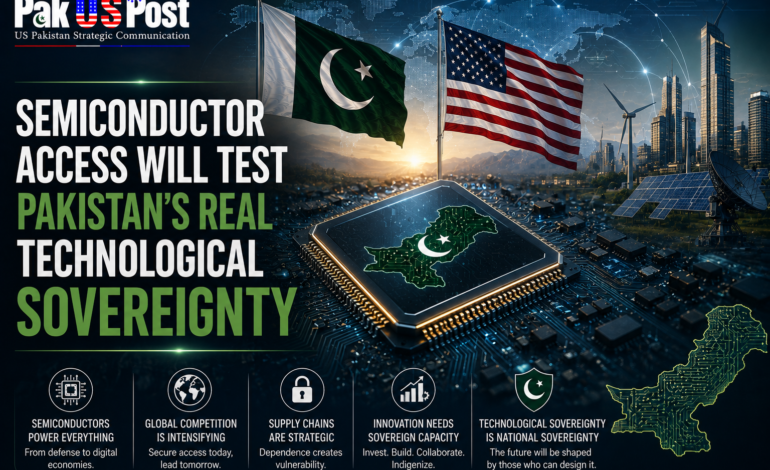
Semiconductor Access Will Test Pakistan’s Real Technological Sovereignty

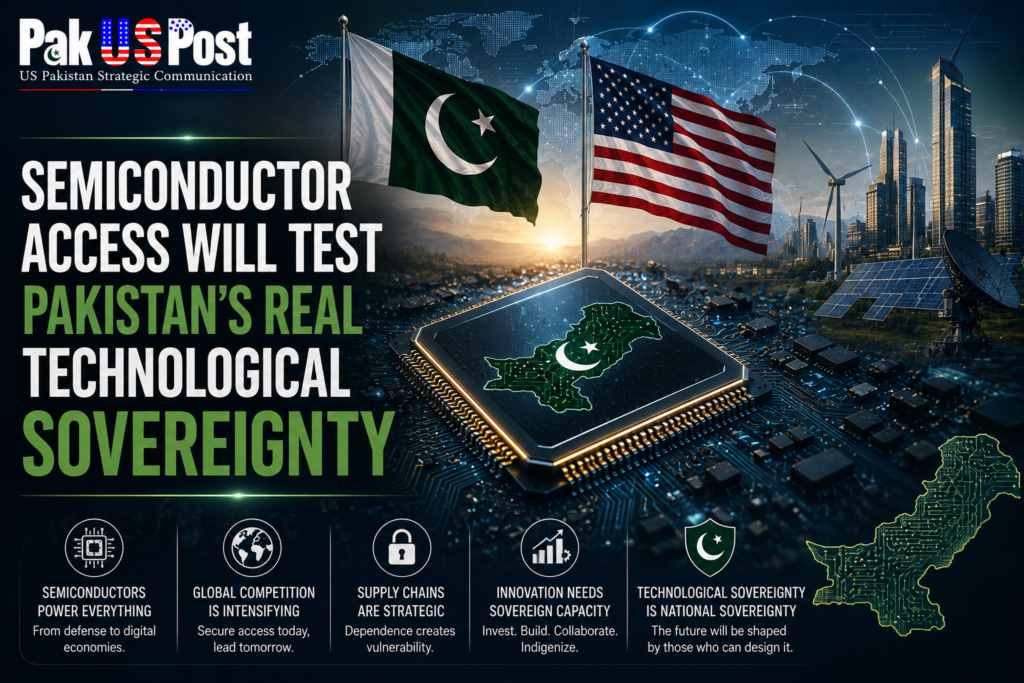
Pak US Post enters the semiconductor question at an uncomfortable juncture: Pakistan wants deeper access to American advanced technology while possessing only a modest domestic ecosystem capable of absorbing, securing, adapting and ultimately reproducing sophisticated technological capabilities. The emerging American technology control environment is not merely an export licensing regime. It is an architecture of strategic trust, supply chain assurance, research security, computational access, end use verification and institutional credibility. For Islamabad, the central challenge is therefore not how to obtain more chips, servers or artificial intelligence accelerators. It is whether the state can demonstrate that Pakistani institutions, universities, companies and laboratories constitute a sufficiently reliable environment for sensitive technology to enter without diversion, unauthorised re export, intellectual property leakage or strategic misuse.
Washington increasingly differentiates between commercial customers and trusted technological partners. That distinction matters. Semiconductors, advanced computing systems, cybersecurity equipment, cloud platforms and artificial intelligence hardware have become embedded in national security calculations, making access increasingly conditional upon provenance, destination, end use and the institutional identity of the recipient. Pakistan cannot assume that historical security cooperation automatically translates into preferential technology access. Nor should it frame American controls simply as an external impediment. The more consequential interpretation is that export controls expose weaknesses that Pakistan has postponed addressing: fragmented regulatory authority, inadequate technology classification, weak laboratory security, insufficient corporate compliance, limited semiconductor design capability, uneven cyber hygiene and a shortage of specialists capable of operating at the intersection of engineering, law and national security.
A credible Pakistan US technology relationship therefore requires a shift from procurement diplomacy to capability diplomacy. Government ministries should stop treating advanced technology as an import category and begin managing it as a national capability portfolio. A federal technology access cell, jointly supervised by the relevant ministries responsible for information technology, commerce, science, defence and foreign affairs, should maintain a classified register of technologies subject to elevated American controls and map each category against Pakistani institutions capable of receiving them. The register should distinguish ordinary commercial computing equipment from high performance computing, advanced graphics processors, artificial intelligence accelerators, semiconductor manufacturing equipment, electronic design automation software, cryptographic systems, cybersecurity platforms and cloud services with sensitive computational applications. Such classification would allow Islamabad to negotiate from evidence rather than diplomatic assertion.
Pakistan’s most realistic entry point is unlikely to be frontier semiconductor fabrication. Building an advanced fabrication plant requires enormous capital, specialised chemicals, ultra clean manufacturing environments, sophisticated equipment, uninterrupted power and water, intellectual property arrangements and a mature supplier network. A more credible strategy would begin further upstream and downstream, particularly semiconductor design, embedded systems, chip verification, testing, packaging, electronic design automation, industrial electronics and application specific integrated circuits. These segments offer opportunities for Pakistani engineers without requiring the country immediately to replicate the capital intensity of the world’s most advanced foundries.
Universities should consequently be treated as strategic technology institutions rather than simply suppliers of graduates. A Pakistan US semiconductor partnership should establish designated university laboratories operating under formal research security protocols. Access to restricted equipment, datasets, source code and advanced computing resources should be identity based, logged and periodically audited. Researchers working on sensitive projects should receive training in intellectual property protection, export compliance, cybersecurity, controlled information and responsible disclosure. Laboratory access should not depend exclusively on personal trust or departmental custom. It should be governed by auditable institutional procedures.
American technology companies would also need a clearer Pakistani counterpart. Islamabad should establish accredited technology receiving institutions rather than allowing every university, public body or private company to negotiate independently for sophisticated equipment. Accreditation could be based on five measurable conditions: cybersecurity maturity, financial and beneficial ownership transparency, end use controls, physical security and personnel reliability. An institution meeting those requirements could receive a government issued technology assurance certificate, renewable annually and subject to independent inspection. Such a mechanism would give American firms a verifiable basis for assessing Pakistani partners.
This matters because trusted supply chains are increasingly constructed through documentation. Pakistan needs a national technology provenance system capable of answering basic questions that international suppliers increasingly regard as indispensable. Who ordered the equipment? Who financed it? Where will it be installed? Which individuals can access it? What software will operate it? Can it be transferred to another institution? Who owns the resulting intellectual property? What happens when the project ends? Which authority investigates a suspected diversion? At present, these questions may be distributed across several institutions with no single operational chain of accountability. That fragmentation is itself a technology risk.
The same logic applies to cloud infrastructure. Pakistan’s digital expansion cannot rely on the assumption that cloud capacity is technologically neutral. Advanced cloud environments can provide computational capabilities that are difficult to distinguish from strategic infrastructure. Government agencies and universities should therefore establish a tiered cloud classification system separating ordinary administrative workloads, sensitive public data, regulated research and national security related computing. Procurement rules should require information about data location, administrator privileges, encryption architecture, incident reporting, subcontractors and jurisdictional exposure. American cloud companies would then encounter a Pakistani regulatory environment capable of articulating precisely what protections are expected rather than receiving vague assurances about data security.
Cybersecurity equipment presents an equally delicate problem. Pakistan needs access to sophisticated defensive technologies, but imported cybersecurity platforms can create dependencies of their own. Government agencies should maintain a technology dependency register identifying which critical systems depend upon foreign vendors, proprietary software, foreign update mechanisms or externally controlled cryptographic components. Contracts for strategically important systems should contain provisions for source code escrow where commercially feasible, independent security testing, vulnerability disclosure, continuity of service and emergency replacement. Procurement should be evaluated not merely by acquisition price but by the consequences of vendor withdrawal.
The workforce problem is more fundamental. Pakistan has a large population of technically educated young people, but advanced technology ecosystems require specialised competence rather than aggregate graduate numbers. A national Pakistan US advanced technology fellowship should therefore finance intensive training in semiconductor design, chip verification, hardware security, photonics, advanced packaging, artificial intelligence infrastructure, quantum resistant cryptography, semiconductor supply chain management and technology export compliance. American universities and companies could participate through joint laboratories, visiting faculty arrangements and industrial residencies. Pakistani fellows should be required to return into designated domestic institutions, ensuring that public investment produces institutional rather than purely individual capacity.
Research security deserves particular attention because it is often treated as synonymous with secrecy. It is not. A functioning research security regime protects intellectual property, prevents unauthorised technology transfer, manages conflicts of interest and preserves legitimate scientific openness. Pakistan should establish institutional research security offices in universities participating in strategically sensitive American programmes. These offices would maintain project risk registers, conduct personnel access reviews, verify external collaborations and coordinate disclosure obligations. Their purpose should be to protect scientific cooperation from suspicion, not to convert universities into security bureaucracies.
Washington, for its part, has an interest in avoiding a policy that leaves Pakistan permanently dependent on lower technology tiers. A rigid access regime could unintentionally strengthen precisely the technological vulnerabilities that create proliferation, cybersecurity and supply chain concerns. The United States should therefore consider a graduated technology partnership framework for Pakistan based on demonstrable institutional performance. Access should expand when Pakistan meets defined compliance benchmarks rather than merely following political cycles. Pilot projects could begin with semiconductor design education, secure computing, cybersecurity research, disaster modelling and industrial automation before progressing toward more sensitive computational infrastructure.
Such an arrangement would be more sustainable than requests for blanket exemptions. Pakistan should not ask Washington to overlook controls. It should ask for a transparent pathway through which compliance generates greater technological opportunity. That distinction would also improve the credibility of Pakistani diplomacy. A technology relationship based on exceptions is inherently fragile; one based on verifiable institutional competence can survive changes in administration, strategic priorities and commercial conditions.
The government should establish a Pakistan US Technology Readiness Index covering institutional, technical, regulatory and commercial preparedness. Each prospective recipient institution could be assessed against measurable indicators including cybersecurity certification, percentage of systems subject to independent audit, trained export control personnel, documented equipment inventories, research security procedures, incident response time, intellectual property protection, qualified semiconductor engineers, domestic research expenditure and the proportion of critical technology components for which alternative suppliers exist. The index should not become another ceremonial ranking exercise. It should determine eligibility for specific categories of American technology.
A parallel private sector accreditation programme is essential. Pakistani firms seeking advanced American technology should disclose beneficial ownership, ultimate end users, affiliated companies, foreign subsidiaries and intended applications. The government should maintain a confidential risk assessment mechanism capable of identifying shell companies, opaque intermediaries and unexplained procurement patterns without paralysing legitimate commerce. Financial intelligence, customs authorities, technology regulators and export control officials should share relevant risk indicators under a legally defined protocol. The objective would be targeted assurance, not indiscriminate surveillance of technology businesses.
Pakistan’s strategic institutions also need to recognise that technology sovereignty is not synonymous with autarky. No serious semiconductor economy produces every component domestically. Even leading technology powers depend upon international networks for equipment, intellectual property, materials, design software, packaging and specialised manufacturing. Sovereignty means possessing enough knowledge, redundancy, regulatory competence and bargaining capacity to avoid catastrophic dependence. For Pakistan, that means developing the ability to design chips, audit imported systems, secure computing infrastructure, protect intellectual property, negotiate technology licences and switch suppliers when strategic circumstances demand it.
The military and civilian technology ecosystems should also be connected without collapsing their institutional boundaries. Defence requirements can stimulate domestic competence in secure electronics, communications, sensors, embedded computing and autonomous systems, while civilian industry can provide scale and commercial discipline. A controlled dual use technology framework could permit civilian companies and universities to work on approved technologies while establishing clear restrictions around sensitive applications. This would be preferable to maintaining parallel ecosystems in which military requirements remain insulated from the industrial and academic capacities needed to sustain them.
Parliamentary and civilian oversight should accompany the architecture. Sensitive technology agreements can legitimately contain classified elements, but their financial obligations, institutional responsibilities, compliance requirements and broad performance indicators should be subject to appropriate oversight. A classified annual technology access report could be submitted to designated parliamentary committees, while a public version would disclose aggregate investment, training, research partnerships, technology categories and measurable outcomes. This would reduce the recurring problem in Pakistan of strategic agreements being announced without an intelligible mechanism for evaluating implementation.
The Pakistan US relationship should ultimately be judged by what Pakistani institutions can do after American technology arrives. If imported processors remain dependent on foreign technicians, if research laboratories cannot meet basic security standards, if universities lack advanced semiconductor curricula, if regulators cannot identify controlled equipment and if companies cannot protect proprietary designs, then greater access merely enlarges consumption. It does not create sovereignty.
The more ambitious objective is an ecosystem in which American technology becomes catalytic rather than substitutive. Pakistan should seek joint design centres, engineering services, secure research facilities, advanced packaging ventures, industrial AI laboratories and workforce programmes capable of generating intellectual property inside the country. American firms should be encouraged to view Pakistan not simply as a market for hardware but as a potential engineering and innovation node, provided Pakistani institutions can meet internationally credible standards.
For Pak US Post, the strategic conclusion is therefore straightforward but demanding. Pakistan’s technological relationship with the United States will not be secured through diplomatic lobbying alone, nor through periodic purchases of expensive equipment. It will be earned through institutional competence that can be inspected, measured and trusted. Islamabad should establish technology accreditation, research security, export compliance, supply chain provenance, workforce certification and institutional audit as components of one national framework. Washington should reciprocate with a graduated access mechanism linked to demonstrated compliance and genuine capacity building.
The decisive contest is not over who owns the fastest processor. It is over who possesses the institutional machinery capable of turning advanced computation into durable national capability. Pakistan cannot control every node of the global semiconductor system, and it need not try. It can, however, become sufficiently competent to design, secure, regulate, absorb and strategically deploy the technologies on which its economic and national security future increasingly depends. That is the point at which technology access ceases to be consumption and becomes sovereignty.
A Public Service Message