
The Pakistan US Narrative War Is Now a Security Issue

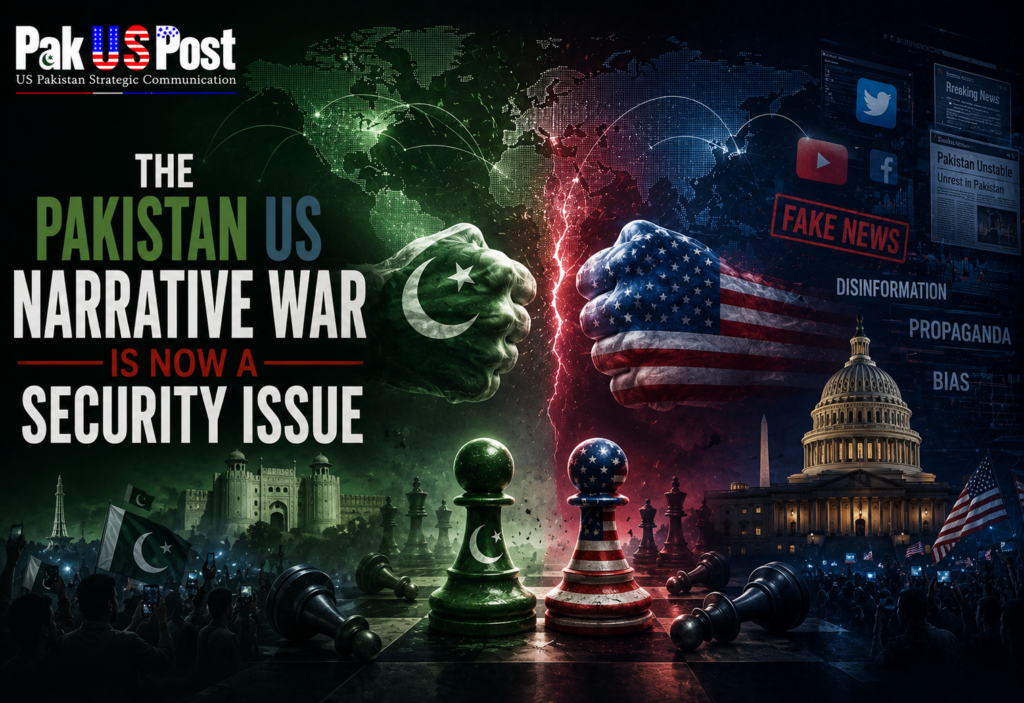
PAK US POST examines an increasingly consequential theatre of bilateral competition: the digital information environment in which Pakistan US relations are interpreted, contested and politically weaponised. The strategic problem is no longer confined to propaganda in its conventional sense. It concerns the architecture through which millions of citizens encounter fragments of diplomacy, military cooperation, economic negotiations, sanctions, visas, counterterrorism operations and official statements, frequently without knowing who selected the material, altered its context, or determined its distribution. In this environment, an obscure diplomatic exchange can acquire greater political salience than a negotiated agreement, while an authentic statement can be rendered indistinguishable from fabricated material. For Pakistan, the resulting vulnerability is not principally reputational. It is institutional. A state whose citizens cannot reliably distinguish verified information from engineered interpretation becomes less capable of sustaining coherent foreign policy during moments of strategic pressure.
Pakistan US relations are particularly susceptible to this phenomenon because they possess an unusually dense archive of contradictory political memories. The relationship has alternated between security cooperation and strategic estrangement, economic engagement and coercive pressure, intelligence collaboration and public suspicion. Each phase has generated documentary material capable of being repurposed for contemporary political narratives. A decade old television interview can be presented as evidence of current policy. A photograph from a military exercise can be circulated as proof of political subordination. A congressional statement can be detached from its legislative context and portrayed as an official American threat. Conversely, a diplomatic concession may be exaggerated as evidence of an entirely transformed relationship. The factual age of the material becomes almost irrelevant once algorithms discover that the emotional interpretation attracts sustained engagement.
This is where the information environment departs from the traditional model of public diplomacy. Earlier communication systems were characterised by identifiable publishers, editorial hierarchies and relatively observable distribution channels. Digital platforms have substituted a more opaque mechanism. TikTok rewards retention, YouTube optimises recommendation chains, X accelerates controversy, Facebook aggregates communities, podcasts cultivate parasocial authority, television clips migrate across platforms, while closed messaging networks permit narratives to circulate beyond conventional verification. The same piece of material can therefore pass through several informational ecosystems, acquiring additional captions, interpretations and insinuations at every stage. What begins as an authentic diplomatic statement may eventually appear as a synthetic political artefact whose original provenance is no longer visible.
The strategic implication is significant. Algorithms do not need to manufacture falsehoods themselves to manufacture strategic public opinion. They need only identify material that generates disproportionate emotional engagement and repeatedly expose audiences to it. A relatively marginal interpretation can therefore become socially dominant through repetition. This produces a distinction policymakers should take seriously: popularity is not evidence, virality is not consensus, and digital visibility is not public legitimacy. Yet governments, political parties, media organisations and even security institutions can become tempted to treat online volume as an empirical measure of national sentiment. That creates a feedback loop in which artificial amplification influences elite perceptions, elite perceptions influence policy communication, and policy communication subsequently generates additional material for algorithmic amplification.
The Pakistan US narrative contest is structured around several durable frames. The interference frame interprets American diplomatic activity through sovereignty and external manipulation. The strategic partnership frame emphasises counterterrorism, regional stability, defence cooperation and institutional engagement. The sovereignty frame treats foreign assistance, military access and diplomatic pressure as tests of Pakistan’s autonomous decision making. The dependency frame focuses on historical reliance upon American security and financial architecture. The economic opportunity frame emphasises trade, investment, technology and access to American markets. The anti American frame compresses multiple disagreements into a broader rejection of Washington. The counterterrorism frame interprets bilateral cooperation primarily through security requirements. The diplomatic success frame, meanwhile, can convert routine meetings into declarations of strategic breakthrough.
None of these frames is inherently illegitimate. Democratic societies require competing interpretations of foreign policy. The danger emerges when a frame becomes detached from evidence and is systematically reinforced through coordinated manipulation. An authentic disagreement can be converted into a false crisis. A routine diplomatic communication can be transformed into evidence of humiliation. A policy adjustment can be represented as capitulation. Equally, genuine strategic risks can be concealed beneath triumphalist narratives. Information integrity therefore cannot mean suppressing criticism of the United States, protecting American diplomatic messaging, or instructing Pakistani citizens what conclusion to reach. Its legitimate objective should be narrower and more defensible: preserving the evidentiary conditions under which citizens, journalists, parliamentarians and policymakers can distinguish fact from fabrication.
This requires Pakistan to reconsider the institutional treatment of digital information. At present, information verification is frequently approached as a communications problem, delegated to public relations machinery after a misleading narrative has already acquired momentum. That is too late. Strategic misinformation should be treated as an early warning problem. The relevant question is not merely whether a viral claim is false. It is whether its circulation indicates coordinated manipulation, exploitation of a known societal fault line, foreign influence activity, domestic political mobilisation, criminal impersonation or spontaneous public distrust. These are materially different phenomena and require different responses.
A Pakistan US Information Integrity Cell should therefore be established through an interagency mechanism with a clearly defined civilian mandate and parliamentary reporting architecture. Its function should not be political messaging. It should establish a common evidentiary picture. Representatives from foreign affairs, information, interior, information technology, relevant regulatory bodies, cyber institutions and designated analytical units should operate against a standardised taxonomy covering manipulated media, synthetic content, impersonation, coordinated inauthentic behaviour, recycled footage, context laundering, selective quotation and fabricated official documents. The cell should maintain a continuously updated incident register, recording the original claim, first known source, dissemination pattern, linguistic variants, verification status, affected institutions and corrective action.
The distinction between monitoring and intervention is essential. Intelligence and security agencies may have legitimate reasons to identify coordinated influence operations, particularly when foreign actors attempt to manipulate strategic decision making. But a domestic information integrity system cannot become an instrument for suppressing political disagreement. Operational separation should therefore be built into the architecture. Analytical units should identify and assess information threats. Independent verification bodies should establish factual findings. Relevant regulators should determine whether platform rules or laws have been breached. Political authorities should not be permitted to retrospectively define inconvenient criticism as disinformation.
Pakistan also requires a multilingual verification infrastructure because information manipulation rarely respects linguistic boundaries. A claim may originate in English, acquire political significance in Urdu, develop a more emotive version in Punjabi, and circulate through Pashto, Sindhi or other linguistic communities. Verification that exists only in English therefore produces an incomplete national picture. A central verification service should publish concise evidence cards in major Pakistani languages, identifying what is known, what remains uncertain, what material has been manipulated and where the original evidence can be examined. The objective should be speed without sacrificing provenance. A correction issued forty eight hours after a fabricated video has reached millions may be factually accurate yet strategically ineffective.
Newsrooms have an equally important responsibility. Pakistani television channels frequently broadcast social media material before establishing its provenance, after which the clip enters the television ecosystem and returns to digital platforms carrying the authority of a mainstream news organisation. This circularity creates an artificial validation mechanism. A newsroom protocol for Pakistan US coverage should therefore require provenance checks before broadcasting viral diplomatic or military content, particularly when the material involves senior officials, armed forces, intelligence matters, national security incidents or allegations of foreign interference. Every visual should have an identifiable source, date and contextual description where reasonably available. Anonymous material should not receive institutional credibility merely because it is already trending.
The United States should be approached through the same evidentiary standard. Pakistan cannot demand information integrity domestically while accepting every American official statement as self authenticating. Washington’s public communications, congressional commentary, military statements and think tank assessments should be distinguished according to institutional authority and policy relevance. American officials can disagree with one another. Congressional statements are not necessarily executive policy. A think tank report is not government doctrine. A television commentator is not an official source. Establishing these distinctions would reduce the tendency of Pakistani discourse to treat the enormous American policy ecosystem as a single strategic actor.
Platform cooperation should consequently become a defined component of bilateral diplomacy. Pakistan should seek formal channels with major technology companies for rapid authentication of official accounts, preservation of evidentiary material associated with major influence incidents, notification concerning impersonation of Pakistani or American public officials, and accelerated review of demonstrably manipulated media during acute national security events. Such cooperation should remain governed by transparent legal procedures rather than informal political requests. The state should not demand removal merely because material is embarrassing or critical. Its requests should be evidence based, reviewable and confined to established violations or demonstrable manipulation.
The problem of synthetic media makes this architecture more urgent. Generative artificial intelligence has lowered the technical threshold for producing convincing audio, video and visual fabrications. A fabricated speech by a Pakistani official, an altered American diplomatic statement or an AI generated recording purporting to reveal a confidential conversation can now circulate before conventional journalists have time to establish authenticity. Verification must therefore move upstream. Public institutions should maintain cryptographically verifiable repositories of official speeches, press conferences, diplomatic statements and high value audiovisual material. Where technically feasible, provenance metadata should accompany original government content. This would not make forgery impossible, but it would establish a stronger evidentiary baseline against which suspicious material could be tested.
The diplomatic corps should also receive specialised information integrity training. Pakistani missions in Washington and other American locations should maintain an analytical distinction between hostile narrative activity, ordinary political criticism and legitimate media scrutiny. Embassy monitoring should identify emerging narratives before they become bilateral controversies, while avoiding the temptation to respond to every online provocation. The same discipline should apply to Washington’s diplomatic mission in Islamabad. Excessive reactive communication can inadvertently amplify narratives that would otherwise remain marginal. Strategic silence is sometimes more protective than an immediate rebuttal, particularly when engagement increases algorithmic visibility.
A bilateral information integrity protocol could institutionalise these practices. Islamabad and Washington should establish designated contact points for urgent verification during crises involving military incidents, terrorism allegations, sanctions, elections, diplomatic expulsions, cyber incidents or major policy announcements. The protocol should not create a joint censorship mechanism. It should provide a factual deconfliction channel. When fabricated material begins circulating, each government could rapidly establish whether an alleged statement, photograph, document or event is authentic. The result could then be communicated independently through each government’s established channels. This would reduce the possibility that a false claim acquires bilateral momentum simply because neither side can verify it quickly.
Parliamentary oversight should form another layer of legitimacy. Any national information integrity architecture touching foreign influence, platform cooperation or strategic communications requires defined legal boundaries. Parliamentary committees should receive periodic classified briefings on significant foreign influence incidents, institutional responses and platform engagement, while public reports should disclose aggregate trends without exposing sensitive investigative methods. Independent auditors could examine whether government agencies have used information integrity mechanisms to suppress lawful political speech. Such safeguards are not administrative decoration. They are necessary to prevent a system designed to protect democratic resilience from becoming a mechanism that weakens it.
The media sector needs comparable investment. Universities, journalism schools and professional associations should develop specialised curricula in audiovisual forensics, open source intelligence, algorithmic literacy, geolocation, reverse image analysis, synthetic media detection and source authentication. The training should move beyond conventional fact checking. Journalists increasingly need to understand how information travels, not merely whether a statement is factually correct. A misleading narrative can consist entirely of individually authentic materials arranged to produce a false inference. Strategic verification must therefore examine sequencing, omission, provenance and distribution behaviour.
Pakistan should also build a public digital literacy programme that treats citizens as participants in national resilience rather than passive recipients of government messaging. A short verification protocol could teach users to identify the original source, check publication date, compare independent reporting, inspect whether an official account actually issued the statement, distinguish edited footage from complete footage and treat emotionally incendiary claims with additional caution. Such education should explicitly protect the right to disagreement. The purpose is not to create obedient audiences. It is to create audiences less vulnerable to manipulation.
The economic dimension should not be neglected. Persistent narrative instability affects investor perceptions, technology partnerships and diplomatic confidence. A fabricated security incident can trigger international headlines before a company has assessed its authenticity. A synthetic video alleging unrest can influence risk calculations among insurers, banks and multinational corporations. Information integrity therefore belongs within the broader national investment environment. Pakistan’s digital credibility should be treated as an economic asset, alongside cyber resilience, regulatory predictability and institutional transparency.
The most difficult challenge, however, is institutional trust. Citizens who distrust state institutions will not automatically accept government corrections, even when those corrections are accurate. This is why credibility cannot be manufactured through louder official messaging. Verification must be demonstrably independent, procedurally consistent and willing to correct the state itself. If a Pakistani ministry circulates an inaccurate statistic, the same verification architecture should be capable of identifying it. If an American official statement is misleading, it should be described accurately without political embellishment. If a viral anti American claim is true, it should remain true regardless of its political implications. Information integrity becomes credible only when evidence outranks convenience.
The strategic objective should therefore be resilience, not narrative victory. Pakistan does not need to win every online argument with Washington, nor should it attempt to construct a uniformly favourable digital image of the relationship. Such an ambition would be both unrealistic and strategically counterproductive. A mature state should instead seek an information environment in which fabricated material is difficult to scale, authentic evidence remains traceable, competing interpretations can coexist, and institutions possess the capacity to correct consequential falsehoods before they harden into political assumptions.
For the PAK US POST perspective, this is ultimately a question of state capacity. The next generation of Pakistan US disputes will not necessarily begin with diplomatic notes or press conferences. They may begin with twelve seconds of manipulated video, an anonymous account, a selectively edited quotation or an algorithmically amplified interpretation that acquires millions of views before officials recognise its significance. The country that can establish provenance faster, distinguish coordination from coincidence, communicate uncertainty honestly and correct falsehood without appearing politically threatened will possess an important strategic advantage.
Information credibility should consequently be incorporated into Pakistan’s national resilience doctrine, bilateral diplomatic planning and crisis management architecture. The institutional test is straightforward. When a politically explosive claim appears online at midnight, can Pakistan determine its origin before dawn? Can its journalists authenticate the evidence without waiting for a ministerial instruction? Can its diplomats explain the factual position to Washington? Can its regulators act within law? Can parliamentarians later determine whether the response was proportionate? And can the public distinguish an official correction from another competing narrative?
If the answer is yes, digital manipulation becomes a manageable strategic hazard. If the answer is no, every future Pakistan US crisis will carry an additional battlefield whose contours are defined not by armies or diplomats, but by recommendation engines, synthetic media and accumulated distrust. The decisive contest will therefore not be over who controls the loudest narrative. It will be over who can preserve the credibility of evidence when the information environment is designed to make certainty increasingly difficult.
A Public Service Message