

War, Windfalls, and the Rewiring of Global Trade: Who Really Gains from the US–Israel–Iran Conflict

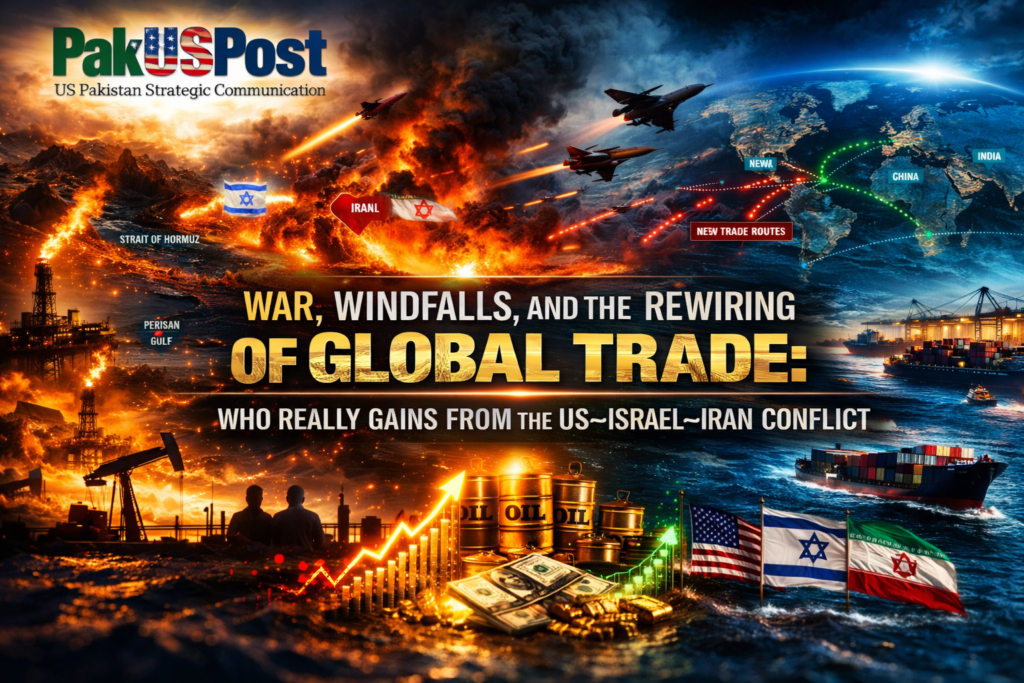
The outbreak of the US–Israel–Iran conflict on 28 February has been framed, quite rightly, as a humanitarian and geopolitical crisis of immense proportions, yet beneath the surface of destruction and diplomatic tension, a quieter transformation is unfolding, one that is reshaping the architecture of global trade, redistributing economic advantage, and challenging long held assumptions about power, geography, and dependency. While missiles redraw frontlines and alliances harden into predictable blocs, the arteries of global commerce have been forced into sudden rerouting, and in that disruption lies an unexpected story of opportunity, particularly for parts of Africa that have historically remained peripheral to the dominant circuits of global trade.
The near paralysis of two of the world’s most critical maritime chokepoints, namely the Strait of Hormuz and the Red Sea, has triggered a cascading effect across shipping, energy markets, and logistics networks. These waterways have long functioned as indispensable conduits for oil, manufactured goods, and raw materials linking Asia, Europe, and beyond. Their disruption has not merely delayed shipments but has forced a structural reconsideration of routes that had previously been taken for granted as immutable. Shipping traffic dropping dramatically in these zones has compelled global carriers to seek alternative pathways, even when those alternatives are longer, costlier, and less efficient under normal conditions. Yet in the abnormality of war, inefficiency in one region becomes opportunity in another.
It is within this context that African economies, often described as marginal in global trade narratives, have found themselves thrust into newfound relevance. Countries such as Kenya, Ethiopia, and Nigeria are emerging as pivotal nodes in a rapidly reconfigured logistics ecosystem. This is not merely a matter of increased traffic but rather a revaluation of geographical positioning that had long been underestimated. Ports, airports, and energy facilities that were once underutilized or dismissed as overly ambitious investments are now operating at or beyond capacity, revealing the latent strategic potential embedded within the continent.
In Kenya, for instance, the transformation of Lamu Port from a symbol of infrastructural excess into a bustling hub illustrates how quickly global perceptions can shift under pressure. Its natural depth, previously a technical detail of limited commercial significance, has become a decisive advantage as ultra large vessels seek safer and more accommodating docking points away from volatile Gulf waters. This shift is not simply about volume increases but about the redefinition of maritime hierarchies, where secondary ports ascend into primary roles due to circumstances beyond their control yet within their capacity to exploit.
Similarly, Ethiopia’s aviation sector has seized the moment with remarkable agility. Ethiopian Airlines, already one of Africa’s most prominent carriers, has leveraged the disruption of Middle Eastern airspace to position Addis Ababa as a critical transit hub. As traditional aviation centers such as Dubai and Doha face operational constraints due to heightened security risks, cargo and passenger flows are being rerouted through safer corridors. This has enabled Ethiopia not only to capture immediate economic gains but also to strengthen its long term position within global aviation networks. The significance of this shift extends beyond revenue figures because it signals a redistribution of connectivity, which in the modern world is synonymous with influence.
Meanwhile, Nigeria’s fortunes have been shaped by the familiar yet potent dynamics of energy markets. The surge in oil prices, driven by uncertainty and supply disruptions linked to the conflict, has provided an unexpected fiscal cushion for a country that has often struggled with budgetary constraints. When benchmark prices are significantly exceeded, the resulting windfall creates opportunities for debt reduction, infrastructure investment, and social spending, although history cautions that such windfalls are not always managed prudently. Nevertheless, the immediate effect is unmistakable as Nigeria finds itself benefiting from a crisis that is simultaneously destabilizing other economies.
What is particularly noteworthy, however, is that these developments are not isolated incidents but interconnected elements of a broader systemic shift. The rerouting of maritime traffic around the Cape of Good Hope, for example, has revitalized ports in southern Africa, including Durban, which has managed to shed its reputation for inefficiency under the pressure of increased demand. This improvement is not merely operational but symbolic because it challenges entrenched narratives about African infrastructure being inherently incapable of meeting global standards. When necessity compels adaptation, latent capacities often become visible, and in this case, they have translated into measurable performance gains.
At the same time, countries such as Morocco and Namibia have capitalized on their geographical positioning to expand their roles within aviation and maritime support services. The expansion of routes by Royal Air Maroc and the increased bunkering activity at Walvis Bay reflect a diversification of opportunities that extends beyond traditional trade flows. These developments underscore the multifaceted nature of the current transformation, where benefits are distributed across sectors ranging from logistics and energy to aviation and services.
Yet to interpret these gains as purely opportunistic would be to overlook the deeper structural implications at play. The current moment raises fundamental questions about the resilience and adaptability of global trade systems. For decades, the concentration of logistical infrastructure in specific regions, particularly the Middle East, was seen as both efficient and inevitable. However, the vulnerability exposed by the conflict suggests that such concentration may be less sustainable than previously assumed. Diversification, once considered a strategic luxury, is rapidly becoming a necessity.
From a United States perspective, this evolving landscape presents both challenges and opportunities. On one hand, the disruption of traditional routes complicates supply chains and introduces new uncertainties into global markets, which can have domestic economic repercussions. On the other hand, the emergence of alternative hubs offers potential avenues for strategic engagement with regions that have historically received less attention within US foreign policy frameworks. The question, therefore, is not merely who benefits in the short term but how these benefits can be translated into long term partnerships and influence.
There is also a paradox embedded within this transformation. The conflict, intended in part to assert strategic dominance and contain adversaries, is simultaneously enabling the rise of actors that operate outside the traditional spheres of influence. African states, in this context, are not merely passive beneficiaries but active participants in a reordering of global dynamics. Their ability to leverage geography, infrastructure, and policy decisions will determine whether the current windfall evolves into sustained development or dissipates once the immediate crisis subsides.
Furthermore, the concept of crisis induced opportunity invites a more nuanced ethical and philosophical reflection. The idea that economic gains can emerge from widespread suffering is not new, yet it remains deeply unsettling. It challenges conventional moral frameworks and compels a reconsideration of how resilience and opportunism are defined. Are these African economies simply adapting to circumstances beyond their control, or are they capitalizing on a system that inherently rewards those positioned to benefit from disruption? The answer likely lies somewhere in between, reflecting the complexity of global interdependence.
In addition, the role of innovation and improvisation cannot be overlooked. The emergence of alternative shipping methods, such as the increased use of roll on roll off vessels to circumvent high insurance costs associated with conflict zones, demonstrates how quickly industries can adapt when faced with constraints. These adaptations, while initially reactive, can lead to lasting changes in operational practices, thereby influencing the future trajectory of global trade.
It is also important to consider the temporal dimension of these developments. While the immediate gains are evident, their sustainability remains uncertain. If the conflict persists or escalates, the newly established routes and hubs may solidify into permanent features of the global economy. Conversely, if stability returns, there may be a reversion to previous patterns, although not necessarily a complete one. The experience of disruption often leaves a lasting imprint, altering perceptions and strategies even after normalcy is restored.
Moreover, the broader implications for global power distribution are significant. The decentralization of trade routes diminishes the dominance of traditional chokepoints and, by extension, the actors that control them. This does not imply a complete erosion of their importance but rather a relative shift that creates space for new players to assert themselves. In this sense, the current moment can be seen as part of a larger trend toward multipolarity, where influence is more diffused and contingent.
For Pakistan, observing these developments offers valuable lessons. The country’s own strategic location and ongoing investments in infrastructure position it as a potential beneficiary of similar shifts, yet realizing that potential requires proactive policy measures and a willingness to adapt to changing circumstances. The example of African states demonstrates that opportunities often arise unexpectedly and that the ability to capitalize on them depends on preparedness as much as geography.
Ultimately, the question of who truly gains from the conflict cannot be answered in simple terms. While certain African economies are experiencing immediate benefits, these gains are intertwined with broader systemic changes that affect multiple actors in different ways. The United States, despite being a central player in the conflict, may find its strategic objectives complicated by the unintended consequences of its actions. Meanwhile, other regions and countries will navigate the evolving landscape based on their capacities and choices.
What is clear, however, is that the war has accelerated processes that were already underway, revealing the fragility of established systems and the potential for transformation in times of crisis. The rewriting of global trade routes is not merely a logistical adjustment but a reconfiguration of economic and geopolitical realities. As such, it demands careful analysis and strategic foresight, particularly from those who seek to understand and influence the future direction of the global order.
In the final analysis, the intersection of war and commerce underscores a fundamental truth about the modern world, which is that disruption, while destructive, is also generative. It dismantles existing structures while creating space for new ones to emerge. Whether these new structures lead to a more equitable and resilient global system or simply replicate existing inequalities in different forms remains an open question. What can be said with certainty is that the current moment marks a turning point, one in which the margins are becoming centers and the overlooked are becoming indispensable.
A Public Service Message


