
Pakistan’s Economic Repositioning in an Era of Prolonged Global Instability: From Vulnerability to Strategic Leverage

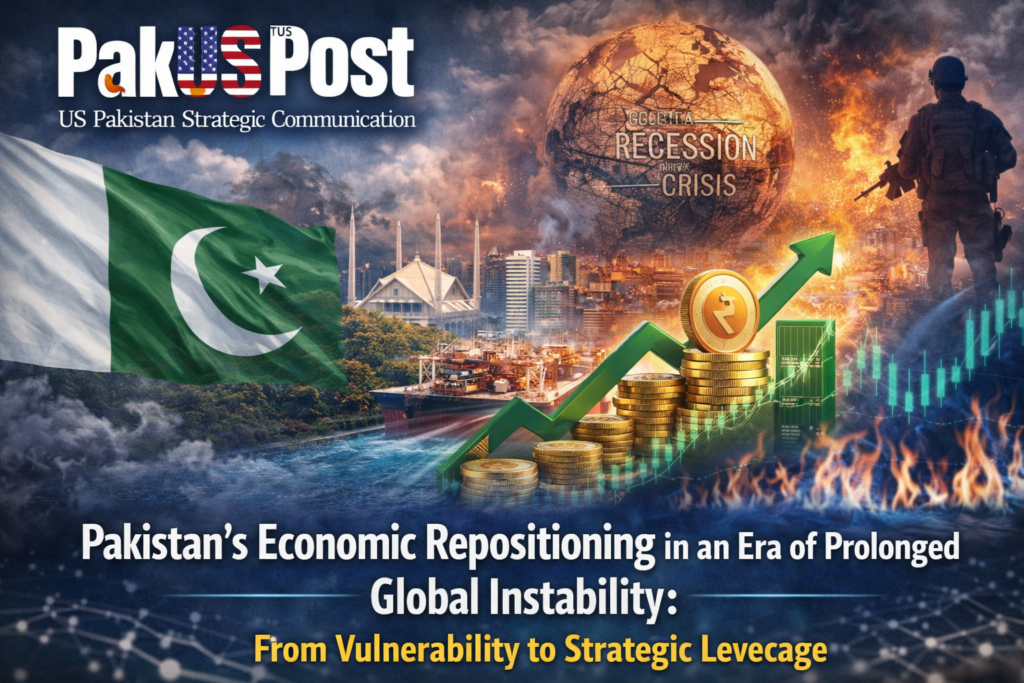
Pakistan’s economic trajectory in an era of prolonged global instability is no longer a question of survival alone but of strategic repositioning. The turbulence emanating from the Middle East, particularly disruptions in energy flows, financial volatility, and shifting geopolitical alignments, is reshaping the architecture of the global economy. For a country like Pakistan, historically vulnerable to external shocks yet strategically positioned at the crossroads of Asia, this moment presents both acute risks and underexplored opportunities. The challenge for policymakers is not merely to cushion the economy against immediate shocks but to recalibrate its structural foundations in a way that converts instability into leverage.
In the short term, Pakistan faces a confluence of pressures that are deeply interconnected. Energy prices remain the most immediate transmission channel of Middle Eastern instability. Given Pakistan’s dependence on imported oil and liquefied natural gas, any sustained increase in prices directly feeds into domestic inflation, widens the current account deficit, and strains fiscal balances through energy subsidies and capacity payments. Inflationary pressures, already embedded in the economy, risk becoming entrenched, eroding purchasing power and complicating monetary policy. The State Bank is forced into a tightening cycle that suppresses growth while attempting to anchor expectations, creating a delicate balancing act between stabilization and economic activity.
Simultaneously, global trade is entering a phase of fragmentation. Shipping disruptions, insurance premiums linked to geopolitical risk, and reconfiguration of supply chains are slowing trade flows. For Pakistan, whose export base remains narrow and concentrated in low value-added textiles, this slowdown translates into reduced external demand and heightened competition. Traditional markets in Europe and North America are themselves grappling with inflation and recessionary pressures, limiting their import appetite. The immediate consequence is a compression of export earnings at a time when foreign exchange reserves are already under stress.
Financial conditions globally are tightening as major economies maintain higher interest rates to combat inflation. This environment reduces capital flows դեպի emerging markets and increases the cost of external borrowing. Pakistan, with its history of recurring balance of payments crises, finds itself particularly exposed. Sovereign risk premiums rise, access to international capital markets becomes constrained, and rollover risks intensify. Engagement with institutions such as the International Monetary Fund becomes not just a policy choice but a necessity for maintaining macroeconomic stability.
Yet within this challenging landscape lies a set of strategic openings that can redefine Pakistan’s economic trajectory if approached with clarity and coherence. The first is energy diplomacy. While rising energy prices are a burden, the geopolitical fragmentation of energy markets also creates space for innovative procurement strategies. Sanctions regimes on countries like Iran and Russia have created discounted energy corridors that, while politically sensitive, offer economic advantages. Pakistan’s ability to negotiate flexible payment mechanisms, possibly in local currencies or through barter arrangements, could significantly reduce its import bill. This requires a nuanced diplomatic posture that balances relations with Western partners while quietly leveraging regional opportunities.
In the medium to long term, export diversification becomes the cornerstone of resilience. Pakistan cannot remain reliant on a narrow set of commodities if it seeks to withstand global shocks. The country possesses latent potential in sectors such as information technology, pharmaceuticals, agritech, and light engineering. The global shift towards digital services provides a particularly compelling avenue. Pakistani freelancers and IT firms have already demonstrated competitiveness in global markets. With targeted policy support, including tax incentives, infrastructure development, and regulatory facilitation, the digital economy can evolve into a major source of foreign exchange. Unlike traditional exports, digital services are less susceptible to logistical disruptions and can scale rapidly.
Agriculture, often viewed through the lens of subsistence and domestic consumption, also holds untapped export potential. Global food insecurity, exacerbated by climate change and geopolitical conflicts, has increased demand for agricultural commodities. Pakistan’s fertile land and diverse cropping patterns position it to become a significant player in regional food markets. However, this requires a shift from raw exports to value-added products, improved supply chain logistics, and adherence to international quality standards. Investment in cold storage, processing facilities, and certification mechanisms can transform agriculture into a high-value export sector.
Regional trade corridors represent another critical dimension of Pakistan’s strategic response. The country’s geography places it at the intersection of South Asia, Central Asia, and the Middle East. Connectivity initiatives, particularly those linked to China’s Belt and Road framework, offer pathways to integrate Pakistan into broader regional supply chains. By positioning itself as a transit and logistics hub, Pakistan can generate revenue through trade facilitation while reducing its own import costs. Enhanced connectivity with Central Asian republics can open new markets for Pakistani goods and provide access to energy resources. Similarly, improved trade relations with neighboring countries can mitigate the impact of global trade slowdowns by fostering regional demand.
The role of multilateral institutions must also be reframed. Engagement with the International Monetary Fund has traditionally been viewed in Pakistan as a last resort, often accompanied by politically difficult conditionalities. However, in an era of global instability, such engagement can be leveraged strategically. IMF programs provide not only financial support but also a signal of credibility to international markets. This can unlock additional funding from other multilateral and bilateral partners. The key is to align IMF-driven reforms with a domestically owned economic strategy rather than treating them as externally imposed measures. Structural reforms in taxation, energy pricing, and public sector governance, while politically sensitive, are essential for long-term stability.
Fiscal policy must undergo a fundamental transformation. Pakistan’s tax base remains narrow, with a disproportionate reliance on indirect taxes that exacerbate inequality and inflation. Expanding the tax net, particularly by bringing untaxed sectors into the formal economy, is critical. At the same time, expenditure rationalization is necessary to create fiscal space for development spending. This includes reducing inefficiencies in state-owned enterprises, targeting subsidies more effectively, and prioritizing investments that generate long-term economic returns. Fiscal discipline, when combined with growth-oriented spending, can stabilize public finances without stifling economic activity.
Monetary policy, while constrained in the short term, can support long-term objectives by fostering financial inclusion and stability. The expansion of digital banking and fintech solutions offers an opportunity to bring underserved populations into the formal financial system. This not only enhances economic participation but also improves the transmission of monetary policy. A more inclusive financial system can mobilize domestic savings, reducing reliance on external borrowing.
One of the less discussed but increasingly important aspects of Pakistan’s economic trajectory is the role of narrative and perception. In a global environment characterized by uncertainty, investor confidence is influenced as much by perception as by fundamentals. Pakistan must actively shape its economic narrative, emphasizing resilience, reform, and opportunity. Strategic communication, both domestically and internationally, can attract investment and build confidence among stakeholders. This is particularly relevant for engaging the Pakistani diaspora, which represents a significant source of remittances and potential investment.
Climate change adds another layer of complexity to Pakistan’s economic outlook. Extreme weather events, such as floods and droughts, have already demonstrated their capacity to disrupt economic activity and strain public finances. However, the global focus on climate finance presents an opportunity. Pakistan can position itself as a recipient of climate-related funding by aligning its development projects with sustainability goals. Investments in renewable energy, water management, and climate-resilient infrastructure can reduce vulnerability while attracting international support.
The interplay between geopolitics and economics is perhaps most evident in Pakistan’s relationship with major powers. The United States, China, and Gulf countries each represent distinct opportunities and constraints. Balancing these relationships requires a sophisticated approach that prioritizes economic interests while navigating political sensitivities. For instance, deeper economic engagement with Gulf countries can provide investment and energy security, while partnerships with China can enhance infrastructure and industrial capacity. At the same time, maintaining constructive relations with the United States is essential for access to global financial systems and markets.
Ultimately, Pakistan’s economic trajectory under prolonged global instability will be determined by its ability to move from a reactive to a proactive policy framework. This involves anticipating global trends, identifying areas of comparative advantage, and implementing reforms that enhance competitiveness. The current environment, while challenging, also disrupts established hierarchies and creates space for emerging economies to redefine their roles.
For policymakers and diplomats, the imperative is clear. Economic policy can no longer be formulated in isolation from geopolitical considerations. Energy diplomacy, trade strategy, financial engagement, and domestic reforms must be integrated into a coherent framework that aligns short-term stabilization with long-term transformation. Pakistan’s vulnerabilities are real, but so are its possibilities. By leveraging its strategic location, demographic potential, and emerging sectors, the country can not only withstand the shocks of global instability but also carve out a more resilient and dynamic economic future.
The path forward requires political will, institutional capacity, and a willingness to embrace change. Incremental adjustments will not suffice in a world that is undergoing structural shifts. Bold, well-calibrated decisions are needed to reposition Pakistan within the evolving global order. If executed effectively, the current period of instability could mark not a decline but a turning point in Pakistan’s economic history, where adversity becomes the catalyst for transformation and strategic renewal.
A Public Service Message