
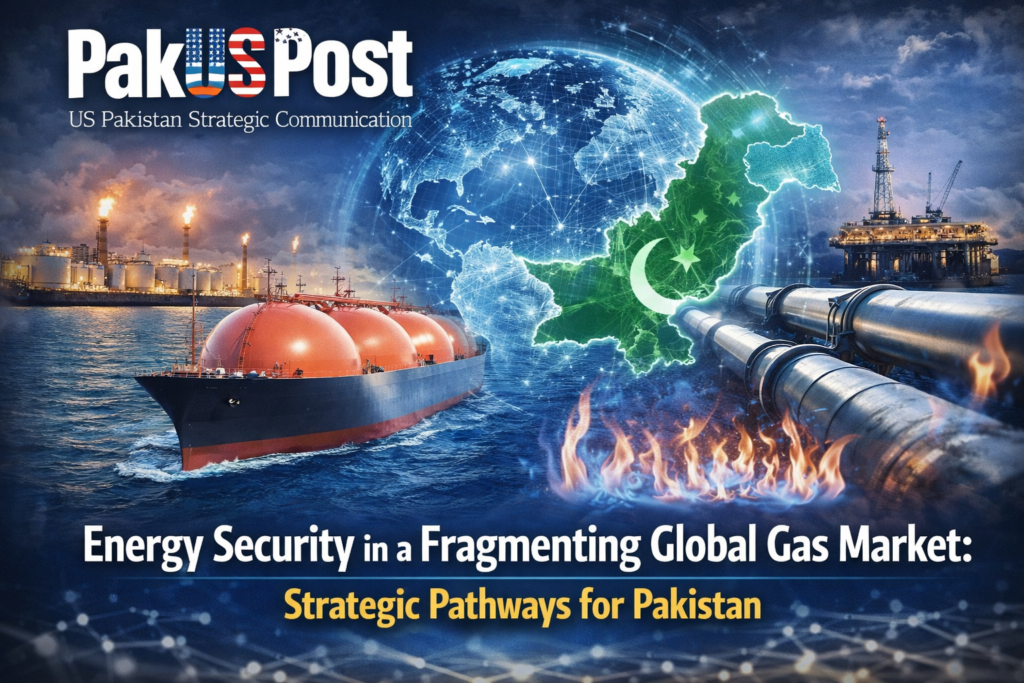
Energy Security in a Fragmenting Global Gas Market: Strategic Pathways for Pakistan

Energy security is no longer a technical question of supply chains and infrastructure but a deeply political contest shaped by sanctions regimes, currency hierarchies, and geopolitical realignments. The fragmentation of the global oil and gas order, accelerated by sanctions on Iran and Russia, has opened a strategic window for countries like Pakistan that have historically remained price takers in global energy markets. What appears as disruption at the global level can be reinterpreted as opportunity at the national level, provided Islamabad adopts a calibrated, multi vector energy diplomacy that blends pragmatism with strategic foresight.
The international energy system is undergoing a silent restructuring. Sanctions on Iran have constrained its ability to export gas and oil through formal channels, forcing it to seek alternative markets and unconventional payment systems. Simultaneously, sanctions on Russia following its confrontation with the West have redirected large volumes of discounted hydrocarbons towards non Western buyers. This dual pressure has weakened the dominance of traditional energy flows governed by Western financial systems and opened parallel circuits where transactions are negotiated outside the purview of the dollar centric order. For Pakistan, a country grappling with chronic balance of payments crises and rising import bills, this moment offers an unusual degree of bargaining leverage.
At the center of this strategic opportunity lies the long stalled Iran Pakistan gas pipeline, a project that has lingered for decades under the shadow of geopolitical pressure. Historically, Islamabad has hesitated to proceed due to the threat of secondary sanctions from the United States and its allies. However, the global context has shifted. The normalization of energy transactions with sanctioned states by several major economies has diluted the stigma associated with such engagements. Countries across Asia have continued to import Russian energy through creative financial mechanisms, often at discounted rates, demonstrating that sanctions regimes, while powerful, are not impermeable.
Reviving the Iran Pakistan pipeline now carries a different strategic logic than it did in previous decades. It is no longer merely an infrastructure project but a geopolitical instrument that can anchor Pakistan’s long term energy security. Iran possesses the world’s second largest natural gas reserves, much of which remains underutilized due to export restrictions. Pakistan, on the other hand, faces an acute gas shortage that has crippled industrial productivity and forced reliance on expensive liquefied natural gas imports. The complementarity is obvious, but the challenge lies in designing a framework that minimizes exposure to sanctions while maximizing economic benefit.
One possible pathway is the adoption of flexible payment mechanisms that bypass traditional banking channels. The experience of countries trading with Iran and Russia suggests a growing reliance on barter arrangements, local currency settlements, and third party intermediaries. Pakistan could explore a rupee rial or yuan rial settlement structure, particularly in coordination with China, which has already developed financial systems capable of operating outside the dollar dominated network. Such arrangements would not only facilitate energy imports but also reduce pressure on Pakistan’s foreign exchange reserves, a persistent vulnerability in its economic architecture.
The integration of energy diplomacy with broader regional connectivity frameworks is essential in this regard. The China Pakistan Economic Corridor, a flagship component of China’s Belt and Road Initiative, offers a ready made platform through which energy cooperation can be institutionalized. By aligning the Iran Pakistan pipeline with CPEC, Islamabad can transform a bilateral project into a trilateral strategic corridor that serves the interests of all three countries. For China, access to Iranian energy through Pakistan provides an additional layer of supply security. For Iran, it offers a reliable export route that circumvents sanctions. For Pakistan, it ensures a steady flow of affordable gas while attracting investment in associated infrastructure.
However, such alignment must be handled with diplomatic finesse. The United States remains a critical partner for Pakistan in areas ranging from financial assistance to security cooperation. Any overt defiance of US sanctions could trigger punitive measures that outweigh the benefits of cheaper energy imports. Therefore, Islamabad’s strategy must be rooted in ambiguity and incrementalism rather than confrontation. Instead of announcing a full scale revival of the pipeline, Pakistan could begin with limited, pilot scale engagements that test the feasibility of alternative payment systems and logistical arrangements. This gradual approach would allow policymakers to assess risks and adjust course without provoking an immediate backlash.
Diversification of LNG imports constitutes another crucial pillar of Pakistan’s energy strategy. While pipeline gas offers long term stability, LNG provides flexibility and immediate relief. The global LNG market itself is undergoing transformation, with new suppliers entering the scene and pricing structures becoming more competitive. Pakistan has traditionally relied on long term contracts with a limited number of suppliers, exposing it to price volatility and supply disruptions. Expanding the supplier base to include countries willing to offer favorable terms, including those under sanctions, can enhance resilience.
Russia, in particular, presents an underexplored opportunity in this domain. Despite sanctions, Russian LNG has found its way into global markets through indirect channels, often at discounted prices. Pakistan could engage in discreet negotiations to secure such supplies, possibly through intermediaries or swap arrangements. This would require a sophisticated understanding of global trading networks and the ability to navigate legal ambiguities, but the potential cost savings justify the effort. Moreover, engagement with Russia in the energy sector could open avenues for broader economic cooperation, including investment in refining and storage infrastructure.
The challenge of avoiding secondary sanctions while pursuing these opportunities cannot be underestimated. The United States has demonstrated its willingness to enforce sanctions extraterritorially, targeting entities that engage with sanctioned states. For Pakistan, which remains dependent on international financial institutions and Western markets, the risk is particularly acute. Mitigating this risk requires a combination of legal innovation, diplomatic engagement, and strategic communication.
On the legal front, Pakistan must invest in developing expertise in sanctions compliance and risk management. This includes structuring contracts in ways that minimize exposure, using non sanctioned entities as intermediaries, and ensuring transparency where necessary to avoid allegations of illicit activity. Diplomatically, Islamabad should engage with Washington to articulate its energy security needs and seek exemptions or waivers where possible. The precedent exists, as several countries have secured limited waivers for energy imports under specific conditions. While such waivers may not be guaranteed, proactive engagement increases the likelihood of a favorable outcome.
Strategic communication is equally important. Pakistan must frame its energy initiatives not as acts of defiance but as necessities driven by economic realities. Emphasizing the developmental impact of affordable energy, particularly in terms of industrial growth and poverty alleviation, can help build a narrative that resonates with international stakeholders. At the same time, maintaining a balanced foreign policy that avoids overt alignment with any single bloc will preserve Pakistan’s strategic autonomy.
The domestic dimension of energy security also warrants attention. Infrastructure constraints, regulatory inefficiencies, and governance challenges have historically undermined Pakistan’s ability to fully capitalize on available resources. Reviving the Iran Pakistan pipeline or securing discounted LNG supplies will have limited impact if transmission and distribution systems remain inadequate. Therefore, energy diplomacy must be complemented by domestic reforms that enhance efficiency, reduce losses, and improve institutional capacity.
Investment in storage facilities is particularly critical. The ability to store gas and LNG provides a buffer against supply disruptions and price fluctuations, allowing Pakistan to purchase energy when prices are low and utilize it when needed. Similarly, expanding the pipeline network within the country will ensure that imported gas reaches industrial and residential consumers without bottlenecks. These investments require significant capital, which can be mobilized through public private partnerships and collaboration with international partners, including China.
Another dimension that policymakers must consider is the long term transition towards renewable energy. While the current focus is understandably on securing affordable hydrocarbons, the global shift towards cleaner energy sources cannot be ignored. Integrating renewable energy into Pakistan’s energy mix will reduce dependence on imports and enhance sustainability. However, this transition must be managed carefully to avoid exacerbating existing energy shortages. In the short to medium term, natural gas, particularly from Iran, can serve as a bridge fuel that supports economic growth while the renewable sector is developed.
The broader geopolitical implications of Pakistan’s energy strategy are also significant. By positioning itself as a transit and trading hub for energy flows between the Middle East, Central Asia, and South Asia, Pakistan can enhance its regional relevance. This requires not only infrastructure development but also active participation in regional forums and initiatives that shape energy governance. Engaging with organizations and platforms that include major energy producers and consumers will provide Pakistan with a voice in decision making processes that affect its interests.
In this context, the concept of strategic neutrality becomes particularly valuable. Rather than aligning exclusively with any one bloc, Pakistan can adopt a flexible approach that allows it to engage with multiple partners simultaneously. This includes maintaining strong relations with the United States while deepening ties with China, Iran, and Russia. Such a strategy is not without challenges, as it requires careful balancing of competing interests, but it offers the greatest potential for maximizing national benefit.
Ultimately, the fragmentation of the global oil and gas order is reshaping the parameters within which energy security is pursued. For Pakistan, this transformation presents both risks and opportunities. The revival of the Iran Pakistan pipeline, the negotiation of flexible payment mechanisms, and the diversification of LNG imports are not isolated policy choices but interconnected elements of a broader strategy that seeks to leverage geopolitical shifts for national advantage.
Success will depend on the ability of policymakers to think beyond conventional frameworks and embrace innovative solutions. It will require coordination across government agencies, engagement with international partners, and a willingness to take calculated risks. Most importantly, it will demand a clear articulation of national priorities and a commitment to pursuing them with consistency and resolve.
In a world where energy is increasingly weaponized, the countries that succeed will be those that can navigate complexity with agility and foresight. Pakistan has the opportunity to be among them, transforming its energy vulnerability into a source of strategic strength.
A Public Service Message