Pakistan Needs Sovereign Economic Plan Beyond IMF Dependency Cycles Era

Pakistan’s contemporary economic trajectory is increasingly defined by a paradox that is neither purely domestic nor entirely external. It is a state that negotiates its macroeconomic survival through repeated engagements with the International Monetary Fund, while simultaneously projecting the language of sovereignty, resilience, and structural transformation. This duality has become the central tension of Pakistan’s political economy, particularly in the evolving context of Pakistan–US relations and broader multilateral financial governance, where economic stabilisation is no longer merely a technical exercise but a geopolitical signal of alignment, discipline, and conditional trust.
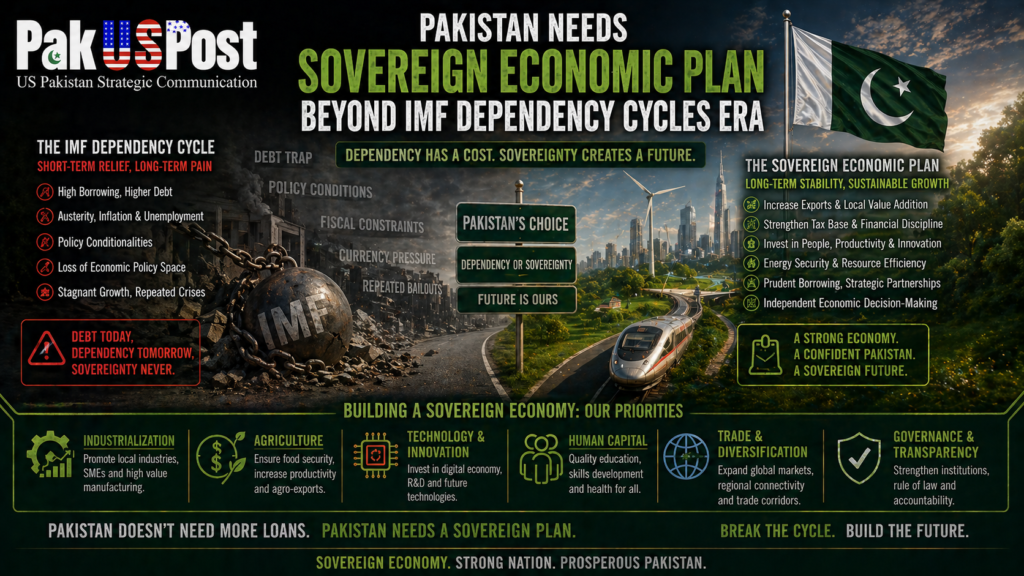
Over the last several decades, Pakistan’s relationship with IMF programmes has shifted from episodic crisis intervention to a near-structural feature of economic governance. What was once conceived as emergency balance-of-payments assistance has gradually become a recurring institutional framework through which fiscal policy, monetary tightening, energy pricing, and even industrial priorities are indirectly shaped. In this configuration, sovereignty is not formally suspended, yet it is operationally constrained through policy conditionalities that define fiscal space and limit discretionary expansion.
The present moment reflects a deeper structural reality. Pakistan is no longer simply managing macroeconomic instability; it is managing a system in which instability is periodically stabilised without being fundamentally resolved. Each programme restores short-term external balance, yet the underlying drivers of crisis—narrow export base, weak tax-to-GDP ratio, energy sector inefficiencies, and import dependency—remain largely intact. The result is a cyclical equilibrium in which reform is repeatedly initiated, partially implemented, and politically recalibrated before structural completion.
In this context, the idea of a sovereign economic transformation plan emerges not as rhetorical aspiration but as institutional necessity. Sovereignty here does not imply disengagement from international financial institutions, nor does it suggest autarkic economic nationalism. Rather, it implies the construction of an internally coherent economic architecture capable of setting its own developmental priorities, sequencing reforms according to domestic productive logic, and insulating core strategic objectives from cyclical external conditionalities.
The critical limitation of Pakistan’s current economic model is not merely fiscal fragility; it is strategic fragmentation. Policy cycles are frequently reset with each new IMF programme, each new administration, or each external shock. As a result, long-term industrial policy is subordinated to short-term stabilisation imperatives. Energy pricing reforms are designed to meet immediate fiscal targets rather than long-term competitiveness. Tax reforms are structured to unlock disbursements rather than broaden structural compliance. Exchange rate adjustments are calibrated to external account pressures rather than export-led industrial planning.
Within international policy circles, particularly in Washington-based financial institutions and multilateral development frameworks, Pakistan is often analysed through the lens of “stabilisation fatigue.” This refers to the repeated necessity of intervention without corresponding structural transformation. From a Pakistan–US policy perspective, this creates a subtle but important divergence of interest. The United States, operating through multilateral financial architecture, prioritises macroeconomic stability, debt sustainability, and systemic risk containment. Pakistan, however, requires not only stability but structural expansion of productive capacity, export diversification, and technological upgrading.
The gap between these two imperatives defines the core policy challenge of the present era. Stabilisation without transformation produces short-term predictability but long-term vulnerability. Conversely, transformation without stabilisation risks immediate macroeconomic disorder. The absence of a unified sovereign roadmap means Pakistan oscillates between these two imperatives without fully resolving either.
A sovereign economic transformation plan would require a fundamental reorientation of state priorities. At its core, it must redefine the relationship between the state, the market, and external financial institutions. The state would no longer function primarily as a crisis manager responding to external constraints, but as a strategic coordinator of long-term economic capability building. This includes industrial policy coordination, export ecosystem development, energy sector restructuring, and institutional reform of revenue collection mechanisms.
One of the most critical structural weaknesses in Pakistan’s economic architecture is the limited scale and concentration of its export base. Despite periodic growth spurts, exports remain heavily concentrated in low-value-added textiles and a narrow set of commodity-linked sectors. This structural limitation constrains foreign exchange stability and increases vulnerability to external shocks. IMF-supported stabilisation programmes often correct current account imbalances through import compression rather than export expansion, reinforcing a contractionary equilibrium rather than a growth-oriented one.
From a policy standpoint, this reveals a deeper institutional asymmetry. External stabilisation frameworks are designed to ensure macroeconomic discipline, not industrial transformation. As a result, Pakistan’s development trajectory is effectively split between stabilisation instruments and fragmented industrial policy initiatives that lack coherence, scale, and long-term financing mechanisms.
In parallel, domestic political economy constraints further complicate reform sequencing. Energy pricing, tax broadening, and subsidy rationalisation are not merely technical decisions but politically sensitive interventions that directly affect household welfare and electoral legitimacy. Consequently, successive governments tend to delay structural reforms until external pressure intensifies, at which point reforms are implemented rapidly but without sufficient domestic consensus or institutional absorption capacity.
The media environment further amplifies these contradictions. Economic adjustment measures are often interpreted through narratives of hardship, sovereignty erosion, or external coercion. In televised political discourse and increasingly on digital platforms, IMF programmes are frequently framed not as macroeconomic stabilisation tools but as symbols of external control. This discursive framing shapes public perception, limits policy flexibility, and increases the political cost of reform implementation.
At the same time, there exists an alternative narrative within policy and business circles that views IMF engagement as a necessary discipline mechanism that enforces fiscal restraint and prevents macroeconomic collapse. This dual narrative structure produces what can be described as “interpretive instability,” where the same policy is simultaneously perceived as stabilising and constraining depending on the political or institutional vantage point.
The absence of a sovereign economic transformation roadmap means that these narratives remain unresolved, continuously oscillating between crisis and recovery without transitioning into structural growth. The challenge is therefore not simply economic but epistemic: how economic policy is understood, communicated, and legitimised within the state and society.
From a strategic perspective, particularly in relation to Pakistan–US economic engagement, this dynamic has broader implications. The United States, through its influence in multilateral financial institutions, plays a critical role in shaping the conditional architecture of Pakistan’s economic programmes. However, the US policy focus remains primarily on macroeconomic stability, debt transparency, and systemic risk mitigation rather than deep industrial transformation or export diversification.
This creates a structural mismatch. Pakistan seeks developmental transformation; external financial architecture prioritises stability and risk containment. Without an internally defined sovereign roadmap, Pakistan’s policy trajectory remains externally anchored even when domestically negotiated.
A sovereign transformation plan would therefore require three foundational shifts.
First, a redefinition of fiscal strategy from short-term deficit control to long-term revenue capacity expansion. This implies not only tax reform but the formalisation of the informal economy through digital taxation systems, property registration integration, and financial documentation expansion.
Second, an export-centric industrial strategy that moves beyond sectoral incentives toward integrated value chain positioning. This would require coordinated investment in logistics infrastructure, energy cost rationalisation, and compliance alignment with global trade standards, particularly in high-regulation markets.
Third, institutional insulation of key economic planning bodies from cyclical political disruption. Without bureaucratic continuity in economic planning, long-term strategies are repeatedly reset, leading to policy discontinuity and investor uncertainty.
However, the feasibility of such a transformation plan is constrained by existing governance structures. Bureaucratic fragmentation, political turnover, and institutional overlap between federal and provincial economic authorities limit policy coherence. Moreover, the incentive structure within the state apparatus often rewards short-term stabilisation achievements rather than long-term structural reform success.
In this sense, the challenge is not the absence of policy knowledge but the absence of implementation continuity. Pakistan’s economic policy ecosystem is replete with diagnostic clarity but deficient in sustained execution capacity. This gap between analysis and implementation is where repeated IMF cycles find structural relevance, as external institutions often provide the continuity that domestic institutions fail to maintain.
Yet reliance on external continuity is not a substitute for sovereign planning. It is, at best, a stabilisation mechanism. At worst, it entrenches dependency cycles that delay structural reform while maintaining macroeconomic equilibrium at a lower growth trajectory.
The question, therefore, is not whether Pakistan should disengage from IMF programmes, but whether it can construct an internal economic framework robust enough to reduce the frequency, intensity, and duration of such engagements. Sovereignty, in this context, is measured not by absence of external engagement but by reduction of structural dependence.
Ultimately, Pakistan’s economic future will be shaped by its ability to reconcile three competing imperatives: macroeconomic stability, political legitimacy, and structural transformation. At present, these three objectives operate in tension rather than alignment. IMF programmes address stability, political systems respond to legitimacy pressures, and structural transformation remains partially aspirational.
A sovereign economic transformation plan would seek to integrate these imperatives into a single coherent framework, where stabilisation is not an end in itself but a precondition for sustained industrial and export-led growth. Without such integration, Pakistan risks remaining locked in an intermediate state of managed instability—periodically stabilised, externally supported, but structurally incomplete.
In the evolving geopolitical economy of Pakistan–US relations and global financial governance, the central policy challenge is therefore not access to capital but the design of economic sovereignty itself.
A Public Service Message