Europe Funds Ukraine and Redefines War Through Economic Endurance Strategy

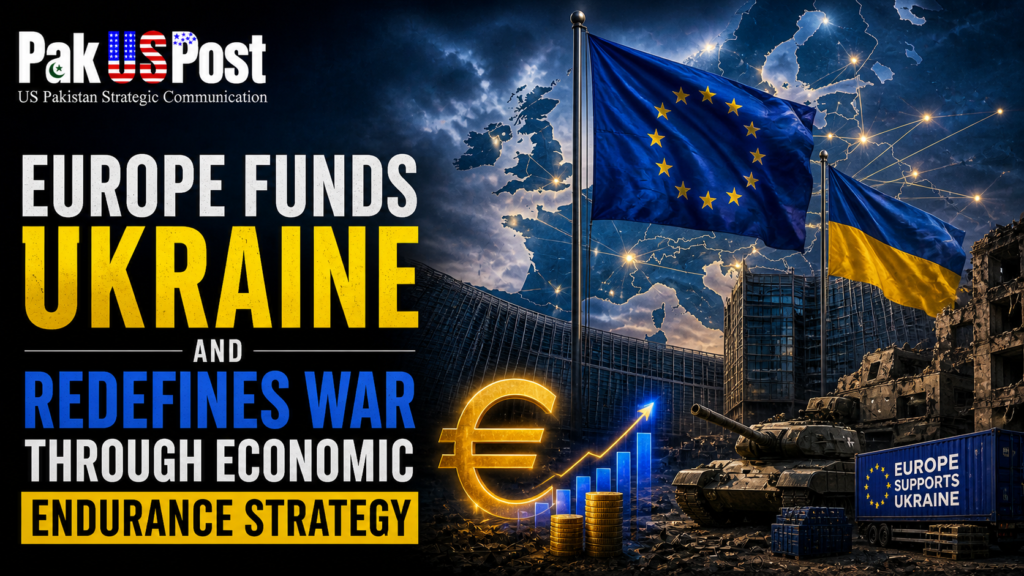
The decision by the European Union to mobilise a financial commitment of one hundred and five billion dollars for Ukraine represents a decisive transformation in the conduct of modern conflict, signalling a shift from immediate battlefield escalation toward a structured doctrine of long duration economic endurance. This transition does not replace military engagement, rather it reorders its hierarchy by placing fiscal continuity, institutional stability, and infrastructural resilience at the centre of strategic resistance against Russia. The war is no longer confined to territorial confrontation, it is extended into the domains of finance, governance, and systemic sustainability, where endurance itself becomes a measurable form of power.
This financial commitment reflects a deeper recalibration within European strategic thinking. Earlier phases of the conflict were defined by reactive military assistance, emergency sanctions, and fragmented policy coordination. The current phase represents the institutionalisation of a long term framework in which Ukraine is sustained as a functioning state under prolonged stress. Public sector salaries, pensions, energy systems, and reconstruction are not auxiliary concerns, they are integral to the strategic objective of preventing systemic collapse. The preservation of administrative continuity becomes a defensive mechanism, ensuring that Ukraine retains the capacity to govern, mobilise, and endure.
The concept of economic endurance warfare fundamentally alters the structure of conflict. Traditional models emphasised decisive engagements, territorial gains, and rapid shifts in control. In contrast, the Ukraine case introduces a prolonged contest in which the ability to sustain governance, absorb economic shocks, and maintain institutional coherence becomes decisive. The European Union’s funding embeds Ukraine within a stabilising financial architecture, transforming economic support into a strategic shield. The battlefield is thus expanded into multiple domains, where fiscal systems, infrastructure, and public administration function as critical components of resistance.
Alliance cohesion becomes central within this framework. Sustaining such a substantial financial commitment requires continuous political alignment across European states, each facing domestic economic pressures and competing priorities. The institutional structures of the European Union play a stabilising role by formalising commitments within budgetary mechanisms and distributing financial responsibilities. However, the long term durability of this cohesion depends on sustained political will, economic capacity, and the ability to reconcile internal constraints with external strategic objectives. The challenge is not immediate fragmentation but the gradual accumulation of pressure that may test the resilience of collective commitment over time.
The broader international implications of this approach are significant. Within the United States, European financial engagement reinforces transatlantic burden sharing and signals a maturation of European strategic capacity. In the wider global context, including Pakistan, the scale and structure of financial support highlight the role of economic alignment and geopolitical positioning in shaping access to sustained assistance. The Ukraine model demonstrates that long term financial backing is not solely a function of humanitarian concern but is embedded within strategic calculations that link economic support to broader security objectives.
The financialisation of conflict also redefines the instruments of power within international relations. Economic tools such as loans, grants, sanctions, and reconstruction funds become central to strategic competition. The European Union’s approach illustrates how financial systems can be mobilised to achieve geopolitical outcomes, extending influence while shaping the trajectory of conflict. This reflects the broader emergence of geoeconomics as a dominant paradigm, where economic policy is directly integrated into security strategy rather than operating as a separate domain.
For Russia, this strategy presents a complex and evolving challenge. While military operations remain a core component of its approach, the long-term trajectory of the conflict increasingly depends on economic sustainability and domestic resilience. The European Union’s funding signals an intention to sustain pressure over time, gradually increasing the cost of engagement and testing the limits of Russian endurance. This creates a strategic environment in which outcomes are determined less by decisive victories and more by the cumulative effects of prolonged strain across economic and institutional systems.
From a Pakistan United States policy perspective, the shift toward economic endurance warfare offers critical insights. It underscores the importance of financial resilience, institutional capacity, and governance stability as components of national security. For Pakistan, which operates within a complex economic environment, the Ukraine case illustrates how sustained external financial support can stabilise a state under pressure while also demonstrating the strategic conditions under which such support is mobilised. It highlights the necessity of aligning economic policy with broader strategic objectives to enhance resilience and secure long-term partnerships.
The long term implications of this transformation extend beyond the immediate conflict. If the model of economic endurance proves effective, it may redefine the nature of warfare by prioritising sustainability over rapid escalation. States with strong economic systems, institutional coherence, and access to financial networks will possess a decisive advantage in such an environment, while those with structural vulnerabilities will face increased exposure to prolonged pressure. This shift has the potential to reshape global power dynamics by elevating economic capacity to the level of primary strategic determinant.
In conclusion, the European Union’s financial commitment to Ukraine represents a fundamental evolution in the conduct of modern conflict. It redefines war as a sustained contest of endurance, integrates economic resilience into strategic doctrine, and reshapes alliance dynamics within an increasingly complex geopolitical landscape. For Pakistan United States policy discourse, it highlights the necessity of adapting to a strategic environment in which financial strength, institutional stability, and long-term sustainability is as critical as traditional measures of military power, and where the capacity to endure becomes the defining feature of strategic success.
A Public Service Message