United Kingdom Tobacco Ban Redefines Liberal Governance Boundaries Today

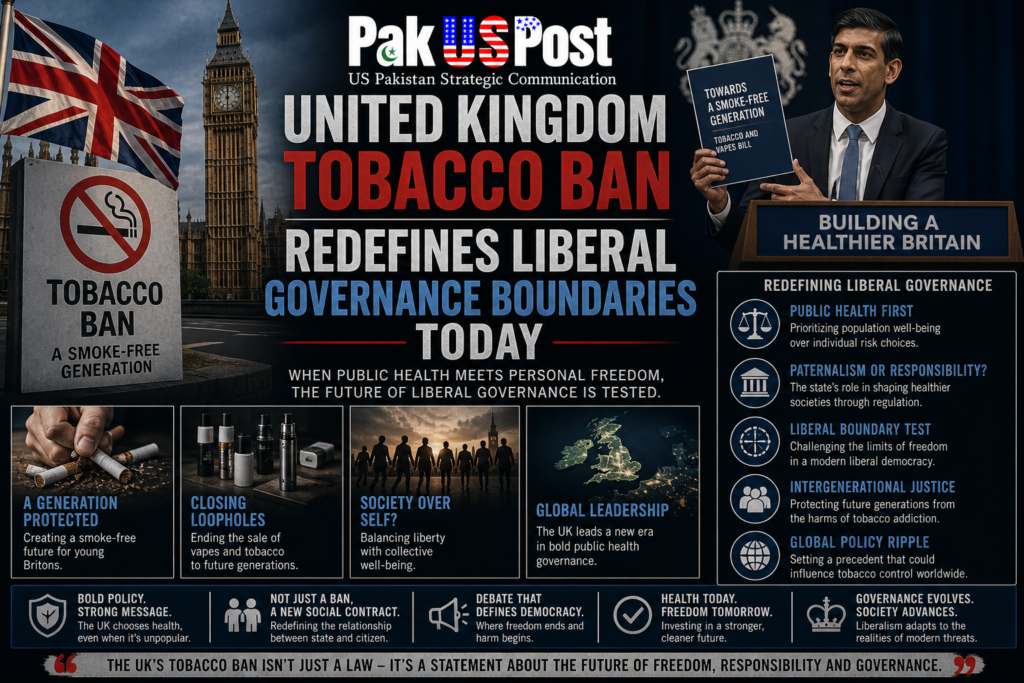
The United Kingdom’s move toward a generational smoking ban has opened an unusually deep debate about the future architecture of liberal governance, where the state increasingly positions itself not only as regulator of present behavior but as architect of future citizen eligibility. On the surface, the policy is framed within familiar public health logic, reducing long term healthcare burdens, preventing addiction, and safeguarding future generations from a known carcinogenic risk. Yet beneath this technocratic justification lies a more consequential shift in political philosophy, one that quietly stretches the boundaries of what liberal democracies consider legitimate state intervention in individual autonomy.
What makes this policy analytically significant is not simply its health objective but its temporal logic. Instead of restricting smoking through taxation, age limits, or awareness campaigns, the proposal effectively prevents an entire cohort from ever legally entering tobacco consumption. This transforms regulation from a corrective mechanism into a generational filter. The state is no longer only managing behavior; it is shaping the horizon of possible behavior before it can even emerge. In political theory terms, this signals a movement from reactive governance to pre-emptive biopolitics, where policy intervenes in the formation of future choices rather than the regulation of existing ones.
Supporters of the policy argue that such intervention is a rational response to asymmetrical information and long term harm. Smoking is not a neutral consumer choice but a structurally addictive practice with well documented public health consequences. From this perspective, generational prohibition is not paternalism but preventive governance, designed to eliminate avoidable suffering at population scale. They further argue that liberalism has never been absolute in its protection of choice, as states routinely restrict harmful substances, mandate seatbelts, and regulate food safety. The smoking ban, therefore, is presented as an extension of existing protective logic rather than a rupture.
However, critics see a deeper constitutional and philosophical shift. They argue that the policy redefines the relationship between citizenship and autonomy by introducing a form of inherited behavioral constraint. Unlike traditional regulations that apply uniformly across age groups, this model creates a temporal inequality in access to legal behavior. One generation is granted a liberty that the next is structurally denied. This raises uncomfortable questions about the permanence of state decisions and the extent to which democratic majorities can preconfigure the moral and behavioral boundaries of future minorities who cannot yet participate in the political process.
In media discourse, the policy has been framed in sharply polarized terms. Public health narratives emphasize protection, prevention, and long term societal benefit. Libertarian critiques emphasize coercion, state overreach, and the erosion of individual sovereignty. Yet both frames often miss the deeper transformation underway, which is not simply about smoking but about the evolving nature of governance itself in advanced liberal democracies. The state is increasingly operating in predictive mode, using data, risk modeling, and long term demographic forecasting to justify interventions that extend far beyond immediate harm reduction.
This shift is not occurring in isolation. Across multiple policy domains, from digital regulation to climate governance, states are adopting increasingly forward looking frameworks that prioritize anticipated risk over present consent. In this sense, the UK tobacco policy can be seen as part of a broader epistemic change in governance, where uncertainty about future harm is sufficient justification for present restriction. The political imagination of the state is expanding into the future, and with it, the temporal scope of authority.
For Pakistan, this development carries indirect but important analytical relevance, particularly in policy dialogues conducted through platforms such as Pakistan US Post, where governance models from advanced economies are often examined for transferable lessons. The key takeaway is not imitation but interpretation. Public health challenges in Pakistan, including tobacco consumption, are real and significant, but the institutional context differs sharply. Regulatory capacity, enforcement mechanisms, and public trust levels vary considerably, meaning that direct transplantation of generational prohibition models would likely produce unintended consequences, including informal market expansion and enforcement asymmetries.
For the United States, the UK example reopens long standing debates about the limits of state intervention in a constitutionally grounded liberal order. American political culture remains deeply sensitive to perceived encroachments on individual liberty, particularly when they involve behavioral prohibition rather than taxation or regulation. While certain public health interventions are widely accepted, a generational ban would likely encounter significant judicial and political resistance. The divergence between UK and US approaches thus reflects not only policy preference but deeper constitutional cultures of liberty and governance.
At the same time, it would be simplistic to frame this as a binary conflict between freedom and control. Modern governance operates through more subtle mechanisms of influence, including behavioral economics, nudging architectures, and digital monitoring systems. The smoking ban sits within this broader continuum of soft governance, where state power is exercised less through coercion and more through design of choice environments. What distinguishes the UK case is its explicitness in setting a permanent temporal boundary on a specific behavior, making visible what is often implicit in other regulatory domains.
There is also a geopolitical dimension to consider. As states compete in demonstrating policy innovation, particularly in public health and climate governance, regulatory boldness becomes a form of soft power signaling. The UK’s tobacco policy may thus function not only as domestic health strategy but also as international demonstration of regulatory leadership. This is particularly relevant in a post Brexit environment where Britain seeks to redefine its global policy identity outside European Union frameworks.
Yet the long term success of such policies will depend less on symbolic innovation and more on practical enforcement and social adaptation. Historical experience suggests that prohibition based approaches often generate complex secondary effects, including black markets, behavioral substitution, and enforcement disparities. Whether generational prohibition avoids these dynamics will depend on sustained investment in public education, healthcare access, and behavioral support systems.
Ultimately, the deeper question raised by this policy is not whether smoking should be reduced, but how far liberal democracies are willing to go in predefining the behavioral boundaries of future citizens. If the state can legitimately prohibit a behavior for those not yet born, then the temporal scope of governance expands dramatically. This raises profound implications for democratic theory, particularly the principle that political authority should remain contestable by those subject to it.
For policymakers engaged in transnational dialogue, including platforms like Pakistan US Post, the UK experience offers both inspiration and caution. It demonstrates the growing capacity of states to act on long term collective risks, but also highlights the need for careful calibration between prevention and autonomy. The challenge for modern governance is no longer simply managing present behavior, but determining how far into the future democratic authority can justifiably extend without undermining its own philosophical foundations.
A Public Service Message