
Syria Transitional Justice Becomes Diplomacy Theatre of Legitimacy Claims

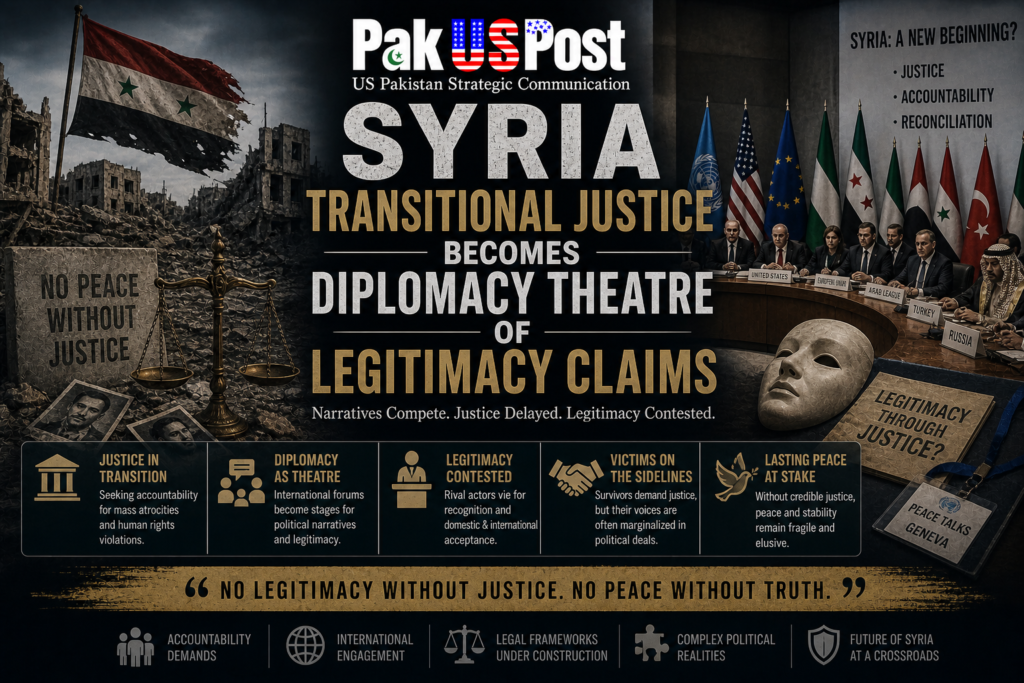
Syria’s recent wave of high-profile arrests linked to alleged past atrocities has reopened an old but unresolved question in post-conflict governance, whether transitional justice is a genuine moral and legal reckoning or a carefully staged instrument of geopolitical reintegration. On the surface, these arrests signal movement toward accountability after years of civil war, repression, and fragmented sovereignty. Yet beneath this surface lies a more complex architecture of political signalling, where justice functions not only as a legal mechanism but also as a currency of international legitimacy. The distinction between accountability and performance is increasingly blurred in contemporary conflict states, and Syria now stands as one of its most visible laboratories.
Transitional justice in theory is meant to restore moral order after systemic violence. It is supposed to reconstruct trust between the state and society through truth commissions, prosecutions, reparations, and institutional reform. In practice, however, it often becomes a selective and strategically timed process, shaped by political necessity rather than comprehensive reckoning. Syria’s recent arrests must therefore be read within a dual register. On one level, they indicate an attempt to demonstrate responsiveness to long standing allegations of war crimes and abuses. On another level, they appear calibrated to reshape external perceptions at a moment when regional realignments are gradually reopening diplomatic channels with Damascus.
The timing is significant. As regional states recalibrate their positions in the Middle East, Syria is no longer treated as a permanently isolated actor but as a reinsert able node in a shifting geopolitical order. Normalization discussions with several Arab capitals, cautious engagement signals from regional powers, and incremental diplomatic recontacts have created a window in which symbolic legal actions carry amplified weight. In such a context, arrests are not merely domestic legal acts. They become messages directed outward, particularly toward actors that condition reintegration on at least minimal gestures of accountability.
For international observers, particularly in Western policy circles, these developments generate a familiar interpretive tension. On one hand, any movement toward accountability is welcomed as a step away from impunity. On the other hand, there is growing skepticism that selective prosecutions in authoritarian or semi-authoritarian contexts serve more as reputational management tools than as genuine institutional reforms. Syria exemplifies this ambiguity with unusual clarity. The state retains strong coercive capacity but limited transparency, which makes external verification of judicial integrity difficult. As a result, the boundary between justice and image management becomes analytically unstable.
Media framing plays a central role in shaping global interpretation of these events. International coverage often highlights individual arrests as evidence of progress, while giving less attention to the structural continuity of the institutions conducting them. This creates a narrative asymmetry in which discrete acts of accountability are magnified, while systemic questions about judicial independence, evidentiary standards, and due process remain underexplored. In this sense, transitional justice becomes not only a legal process but also a media mediated performance of state re-entry into global legitimacy circuits.
The Syrian case also raises broader questions about the evolving nature of sovereignty in post conflict environments. Sovereignty is no longer judged solely by territorial control or institutional survival. It is increasingly evaluated through the lens of international acceptability, where states must demonstrate adherence, or at least symbolic alignment, with global norms of accountability. This creates incentives for performative compliance, where legal gestures are calibrated to external expectations rather than internal transformation. The result is a hybrid form of governance in which justice is partially externalized as a diplomatic instrument.
From a comparative perspective, this phenomenon is not unique to Syria. Other post conflict states have similarly engaged in selective accountability processes that serve both domestic consolidation and international signaling. However, Syria’s prolonged isolation and the scale of wartime destruction give its current phase a distinct intensity. The stakes of reintegration are higher, and therefore the symbolic value of legal gestures is amplified. Each arrest, each announcement, each procedural step becomes part of a broader negotiation over legitimacy.
In this context, the role of external powers becomes particularly important. The United States, for instance, has historically maintained a position of conditional engagement, linking normalization prospects to substantive political transition and accountability. Yet Washington’s influence in shaping actual transitional justice mechanisms inside Syria remains limited. This creates a gap between normative expectations and operational leverage. The result is a policy environment in which rhetoric of accountability persists, but enforcement mechanisms are diffuse and inconsistent.
For Pakistan, which increasingly positions itself as a diplomatic interlocutor across Middle Eastern transitions through platforms like Pakistan US Post policy dialogues and broader South South engagement frameworks, the Syrian case offers an instructive caution. It highlights the risks of adopting overly binary interpretations of transitional justice as either success or failure. Instead, Pakistan’s policy community can draw a more nuanced lesson, that post conflict accountability processes are often embedded in layered political economies of legitimacy, where legal reforms, international recognition, and domestic stabilization operate simultaneously but not always coherently.
For US policymakers, the Syrian trajectory underscores a recurring strategic dilemma. The pursuit of accountability as a normative objective often competes with pragmatic considerations of regional stabilization and geopolitical recalibration. As global priorities shift toward multipolar competition and regional burden sharing, the leverage available for enforcing comprehensive transitional justice frameworks diminishes. This creates a gap between declared values and achievable outcomes, which adversarial actors can exploit to advance narratives of inconsistency in Western policy.
At the same time, it would be analytically incomplete to dismiss Syria’s recent actions as purely theatrical. Even selective accountability can produce incremental institutional effects. Arrests, however symbolic, can alter elite behavior, signal internal recalibrations, and open limited space for legal discourse. The challenge lies in distinguishing between cosmetic reform and the early stages of genuine institutional transformation. This requires sustained monitoring beyond headline events, focusing on judicial procedures, evidentiary transparency, and long term patterns of enforcement.
The deeper issue, however, is conceptual. Transitional justice in the contemporary international system increasingly operates at the intersection of law, diplomacy, and media representation. It is no longer confined to post conflict reconstruction alone but is embedded in broader struggles over narrative legitimacy. States emerging from conflict are required not only to rebuild institutions but also to narrate their transformation in ways that are legible and acceptable to external audiences. Syria’s current trajectory reflects this dual demand.
For global policy frameworks, including those debated in emerging platforms such as Pakistan US Post analytical forums, the implication is clear. Transitional justice cannot be evaluated solely through event based indicators such as arrests or commissions. It must be assessed as a dynamic system of incentives, signaling, and institutional depth. Without this shift in analytical lens, policymakers risk misinterpreting symbolic gestures as substantive reform, or conversely dismissing incremental changes that may accumulate over time.
In conclusion, Syria’s recent arrests illustrate the evolving nature of post conflict legitimacy, where justice operates simultaneously as legal process and diplomatic language. The distinction between performance and principle is not always clear, but it remains politically consequential. For states like Pakistan engaging in broader geopolitical discourse, and for actors like the United States shaping conditional engagement strategies, the central lesson is one of analytical restraint. Transitional justice is neither purely authentic nor entirely performative. It is a contested space where law, power, and narrative intersect, often in ways that resist simple categorization.
A Public Service Message