
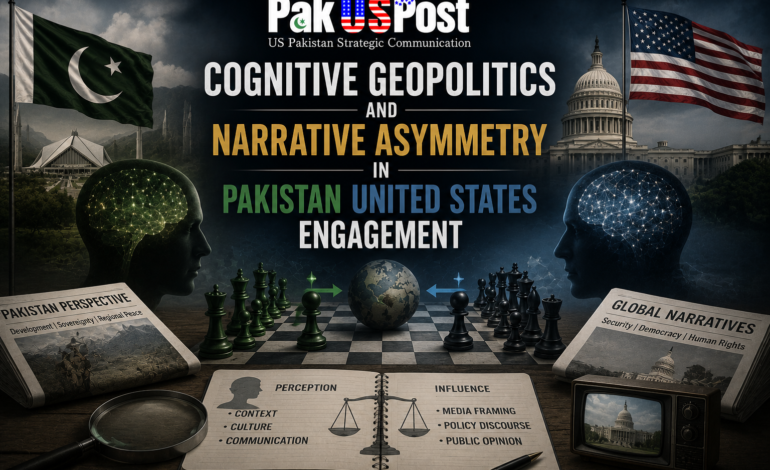
Cognitive Geopolitics and Narrative Asymmetry in Pakistan United States Engagement


The contemporary evolution of Pakistan–United States relations is increasingly intelligible only through the prism of cognitive geopolitics, wherein perception, narrative construction, and epistemic framing acquire as much strategic significance as material capabilities. The bilateral equation is no longer reducible to diplomatic exchanges or transactional cooperation; it has become a contested arena of meaning production in which each side seeks to define the other within strategically functional interpretive boundaries.
At the core of this transformation lies a profound asymmetry in narrative authority. The United States, by virtue of its embedded position within global media ecosystems, financial institutions, and knowledge production networks, retains disproportionate capacity to define the terms of engagement. Pakistan, in contrast, operates within a reactive narrative structure, often responding to externally generated framings rather than independently generating durable global interpretive paradigms. This imbalance produces what can be described as narrative dependency, a condition in which strategic identity is continuously shaped by external perception rather than internal articulation.
This cognitive asymmetry manifests in multiple layers. At the diplomatic level, Pakistan is frequently positioned within security centric narratives that prioritize risk management, nuclear stability, and counterterrorism legacy frameworks. At the economic level, it is framed through cycles of stabilization, debt vulnerability, and reform conditionality. At the geopolitical level, it is situated as an intermediary actor within broader regional contestations rather than as an autonomous agenda setter. These overlapping frames construct a bounded strategic identity that limits the interpretive space available for alternative self representation.
However, Pakistan’s foreign policy establishment has increasingly sought to disrupt this epistemic confinement by actively engaging in narrative engineering. The attempt to reposition the country as a connectivity hub, a mediation platform, and a regional stabilizer reflects a deliberate effort to expand its cognitive footprint in international discourse. This involves not only diplomatic signaling but also the cultivation of thematic narratives around geoeconomics, climate vulnerability, youth demographics, and digital transformation. Yet the effectiveness of such narrative expansion remains constrained by institutional capacity and the persistence of entrenched external frames.
The United States, meanwhile, operates within a multi layered narrative structure that reflects both strategic realism and institutional fragmentation. Different segments of the American policy ecosystem construct Pakistan through divergent lenses. Security institutions emphasize threat containment and strategic caution. Economic institutions emphasize stabilization and reform conditionality. Diplomatic institutions emphasize selective engagement and crisis management. This internal plurality produces a composite narrative that lacks singular coherence but maintains consistent underlying assumptions about asymmetry and risk.
The interaction between these narrative systems generates a condition of interpretive friction. Pakistan’s aspirational narratives of strategic centrality and regional mediation often collide with American narratives of conditional engagement and managed partnership. The resulting dissonance is not merely rhetorical but materially consequential, as it shapes policy expectations, investment flows, and diplomatic prioritization.
A critical dimension of this cognitive architecture is temporal divergence. Pakistan’s strategic narratives are often future oriented, emphasizing potential trajectories of connectivity, demographic dividends, and regional integration. Conversely, United States narratives are predominantly risk adjusted and present focused, emphasizing immediate stability, compliance benchmarks, and crisis mitigation. This temporal misalignment creates persistent difficulties in synchronizing policy expectations and strategic planning horizons.
Within this environment, information ecosystems play a decisive role. Digital platforms, think tank publications, policy briefs, and media discourse collectively construct interpretive frameworks that shape elite decision making. The competition over narrative legitimacy increasingly takes place in these semi autonomous spaces where perception formation precedes formal diplomacy. Pakistan’s limited penetration into these global epistemic infrastructures constitutes a structural disadvantage in shaping long term strategic narratives.
At the domestic level, cognitive geopolitics intersects with internal political discourse in ways that further complicate external engagement. Public perception of the United States oscillates between pragmatic necessity and historical skepticism, influenced by episodic geopolitical crises and regional conflicts. This ambivalence constrains the domestic legitimacy of sustained engagement strategies and introduces volatility into foreign policy continuity.
The strategic implication of this condition is that bilateral relations are increasingly mediated through narrative credibility rather than purely material interests. Trust deficits are not only institutional but epistemic, rooted in competing interpretations of intent, reliability, and strategic purpose. Without addressing this interpretive gap, material cooperation remains vulnerable to recurrent disruption.
For policymakers in Pakistan, the central challenge is to move from reactive narrative consumption to proactive narrative production. This requires institutional investment in strategic communication architecture, intellectual production ecosystems, and global policy engagement platforms. Narrative power in the contemporary system is not an ancillary function of diplomacy but a core component of strategic influence.
For the United States, a recalibration is required to recognize that excessive reliance on security centric framing of Pakistan limits the scope of constructive engagement. A more nuanced cognitive framework that integrates economic, demographic, and regional connectivity dimensions would enable a more stable and multidimensional partnership structure.
At a systemic level, the Pakistan–United States relationship illustrates a broader transformation in global politics where cognition itself becomes a domain of competition. Strategic outcomes are increasingly shaped not only by material capabilities but by the ability to define meaning, establish legitimacy, and structure perception. In this sense, geopolitics is no longer only spatial or economic but deeply epistemic.
Ultimately, the durability of bilateral engagement will depend on whether both states can reconcile their divergent narrative logics into a shared interpretive framework. Without such convergence, cooperation will remain episodic, reactive, and structurally unstable. With it, there exists the possibility of transforming a historically asymmetric relationship into a more coherent and strategically sustainable partnership grounded in mutual intelligibility rather than contested perception.
A Public Service Message


