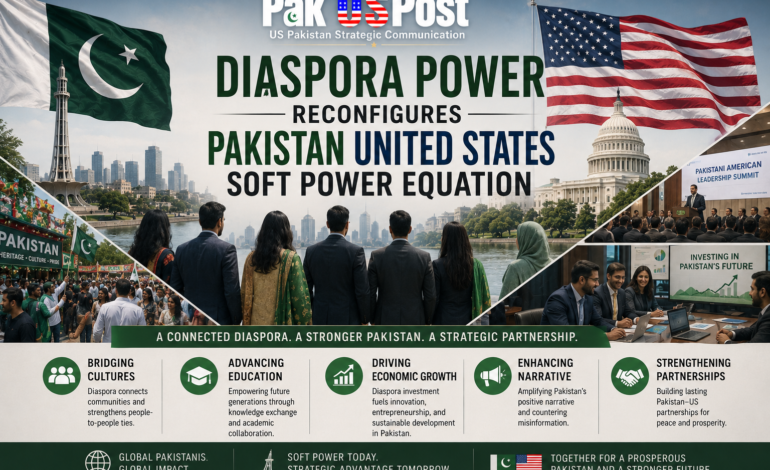
Diaspora Power Reconfigures Pakistan United States Soft Power Equation


In the contemporary architecture of international relations, the concept of diaspora has undergone a profound transformation, shifting from a peripheral sociocultural phenomenon into a strategically consequential instrument of statecraft. For Pakistan, whose geopolitical identity has long been shaped by asymmetries of power, contested narratives, and episodic diplomatic engagements with the United States, the diaspora now represents a latent yet under institutionalised reservoir of influence. It operates across multiple registers simultaneously, as an economic contributor, a cultural translator, a political interlocutor, and increasingly as a narrative broker within the epistemic corridors of American policy making. Yet despite its scale, education profile, and embeddedness within key sectors of the United States, this transnational community remains largely underleveraged within a coherent Pakistani soft power doctrine.
The evolution of diasporic agency must be situated within the broader restructuring of global influence systems, where traditional diplomatic hierarchies are being gradually supplemented, and in some cases displaced, by networked forms of persuasion, advocacy, and informational presence. In this new environment, soft power is no longer exclusively generated through state institutions or formal cultural diplomacy. Instead, it is diffused through dispersed actors embedded within academia, technology ecosystems, think tanks, media platforms, and policy advisory networks. The Pakistani diaspora in the United States is deeply embedded in these sectors, yet its influence remains fragmented, episodic, and often reactive rather than strategically coordinated.
At the core of this underutilisation lies a structural absence of institutional synchronisation between diaspora capabilities and state level foreign policy objectives. Engagement with diaspora communities has historically been symbolic, event driven, or crisis oriented, rather than embedded within a long term strategic framework of narrative construction and policy influence. As a result, diasporic contributions tend to surface during moments of bilateral tension or geopolitical crisis, rather than functioning as continuous channels of influence within the United States policy ecosystem.
This fragmentation is particularly consequential in an era where perception often precedes policy. Within Washington’s policy architecture, narratives about foreign states are shaped not only by official diplomatic channels but also by a dense ecology of think tanks, media outlets, academic institutions, and legislative advisory networks. Diasporic actors, by virtue of their embeddedness in these spaces, possess the capacity to influence interpretive frames through which Pakistan is understood. However, in the absence of coordinated narrative strategy, this capacity remains unevenly distributed and inconsistently mobilised.
The Pakistani diaspora is not a monolithic entity; it is stratified across generational lines, professional domains, ideological orientations, and degrees of political engagement. First generation migrants often maintain stronger affective ties to Pakistan, while second and third generation individuals are more deeply integrated into American socio political structures. This generational divergence produces distinct modes of engagement with homeland politics and policy discourse. The challenge for Pakistan is not to homogenise these differences but to construct a meta framework that can accommodate plural forms of diasporic engagement while aligning them with broader strategic objectives.
Economically, the diaspora already functions as a significant vector of financial inflow through remittances, investment channels, and entrepreneurial linkages. However, the strategic potential of these flows extends beyond macroeconomic stability. They can serve as conduits for technology transfer, knowledge exchange, and institutional collaboration, particularly in sectors such as information technology, healthcare, education, and renewable energy. Yet the absence of structured policy frameworks limits the transformation of these economic interactions into long term developmental partnerships.
More consequential, however, is the diasporic role in shaping epistemic narratives about Pakistan within the United States. In policy ecosystems where perception is often mediated through secondary knowledge production, diasporic academics, researchers, and policy professionals occupy critical intermediary positions. They contribute to scholarly discourse, policy reports, media commentary, and legislative briefings that collectively shape the cognitive environment in which decisions about Pakistan are made. This epistemic influence is subtle but cumulatively significant, particularly in contexts where Pakistan is often framed through security centric or crisis oriented lenses.
Yet the absence of coordinated narrative engagement limits the ability of diasporic actors to consistently counter reductive representations or to amplify alternative narratives centred on economic transformation, technological potential, or cultural plurality. In many cases, diaspora influence becomes reactive, mobilised primarily in response to negative coverage or diplomatic tensions rather than proactively shaping long term narrative trajectories.
The United States itself provides a conducive environment for diasporic political engagement, given its pluralistic institutional structure and openness to advocacy networks. Ethnic diasporas from multiple countries have successfully institutionalised their influence through lobbying organisations, political action committees, academic networks, and media engagement strategies. These models demonstrate that diasporic influence is most effective when it is structurally organised rather than informally dispersed. For Pakistan, the absence of comparable institutional mechanisms represents a strategic gap in its soft power architecture.
In the current geopolitical climate, where US foreign policy is increasingly influenced by domestic political considerations, diasporic lobbying and advocacy can play a pivotal role in shaping legislative and executive perceptions. Issues such as development assistance, security cooperation, trade policy, and climate collaboration are all subject to interpretive framing within domestic political discourse. Diasporic actors, if strategically coordinated, can contribute to reframing Pakistan not as a recurrent crisis state but as a multidimensional partner in regional stability and economic connectivity.
However, effective mobilisation of diaspora power requires a shift from episodic engagement to institutional integration. This involves the creation of structured platforms that connect diaspora professionals with Pakistani diplomatic missions, policy think tanks, and economic planning bodies. It also necessitates the development of transnational advisory mechanisms that allow diaspora expertise to be systematically incorporated into foreign policy formulation rather than being treated as peripheral consultation.
Digital transformation further expands the scope of diasporic influence. Social media platforms, professional networks, and digital publishing ecosystems enable diasporic actors to operate as independent nodes of narrative production. However, these same platforms are governed by algorithmic visibility structures that can amplify or marginalise content depending on engagement metrics and platform priorities. As a result, diasporic influence is simultaneously empowered and constrained by the same digital infrastructures that mediate global information flows.
To fully realise the strategic potential of diaspora engagement, Pakistan must adopt a calibrated soft power doctrine that integrates narrative strategy, institutional coordination, and digital diplomacy. This includes establishing dedicated diaspora policy units within foreign ministry structures, creating incentive frameworks for knowledge exchange, and investing in long term relationship building with diaspora professionals in key sectors. It also requires a reimagining of diplomatic practice itself, from state centric representation to network centric engagement.
Equally important is the need to move beyond transactional approaches to diaspora relations. Remittances and short term political mobilisation, while important, do not constitute a comprehensive soft power strategy. What is required is a sustained effort to build epistemic trust, where diaspora actors perceive themselves not merely as financial contributors or cultural ambassadors but as co architects of Pakistan’s global narrative identity.
In the broader context of Pakistan United States relations, diaspora engagement offers a unique opportunity to recalibrate bilateral perceptions. At a time when geopolitical narratives are increasingly contested and often polarised, diasporic actors can function as stabilising intermediaries capable of translating complex realities into accessible policy discourse. This translational function is particularly valuable in reducing misperceptions, mitigating narrative volatility, and fostering more nuanced policy engagement.
Ultimately, the strategic significance of the Pakistani diaspora lies not only in its demographic presence or economic contribution but in its epistemic positioning within global knowledge systems. It occupies a space where identity, influence, and information intersect, creating opportunities for soft power projection that are both subtle and consequential. However, without institutional foresight and strategic coordination, this potential will remain dispersed across individual achievements rather than consolidated into national capability.
The future of Pakistan United States soft power relations will increasingly depend on how effectively diaspora networks are integrated into broader diplomatic and narrative strategies. In a world where influence is distributed rather than centralised, and where perception often shapes policy outcomes, diaspora engagement is not a supplementary instrument of foreign policy but a central pillar of it.
A Public Service Message