
Algorithmic Governance Distorts Pakistan Digital Visibility and Global Narrative Order

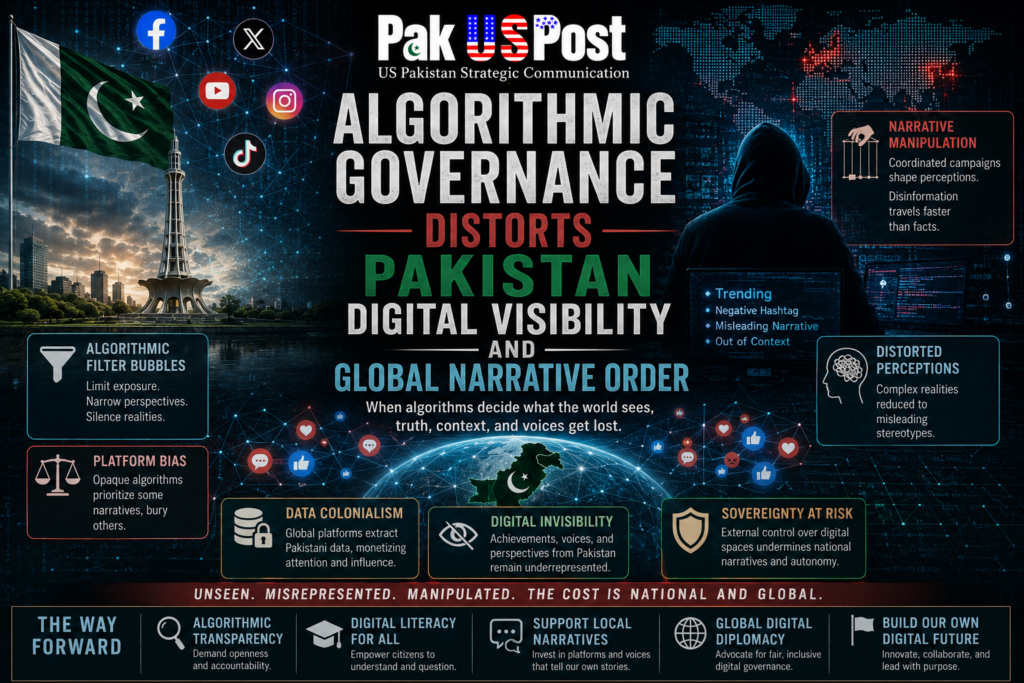
In the contemporary configuration of global informational capitalism, visibility has emerged as a scarce and politically conditioned resource, distributed not through neutral mechanisms of communication but through deeply embedded algorithmic systems that govern attention, prioritisation, and circulation of content. Within this evolving order, Pakistan’s digital presence is increasingly shaped by structural asymmetries embedded in the architectures of Western technology platforms that function as de facto regulators of global perception. These systems, while formally presented as neutral infrastructures of connectivity, operate through opaque logics of optimisation that privilege engagement intensity, behavioural predictability, and commercial viability over contextual accuracy or geopolitical balance.
The consequence is a profound distortion in how Pakistan is represented, perceived, and cognitively mapped within global digital environments. This distortion is not episodic but structural, arising from the underlying design principles of algorithmic governance systems that are calibrated to maximise user retention and monetisation rather than epistemic diversity. In such an environment, countries like Pakistan are often relegated to narrowly defined narrative clusters that emphasise instability, security crises, or episodic political turbulence, while systematically marginalising slower, developmental, intellectual, and cultural narratives that do not conform to high engagement thresholds.
This phenomenon produces what can be analytically described as representational asymmetry, a condition in which the visibility of a state within global digital ecosystems is disproportionately skewed toward certain narrative frames while excluding others. Representational asymmetry does not necessarily imply censorship in the traditional sense; rather, it reflects the structural invisibilisation of complexity through algorithmic filtering processes that operate at scale and in real time. Over time, this generates a cumulative epistemic effect in which Pakistan is persistently perceived through a constrained set of interpretive lenses that are continuously reinforced by platform driven repetition.
At the heart of this process lies the logic of algorithmic governance, a regime in which decision-making authority over information visibility is delegated to machine learning systems trained on historical behavioural data. These systems are not merely technical intermediaries; they are epistemic agents that shape what is seen, what is amplified, and what is systematically deprioritised. Their operation is guided by feedback loops that privilege content capable of generating immediate emotional response, thereby incentivising the proliferation of sensationalist or conflict-oriented narratives at the expense of nuanced or structurally complex information.
For Pakistan, this dynamic has significant implications for global narrative positioning. The country’s digital identity is increasingly mediated through external platforms whose algorithmic priorities do not align with national informational objectives. As a result, the global audience encounters a filtered version of Pakistan that is disproportionately weighted toward crisis narratives, thereby reinforcing preexisting geopolitical stereotypes. This narrowing of representational bandwidth constrains Pakistan’s ability to project alternative narratives centred on economic transformation, technological advancement, cultural production, and intellectual capital.
The issue is further compounded by the consolidation of a small number of global technology corporations that control most of the digital traffic and information distribution channels. These platforms operate transnationally but are governed by regulatory frameworks, cultural assumptions, and economic incentives rooted primarily in Western institutional contexts. Consequently, the epistemic hierarchy embedded within these systems reflects asymmetries of global power, where certain geographies are structurally advantaged in terms of visibility and narrative amplification, while others remain peripheral or episodically visible.
In this context, algorithmic bias does not necessarily manifest as intentional discrimination but as emergent systemic bias resulting from data training sets, engagement optimisation models, and platform monetisation strategies. However, the geopolitical consequences of such bias are nonetheless profound. They shape international perceptions, influence policy discourse, and indirectly affect investment flows, diplomatic engagement, and soft power projection. For Pakistan, this translates into a persistent representational deficit in global digital discourse.
The challenge is further intensified by the increasing convergence of digital platforms with mainstream information ecosystems. Social media networks, search engines, and video distribution platforms now function as primary sources of news and geopolitical interpretation for large segments of the global population. In such a landscape, algorithmic visibility effectively becomes synonymous with informational reality. What is not algorithmically amplified risks becoming epistemically invisible, regardless of its factual significance or strategic importance.
Pakistan’s digital visibility is therefore not merely a question of content production but of structural positioning within global information architectures. The absence of sustained algorithmic amplification for Pakistan related developmental narratives results in a skewed global understanding of the country’s socio economic trajectory. This has downstream effects on international perceptions of stability, governance capacity, and investment potential, thereby reinforcing a cyclical relationship between visibility deficit and narrative marginalisation.
Addressing this challenge requires a shift from reactive digital communication strategies to proactive algorithmic engagement frameworks. Traditional approaches that focus on content generation alone are insufficient in an environment where visibility is governed by opaque computational systems. Instead, Pakistan must develop a multidimensional strategy that engages with the structural logics of algorithmic governance itself, including data architecture, platform engagement protocols, and visibility optimisation techniques.
One critical dimension of this strategy involves the development of indigenous digital ecosystems capable of generating high quality, context rich content that can compete within global attention economies. This includes investment in local media production capabilities, multilingual content generation, and AI assisted narrative modelling that can enhance the global discoverability of Pakistan related content. However, such efforts must be complemented by deeper engagement with platform governance structures.
Engagement with global technology companies must evolve beyond content moderation discussions toward negotiations over algorithmic transparency, visibility equity, and data representational fairness. This requires Pakistan to position itself not merely as a content producing state but as a stakeholder in global digital governance. Issues such as recommendation system design, search ranking criteria, and content distribution logic must be brought into the domain of diplomatic and regulatory negotiation.
At the same time, Pakistan must invest in domestic regulatory and analytical capacity to understand and respond to algorithmic dynamics. The establishment of algorithmic observatories, digital visibility monitoring units, and data analytics institutions would enable the state to systematically track how national narratives are being distributed, amplified, or suppressed across global platforms. Such institutional capacity is essential for moving from passive observation to active intervention in digital narrative ecosystems.
Another critical dimension involves strengthening digital literacy within the domestic population. In environments where informational flows are highly mediated and algorithmically filtered, the ability of citizens to critically interpret digital content becomes a form of cognitive resilience. Enhancing public understanding of how algorithms shape information consumption can reduce susceptibility to distorted narratives and improve the overall quality of public discourse.
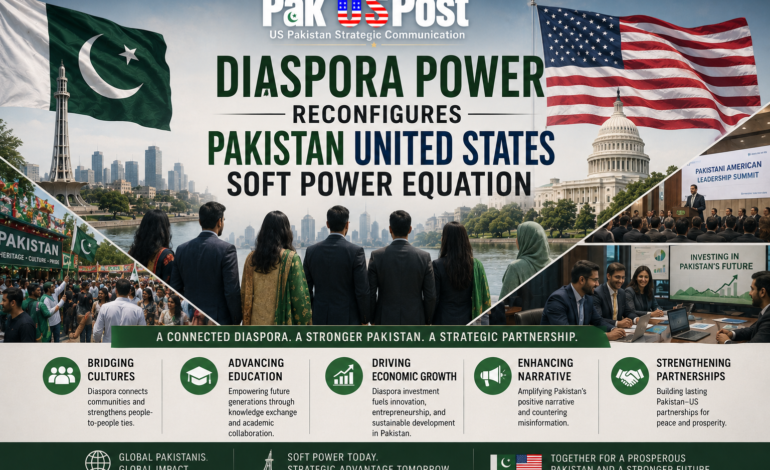
Diasporic networks also play a significant role in this ecosystem, as they often function as amplifiers of Pakistan related content within global digital platforms. However, their influence is also subject to the same algorithmic constraints that govern broader visibility patterns. Strategic coordination with diaspora content producers, influencers, and digital professionals can help enhance the reach and impact of alternative narratives about Pakistan.
Ultimately, the challenge of algorithmic governance is not merely technical but deeply geopolitical. It reflects the distribution of epistemic power in the digital age, where the ability to define visibility is closely linked to the ability to shape perception. For Pakistan, addressing representational bias requires not only technological adaptation but strategic repositioning within global information hierarchies.
The future of Pakistan’s digital presence will depend on its capacity to navigate these complex algorithmic environments while simultaneously asserting its narrative sovereignty. This will require sustained investment in digital infrastructure, institutional innovation, and diplomatic engagement with global technology actors. In an era where visibility is power, and algorithms are the gatekeepers of visibility, the struggle for narrative equity has become a central dimension of statecraft itself.
A Public Service Message