Algorithmic Power and Strategic Asymmetry in Global Decision-Making Systems

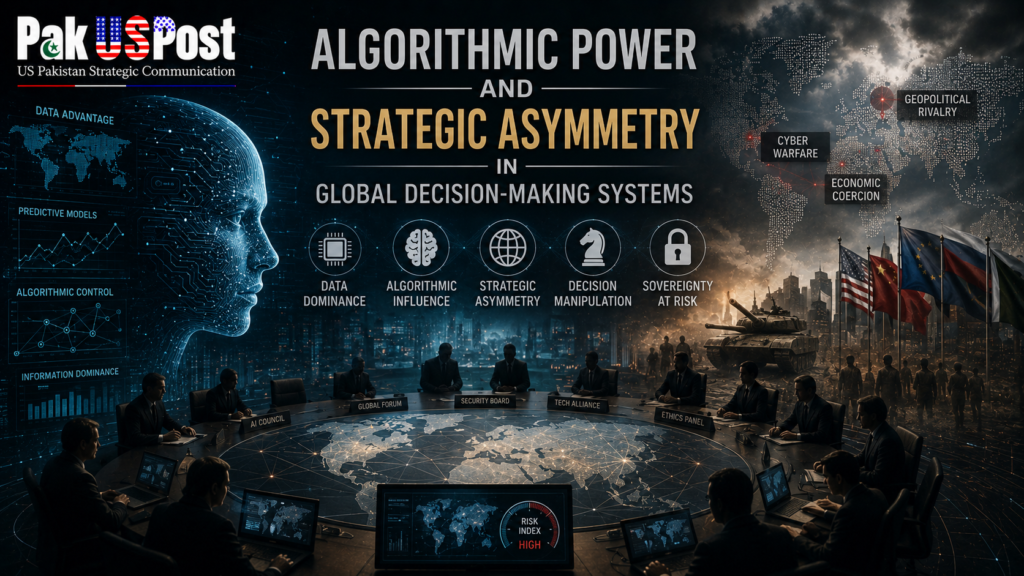
In the contemporary architecture of global power, the decisive variable is no longer the accumulation of conventional force alone, but the compression of decision-making time through algorithmic systems that increasingly mediate intelligence, prediction, and response. Across major strategic theatres, particularly within the evolving interface between advanced Western states and structurally constrained developing economies such as Pakistan, the centre of gravity has shifted from kinetic capability to cognitive velocity. This transformation is not rhetorical. It is embedded in the operational logic of modern intelligence agencies, defence planning units, financial regulators, and diplomatic corps, all of which are progressively reliant on artificial intelligence systems to interpret geopolitical signals in real time and convert them into anticipatory action.
The implications of this shift are profound for states that remain institutionally anchored in legacy bureaucratic models. In such environments, decision cycles are linear, hierarchical, and procedurally delayed, whereas algorithmically enabled states increasingly operate through recursive systems of continuous sensing, pattern recognition, and predictive recalibration. The result is a widening asymmetry not merely in power, but in temporal perception itself. Where one actor forecasts, the other reacts; where one simulates future scenarios at scale, the other processes past events with administrative delay.
For Pakistan, this asymmetry is not abstract. It manifests in intelligence lag, policy fragmentation, and a structural dependency on externally generated data ecosystems that shape threat perception without necessarily reflecting domestic epistemic priorities. The strategic establishment, particularly within security and economic planning domains, is therefore confronted with a dual challenge. It must both integrate artificial intelligence into national decision architectures while simultaneously ensuring that such integration does not reproduce dependency on external computational infrastructures that may encode latent geopolitical biases.
Western states, led by the United States, have already moved decisively toward what may be termed algorithmic statecraft. Intelligence fusion centres increasingly integrate machine learning systems capable of synthesising satellite surveillance, financial transaction monitoring, digital communication metadata, and open-source intelligence streams into unified predictive models. These systems do not merely enhance human decision-making; they restructure it. The human actor becomes a validator of machine-generated probabilities rather than the primary originator of strategic assessment.
This recalibration introduces a form of structural asymmetry that is difficult to quantify in traditional terms. Military parity, diplomatic engagement, and economic interdependence become secondary variables when one side possesses the ability to anticipate strategic moves with significantly reduced latency. In such a configuration, deterrence itself is redefined. The credibility of response is no longer measured solely by capability, but by the speed and accuracy with which intent can be interpreted.
The global diffusion of artificial intelligence has also produced a parallel stratification within the international system. At the apex are states with sovereign computational ecosystems, proprietary data reserves, and advanced semiconductor access. Beneath them are states integrated into global digital platforms but lacking control over underlying infrastructures. At the lowest tier are digitally dependent economies whose data flows, communication systems, and informational architectures are largely governed by external technological actors. Pakistan’s positioning is increasingly closer to the second category, with elements of third-tier vulnerability in critical domains such as cloud dependency, cybersecurity infrastructure, and platform-mediated communication systems.
The hidden risk embedded in this structure is not immediate technological exclusion, but gradual epistemic dependency. When predictive models, risk assessments, and even administrative dashboards are externally sourced, the conceptual framing of reality itself becomes partially outsourced. Strategic perception is thus shaped by systems whose training data, algorithmic priorities, and optimization goals may not align with domestic security imperatives. This introduces a subtle but persistent distortion in national decision-making frameworks.
A further complication arises from the convergence of artificial intelligence systems with financial and informational markets. Algorithmic trading platforms, automated risk assessment tools, and sentiment analysis engines now influence capital flows, currency valuation expectations, and investment decisions at a speed that outpaces traditional regulatory response mechanisms. In such an environment, states that cannot interpret or respond to algorithmic market signals in real time risk systemic economic volatility that is externally amplified.
For Pakistan’s economic planners, this represents a critical vulnerability. Fiscal and monetary policy instruments remain largely reactive, while global financial systems increasingly operate through predictive automation. The resulting gap between policy formulation and market reaction creates structural instability, particularly in emerging economies exposed to external shocks through trade, remittance flows, and debt instruments.
At the military-strategic level, artificial intelligence is reshaping intelligence cycles in ways that compress the space between detection and action. Predictive surveillance systems, autonomous reconnaissance platforms, and real-time signal analysis tools reduce the time available for human deliberation. In contrast, states without integrated AI architectures are forced into slower interpretive loops, relying on fragmented intelligence inputs and manual synthesis processes. This disparity does not simply reduce efficiency; it alters the strategic initiative itself.
The establishment concerns within Pakistan’s strategic institutions must therefore be understood in terms of systemic adaptation rather than incremental modernization. Piecemeal digitization is insufficient. What is required is a structural re-engineering of decision architectures, integrating artificial intelligence not as an auxiliary tool but as a core component of strategic cognition. Without this shift, the gap between perception and reality will continue to widen, increasing the risk of miscalculation in high-stakes environments.
However, the integration of artificial intelligence into national security systems introduces its own set of latent risks. Chief among these is the problem of algorithmic opacity. Machine learning systems, particularly those based on deep neural networks, often operate as non-transparent decision engines. Their outputs are statistically derived rather than logically explained, creating a tension between operational efficiency and interpretive accountability. In strategic environments where attribution, justification, and escalation control are essential, such opacity can become a liability.
Another critical risk lies in data sovereignty. Artificial intelligence systems are only as reliable as the datasets that train them. If training data is sourced externally or filtered through global platforms dominated by a limited number of corporations and states, the resulting models may embed structural biases that are not immediately visible. For a country like Pakistan, this raises the possibility that its strategic decision-making tools may inadvertently reflect external geopolitical assumptions.
There is also the emerging threat of algorithmic warfare. In future conflict scenarios, adversarial actors may seek to manipulate training data, corrupt information pipelines, or inject adversarial inputs designed to distort predictive outputs. Unlike conventional cyberattacks, such interventions do not necessarily disrupt systems; they alter their reasoning. The result is a more insidious form of strategic interference in which decision-making remains functional but becomes progressively misaligned with reality.
From a policy perspective, the response framework must operate across multiple dimensions. First, there is an urgent need for the establishment of sovereign computational infrastructure capable of hosting critical national datasets within secure, domestically governed environments. Without such infrastructure, any attempt at artificial intelligence integration will remain structurally dependent on external cloud ecosystems.
Second, Pakistan must prioritise the development of indigenous algorithmic expertise. This requires sustained investment in advanced computer science education, machine learning research institutions, and applied data science programmes integrated with national security and economic planning bodies. The objective is not merely technological literacy, but strategic interpretive autonomy.
Third, institutional architecture must evolve to accommodate hybrid human-machine decision systems. This does not imply the replacement of human judgment, but the creation of integrated frameworks in which algorithmic outputs are continuously interrogated, validated, and contextualised by domain experts. Such systems must be designed to prevent overreliance on automated outputs while still capturing their analytical advantages.
Fourth, regulatory frameworks governing data governance, privacy, and algorithmic accountability must be strengthened. The absence of robust legal structures governing data usage creates long-term vulnerabilities that extend beyond immediate security concerns into the domain of civil liberties and institutional legitimacy.
Fifth, Pakistan must engage in strategic technological diversification. Overdependence on a narrow set of external technology providers increases exposure to geopolitical leverage through supply chain constraints, software dependencies, and platform governance decisions. A multi-vector approach to technological partnerships, including emerging digital economies and non-traditional technology blocs, can mitigate this risk.
At the diplomatic level, artificial intelligence is increasingly shaping the contours of international negotiation itself. Predictive modelling tools are now used to simulate negotiation outcomes, assess counterpart behaviour, and optimise diplomatic strategies. States lacking access to such tools may find themselves at a structural disadvantage in complex multilateral negotiations where information asymmetry is algorithmically amplified.
The broader geopolitical narrative framing artificial intelligence as a neutral technological advancement obscures its embedded strategic dimensions. AI systems are becoming instruments of state power, embedded within broader ecosystems of economic influence, military capability, and informational control. The convergence of technology corporations and state institutions in advanced economies has effectively dissolved the boundary between commercial innovation and strategic doctrine.
For Pakistan, the strategic imperative is therefore not simply adoption, but adaptation within a constrained environment of global technological stratification. Failure to recognise the systemic nature of algorithmic asymmetry risks locking the country into a permanent state of reactive governance, where policy is continuously shaped by external informational systems rather than internal strategic cognition.
The ultimate risk is not technological backwardness in isolation, but the erosion of decision-making sovereignty. When the speed, structure, and content of national decisions are increasingly mediated by external algorithmic systems, sovereignty becomes procedural rather than substantive. A state may retain formal independence while losing control over the cognitive architecture through which decisions are formed.
In this emerging order, the decisive question is no longer whether artificial intelligence will influence geopolitics, but whether states without algorithmic sovereignty can meaningfully participate in shaping their own strategic futures. For Pakistan’s policy establishment, the answer will depend on the speed with which it transitions from passive technological consumption to active computational sovereignty.
A Public Service Message