
Cyber Infrastructure Dependence and the Future of Hybrid Sovereignty Pakistan

The contemporary notion of sovereignty is undergoing a structural reconfiguration that is neither immediately visible nor conventionally acknowledged within traditional security discourse. In the emerging global order, power is no longer exercised solely through territorial control, military capability, or diplomatic leverage, but through the governance of cyber infrastructure, data ecosystems, and digital dependency chains that underpin the functioning of modern states. Within this recalibrated environment, Pakistan occupies a particularly precarious position, defined by accelerated digital adoption on one hand and persistent infrastructural dependence on external technological architectures on the other.
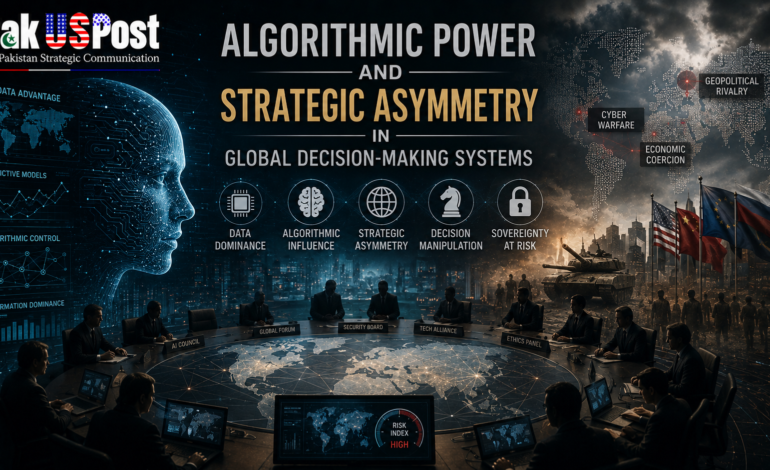
The transformation is subtle in appearance but profound in consequence. States are increasingly governed through hybrid systems where physical sovereignty coexists with digital subordination. This condition may be described as hybrid sovereignty, in which a country retains constitutional independence while critical aspects of its informational, financial, and communicational infrastructure are embedded within transnational technological systems. These systems are often controlled or influenced by a limited number of global technology corporations whose operational logic is shaped by the strategic interests of their home jurisdictions.
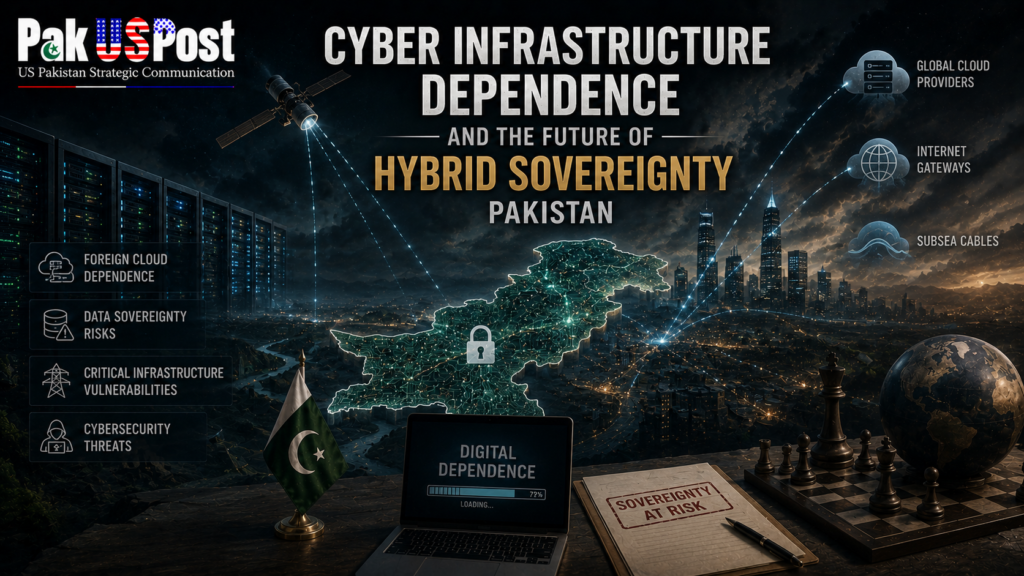
For Pakistan, this hybrid condition is not theoretical. It is embedded in everyday governance structures, financial transactions, telecommunications networks, digital identity systems, cloud storage dependencies, and social media infrastructures that mediate public discourse. The state operates within a layered digital environment where core functionalities are increasingly dependent on platforms and infrastructures beyond its sovereign control. This dependency introduces a series of structural vulnerabilities that extend beyond cybersecurity into the realm of strategic autonomy.
The expansion of digital connectivity in Pakistan has been widely celebrated as an enabler of economic modernization and social inclusion. Mobile banking, e governance systems, online education platforms, digital commerce, and remote communication tools have expanded the state’s functional reach. However, beneath this surface of technological progress lies a deeper structural asymmetry. The foundational layers of these systems are predominantly constructed, maintained, and governed by external actors. This creates a condition where operational efficiency is achieved at the cost of infrastructural sovereignty.
Cyber infrastructure has become the invisible backbone of state functionality. Energy distribution systems, banking networks, telecommunications grids, transportation logistics, and administrative databases are all increasingly reliant on interconnected digital systems. Any disruption, manipulation, or constraint within these networks has the potential to generate cascading effects across multiple sectors simultaneously. Unlike traditional infrastructure, cyber systems operate in real time and at scale, amplifying both efficiency and vulnerability.
The hidden risk for Pakistan lies in the asymmetry between digital dependency and cyber resilience. While the country has rapidly expanded its digital footprint, the development of indigenous cyber security architecture, sovereign cloud infrastructure, and integrated threat detection systems has not evolved at a comparable pace. This creates an exposure gap where external cyber threats or systemic disruptions could produce disproportionate impacts on national stability.
Global developments in cyber warfare doctrine further intensify this concern. Modern conflict scenarios increasingly incorporate hybrid strategies that combine conventional military pressure with cyber disruption, informational manipulation, and economic coercion. In such environments, state capacity is tested not only on the battlefield but within digital ecosystems that govern civilian life. A coordinated cyber intrusion targeting financial systems, energy infrastructure, or communication networks could generate systemic paralysis without traditional military engagement.
Pakistan’s strategic establishment is therefore confronted with a dual challenge. It must simultaneously secure its digital infrastructure while also ensuring that the systems it relies upon do not become instruments of external leverage. This requires a fundamental shift in how cyber sovereignty is conceptualized. Security can no longer be treated as a technical function delegated to specialized agencies alone. It must be integrated into the core architecture of national policy planning, economic strategy, and diplomatic engagement.
One of the most significant dimensions of this challenge is data sovereignty. In the digital age, data functions as a strategic resource comparable to energy or natural capital. It informs predictive analytics, economic modelling, security assessments, and governance frameworks. When data is stored, processed, or analyzed through external infrastructures, it becomes subject to jurisdictional and corporate governance regimes beyond national control. This raises concerns regarding both privacy and strategic autonomy.
Pakistan’s current data ecosystem remains heavily reliant on external cloud services and platform infrastructures. While this facilitates operational efficiency and global integration, it also introduces dependency risks. The absence of fully sovereign data storage systems means that critical information flows may be vulnerable to external access, regulatory constraints, or geopolitical contingencies. In an increasingly fragmented global digital environment, such exposure carries long term strategic implications.
Another critical dimension is platform dependency. Digital platforms now function as intermediaries for communication, commerce, information dissemination, and public discourse. Their algorithmic structures determine visibility, influence, and narrative circulation. In effect, they act as gatekeepers of informational ecosystems. For states like Pakistan, this introduces a new form of structural vulnerability where public perception and political discourse are partially shaped by external algorithmic systems.
The geopolitical dimension of cyber infrastructure is becoming increasingly pronounced. Leading technology powers are now integrating digital governance frameworks into broader foreign policy strategies. Cybersecurity standards, data localization requirements, cloud service regulations, and digital trade agreements are increasingly used as instruments of strategic alignment. States that conform to these frameworks gain access to technological ecosystems, while those that diverge risk partial exclusion or constrained interoperability.
This evolving landscape places Pakistan in a complex strategic position. Its economic modernization requires continued integration into global digital systems, yet excessive dependence on a narrow set of technological ecosystems risks constraining policy autonomy. The challenge is not simply technological but geopolitical, requiring careful calibration between integration and sovereignty.
The financial sector provides a clear illustration of this dynamic. Digital banking systems, mobile payment platforms, and fintech infrastructures have significantly enhanced financial inclusion. However, these systems are often built upon foreign software architectures, cloud infrastructures, and security protocols. This creates a dependency chain where disruptions in external technological ecosystems can directly impact domestic financial stability.
Similarly, the telecommunications sector is increasingly reliant on imported hardware, software, and network management systems. These dependencies introduce potential vulnerabilities at both the hardware and software levels. In scenarios of geopolitical tension or supply chain disruption, access to critical updates, security patches, or system maintenance could be constrained, affecting national communication infrastructure.
The rise of artificial intelligence further complicates this landscape. AI systems depend on large datasets, computational infrastructure, and algorithmic frameworks that are predominantly controlled by a limited number of global actors. Without indigenous AI development capacity, countries risk becoming consumers rather than producers of strategic intelligence systems. This reinforces dependency while limiting interpretive autonomy.
Cyber infrastructure also plays a central role in shaping informational environments. Social media platforms, content distribution networks, and search algorithms determine the visibility of information and the structure of public discourse. In politically sensitive environments, this creates the potential for informational asymmetry where certain narratives are amplified while others are marginalized through algorithmic prioritization.
For Pakistan, this introduces a critical governance challenge. The state must navigate between preserving open informational ecosystems and mitigating the risks of informational destabilization. Excessive restriction risks undermining digital innovation and economic participation, while insufficient oversight may expose the polity to external informational manipulation.
The policy response to these challenges must operate on multiple levels. First, there is an urgent need to develop sovereign cyber infrastructure, including domestically controlled cloud systems capable of hosting critical government and financial data. Such infrastructure would reduce dependency on external providers while enhancing resilience against cyber disruptions.
Second, Pakistan must invest in the development of indigenous cybersecurity capabilities. This includes not only defensive systems but also advanced threat intelligence, penetration testing frameworks, and real time monitoring architectures. Cybersecurity must be treated as a continuous strategic function rather than a reactive technical response.
Third, the country must prioritize the creation of integrated digital governance frameworks that align cybersecurity, data protection, and technological development under a unified strategic vision. Fragmented regulatory approaches are insufficient in addressing the systemic nature of cyber dependency.
Fourth, there is a need to expand domestic capacity in software engineering, cloud architecture, and data science. Human capital development is essential for reducing long term dependency on external technological expertise. Without a skilled domestic workforce, infrastructural sovereignty remains unattainable.
Fifth, Pakistan should pursue strategic diversification in its technological partnerships. Over reliance on a narrow set of global providers increases exposure to geopolitical leverage. A diversified technological ecosystem, incorporating multiple regional and global partners, can enhance resilience and reduce dependency concentration.
At the diplomatic level, cyber infrastructure must now be recognized as a core component of foreign policy engagement. Digital trade agreements, cybersecurity cooperation frameworks, and data governance negotiations are becoming central to international relations. Pakistan must therefore develop specialized diplomatic capacity to engage in techno geopolitical negotiations.
The broader implication of this transformation is that sovereignty itself is being redefined. Traditional notions of territorial control are being supplemented by infrastructural control over digital systems that underpin state functionality. In this context, sovereignty is no longer binary but layered, existing across physical, digital, and algorithmic domains.
The risk for Pakistan is that without strategic intervention, it may find itself in a condition where formal sovereignty remains intact while operational sovereignty becomes increasingly constrained. In such a scenario, critical decisions may be influenced or shaped by external technological systems, even in the absence of direct political interference.
The challenge is therefore not to resist digital transformation, but to reshape its architecture in ways that preserve strategic autonomy. Cyber infrastructure must be treated as a national strategic asset, comparable in importance to energy systems or defense capabilities. Its governance must reflect this status through coordinated institutional oversight, sustained investment, and long-term strategic planning.
Ultimately, the future of hybrid sovereignty will depend on whether states like Pakistan can transition from passive participants in global digital ecosystems to active architects of their own cyber infrastructure. The stakes are not merely technological. They are fundamentally political, economic, and strategic in nature, shaping the contours of sovereignty in the emerging global order.
A Public Service Message