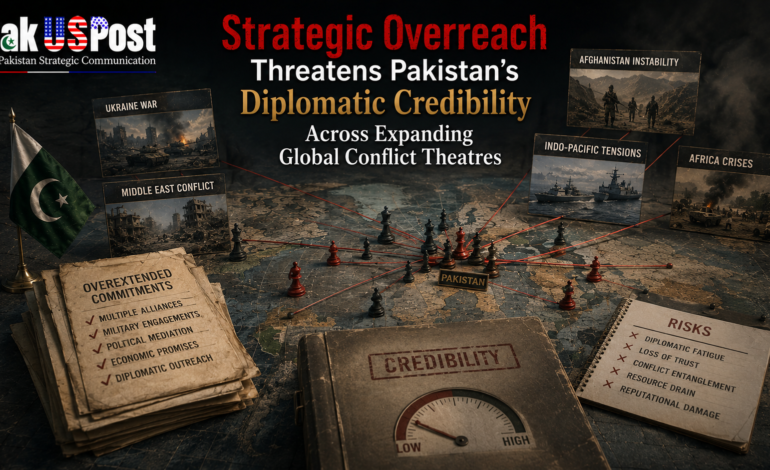
Strategic Overreach Threatens Pakistan’s Diplomatic Credibility Across Expanding Global Conflict Theatres


Pakistan’s foreign policy establishment increasingly projects the image of a state seeking relevance through mediation, strategic balancing, and geopolitical intermediation across multiple theatres of international tension simultaneously. From Washington to Beijing, from Tehran to Riyadh, from Kabul to the Gulf monarchies, Islamabad attempts to preserve channels with rival actors whose interests increasingly collide within a fragmented global order. At first glance, this diplomatic agility appears strategically sophisticated. Yet beneath the optics of engagement lies a deeper and potentially dangerous contradiction. Pakistan’s expanding mediation ambitions may be evolving faster than the institutional capacity required to sustain them.
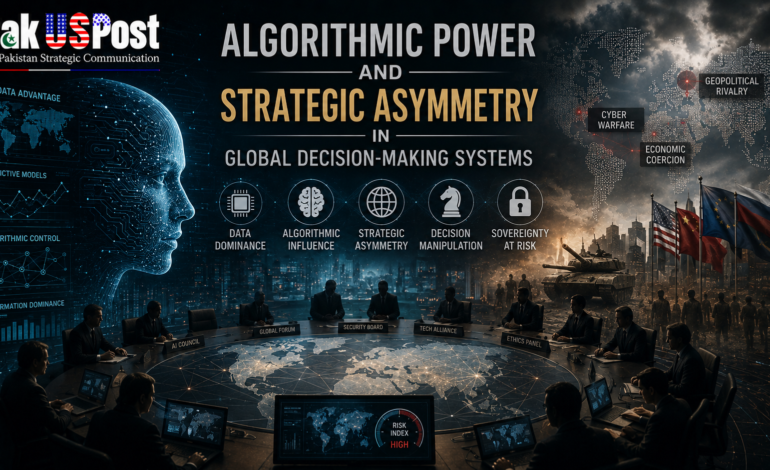
This risk is not theoretical. Contemporary geopolitics is entering an era defined by overlapping crises, economic nationalism, proxy conflicts, energy insecurity, technological rivalry, maritime competition, and ideological fragmentation. In such an environment, middle powers frequently attempt to convert geographic location into diplomatic leverage by presenting themselves as bridges between competing blocs. Pakistan has embraced this role with growing intensity. The challenge, however, is that diplomatic visibility and strategic capability are not synonymous. States can become overexposed internationally while simultaneously weakening internally.
The hidden concern within advanced strategic circles is that Pakistan may gradually drift toward a condition best described as diplomatic overstretch. Under this scenario, the state becomes symbolically indispensable across multiple negotiations but operationally constrained in its ability to deliver sustainable outcomes. The consequences of such imbalance can be severe. Credibility weakens. Expectations become unmanageable. Rival actors question neutrality. Domestic institutions experience exhaustion. Strategic ambiguity eventually transforms into strategic confusion.
Pakistan’s contemporary mediation posture emerged partly from necessity. The withdrawal of American forces from Afghanistan altered regional calculations profoundly. Simultaneously, rising tensions involving Iran, Gulf security frameworks, China’s regional expansion, maritime competition in the Arabian Sea, and renewed fragmentation across the Middle East increased the value of states capable of maintaining communication channels with multiple adversarial actors. Islamabad interpreted this shifting environment as an opportunity to reposition itself diplomatically after years of economic turbulence and political instability.
There was logic behind this recalibration. Pakistan possesses certain structural advantages. Its military establishment retains longstanding operational relationships with Washington. Its strategic partnership with Beijing remains significant. Cultural and political linkages with Gulf monarchies continue despite periodic tensions. Relations with Tehran remain complex yet functional. Islamabad also maintains historical influence regarding Afghanistan’s evolving power structures. Few regional states possess simultaneous access across such divergent geopolitical networks.
However, access alone does not constitute durable influence. Sustainable mediation requires institutional stability, economic resilience, diplomatic consistency, and international credibility. This is where Pakistan’s strategic dilemma becomes increasingly visible. The state attempts to perform the role of a stabilizing intermediary while itself confronting inflationary pressure, debt dependence, governance fragmentation, political polarization, technological limitations, and domestic legitimacy concerns. The contradiction is difficult for external actors to ignore indefinitely.
The United States approaches Pakistan pragmatically within this context. Washington recognizes Islamabad’s utility regarding counterterrorism management, regional crisis communication, and strategic observation of Chinese expansion. Yet American policymakers also remain skeptical of Pakistan’s long term reliability due to historical oscillations in alignment, internal instability, and unresolved tensions surrounding militancy. Consequently, the relationship remains functional but carefully limited. Washington seeks cooperation without strategic overinvestment.
China interprets Pakistan through a similarly dual framework. Beijing values geographic connectivity, maritime access, and strategic depth against Indian competition. Yet Chinese concerns regarding security volatility, bureaucratic inconsistency, and economic instability continue to intensify quietly. Corridor diplomacy initially symbolized transformational partnership, but implementation challenges gradually exposed institutional weaknesses inside Pakistan’s governance architecture. Beijing continues supporting Islamabad because the strategic benefits remain considerable, though patience increasingly coexists with caution.
This dual dependence upon both Washington and Beijing creates a delicate balancing act. Pakistan seeks to avoid exclusive alignment with either power while simultaneously relying upon both for different dimensions of national stability. Such balancing can generate diplomatic leverage under stable conditions. During periods of escalating global polarization, however, intermediary states frequently encounter mounting pressure to clarify strategic orientation. The danger lies not in choosing sides abruptly but in appearing unreliable to all parties simultaneously.
Iran introduces another layer of complexity. Islamabad maintains careful engagement with Tehran while avoiding direct confrontation despite competing Gulf expectations and Western pressure structures. Border security, sectarian sensitivities, regional militancy, energy cooperation, and broader Middle Eastern alignments all intersect within this relationship. Pakistan attempts to preserve equilibrium, yet intensified confrontation between Iran and its adversaries could rapidly narrow Islamabad’s maneuvering space.
The Gulf monarchies themselves have evolved strategically. Saudi Arabia and the United Arab Emirates increasingly prioritize transactional diplomacy grounded in investment logic, technological modernization, and calibrated regional influence. Financial assistance to Pakistan now carries clearer expectations regarding economic reforms, regulatory guarantees, and geopolitical synchronization. Traditional assumptions regarding unconditional solidarity have weakened considerably. Gulf capitals increasingly evaluate Pakistan through cost benefit frameworks rather than purely ideological affinity.
This evolving external environment coincides with growing domestic fragility. Pakistan’s internal polarization represents a major strategic liability often underestimated within foreign policy planning. Competing political factions increasingly interpret external relationships through partisan lenses. Diplomatic developments become domestically weaponized. International engagement risks association with internal legitimacy struggles. Under such conditions, maintaining coherent long term strategic doctrine becomes exceptionally difficult.
The military establishment attempts to preserve continuity amid this volatility. Compared with civilian institutions, the security apparatus retains organizational discipline and strategic memory. Yet even sophisticated military institutions face limitations when economic instability, political fragmentation, and governance fatigue intensify simultaneously. Diplomacy ultimately depends upon broader state capacity, not merely operational intelligence networks or tactical communication channels.
Another underappreciated danger involves reputational dilution. Mediation succeeds only when all parties perceive the intermediary as sufficiently credible, stable, and capable of maintaining confidentiality and consistency. Excessive diplomatic activism can undermine this perception if the mediator appears opportunistic, overstretched, or strategically ambiguous. Pakistan increasingly risks being viewed not as a neutral stabilizer but as a state attempting to maximize geopolitical attention amid domestic vulnerability.
This perception is especially dangerous because contemporary global politics already suffers from declining trust. Great powers increasingly suspect intermediary states of hidden alignments, intelligence sharing, or transactional bargaining. Information warfare intensifies paranoia. Strategic leaks undermine confidentiality. Digital surveillance reduces diplomatic opacity. Under such conditions, maintaining genuine neutrality becomes extraordinarily difficult for economically dependent states.
Pakistan’s economy remains central to this vulnerability. States experiencing persistent fiscal distress inevitably face reduced strategic autonomy. External financing requirements create subtle pressures even without direct coercion. Debt restructuring negotiations, energy dependencies, financial stabilization packages, and investment requirements all shape diplomatic flexibility indirectly. The modern geopolitical environment rarely requires overt domination when structural dependency itself constrains decision making.
Yet within Pakistan’s strategic discourse, there remains a persistent tendency to interpret international attention as confirmation of enduring indispensability. This mindset carries psychological risks. States confronting insecurity often develop what may be described as an indispensability doctrine, overestimating their leverage because external actors continue engaging them during crises. Diplomatic access becomes confused with strategic equality. Tactical utility is mistaken for structural influence.
Historical precedents demonstrate the danger clearly. Numerous intermediary states achieved temporary prominence during periods of geopolitical tension only to experience marginalization once immediate crises subsided. External powers frequently utilize regional actors instrumentally without investing in their long term institutional stabilization. Pakistan itself has experienced versions of this pattern repeatedly across successive geopolitical eras.
The Afghan conflict provides perhaps the clearest example. During the height of American military engagement, Pakistan occupied a central position within regional security calculations. Once Washington’s strategic priorities shifted, Islamabad encountered reduced leverage alongside mounting economic and diplomatic pressures. Tactical relevance did not translate into sustainable transformation. The lesson remains insufficiently internalized within sections of the policy establishment.
Today, similar patterns risk reemerging under different geopolitical conditions. Pakistan seeks visibility across multiple diplomatic theatres simultaneously, yet its institutional foundations remain uneven. Economic fragility persists. Educational decline continues. Technological dependence deepens. Bureaucratic modernization remains incomplete. Public trust in civilian governance fluctuates. These structural weaknesses reduce long term strategic endurance regardless of short term diplomatic activity.
The media environment further complicates matters. Pakistani strategic discourse often celebrates symbolic diplomatic gestures while underexamining operational constraints. International meetings, mediation offers, or high level engagements receive extensive attention domestically because they reinforce perceptions of geopolitical relevance. Yet limited scrutiny exists regarding whether the state possesses sufficient institutional depth to sustain expanded diplomatic responsibilities effectively.
This imbalance risks generating policy overconfidence. Governments begin pursuing visibility for its own sake. Diplomatic expansion becomes psychologically compensatory, masking domestic weaknesses beneath international activism. Strategic signaling gradually prioritizes external recognition rather than internally grounded national capability. Such patterns can produce exhaustion because symbolic ambition outpaces material capacity.
Another hidden danger involves simultaneous expectation management. Rival actors engaging Pakistan often assume different forms of alignment or cooperation. Washington prioritizes security coordination and regional stability. Beijing expects strategic reliability regarding connectivity and broader competition with India. Gulf capitals seek diplomatic synchronization alongside investment protections. Tehran demands balanced treatment despite regional rivalries. Kabul expects engagement regarding border stability and militancy. Meeting these overlapping expectations simultaneously becomes increasingly difficult as global polarization intensifies.
This complexity explains why many successful middle powers adopt selective engagement rather than universal mediation ambitions. Effective diplomacy requires prioritization. States possessing limited resources cannot sustainably involve themselves deeply across every major geopolitical confrontation. Overextension weakens focus and reduces operational credibility. Strategic restraint often produces greater long term influence than hyperactive visibility.
Pakistan’s strategic culture, however, has historically valued geopolitical centrality as a source of national confidence. The state’s identity became deeply connected with its role within regional security architectures. Consequently, periods of reduced international attention frequently generate anxiety among policymakers concerned about marginalization. Diplomatic activism therefore serves both external and psychological functions simultaneously.
The problem is that the contemporary global environment punishes inconsistency more severely than previous eras. Great power competition now intersects with technological rivalry, supply chain restructuring, cyber conflict, information warfare, and economic fragmentation. States perceived as unstable or excessively opportunistic may encounter declining trust from all sides. In such an environment, reliability becomes a premium strategic asset.
Pakistan’s internal governance challenges therefore carry direct diplomatic consequences. Investors evaluate political stability. Allies monitor institutional continuity. Mediating parties assess confidentiality and policy coherence. Domestic unrest weakens external credibility because it signals reduced state capacity. No amount of symbolic diplomacy can permanently compensate for institutional fragmentation internally.
This reality requires a fundamental recalibration of Pakistan’s foreign policy doctrine. Diplomatic ambition must align with institutional capability. Strategic prioritization should replace symbolic omnipresence. Economic stabilization must become recognized as a prerequisite for sustainable geopolitical influence rather than a separate civilian issue disconnected from national security planning.
The establishment particularly must reconsider the relationship between mediation and national resilience. Successful intermediary states generally possess strong bureaucracies, economic predictability, technological sophistication, and internal political coherence. They project stability because they embody stability domestically. Pakistan, by contrast, often attempts to mediate external fragmentation while itself navigating profound internal uncertainty.
This contradiction weakens long term leverage. External actors may utilize Pakistan tactically during crises while hesitating to entrust it with enduring strategic responsibilities. Without deeper institutional reform, Islamabad risks becoming a temporary communication channel rather than a genuinely influential geopolitical actor.
The path forward requires strategic discipline. Pakistan should focus upon selective mediation where comparative advantages genuinely exist rather than pursuing generalized diplomatic activism. Economic recovery should receive priority equal to military preparedness. Technological modernization must accelerate. Civilian institutions require strengthening. Foreign policy coordination needs insulation from short term partisan conflict. Strategic communication should emphasize reliability and competence rather than perpetual indispensability narratives.
Equally important is recalibrating national expectations. Geopolitical relevance alone does not guarantee prosperity, sovereignty, or institutional strength. Many strategically located states remain economically weak and politically unstable precisely because geography attracted external competition without corresponding internal modernization. Pakistan must avoid romanticizing its location while neglecting structural reform.
The broader international system itself is entering a prolonged period of instability. American dominance faces challenge but not collapse. China’s expansion continues yet encounters resistance. Regional powers pursue increasingly autonomous strategies. International institutions weaken. Information warfare accelerates mistrust globally. Under such conditions, fragile intermediary states face extraordinary pressure.
Pakistan still possesses significant strategic opportunities. Its geography remains valuable. Its military retains operational capability. Its population is young. Its diplomatic networks are extensive. Yet these advantages can produce sustainable influence only if supported by institutional endurance and economic resilience. Otherwise, strategic visibility may gradually evolve into strategic vulnerability.
The central challenge for Islamabad is therefore avoiding the temptation of overperformance. States confronting insecurity often attempt to compensate through excessive activism internationally. Yet diplomacy without capacity eventually generates fatigue, suspicion, and diminished credibility. Sustainable influence requires selective engagement grounded in realistic assessments of national capability.
For policymakers within Pakistan’s strategic establishment, the lesson is increasingly urgent. In the emerging global order, the most successful states will not necessarily be those participating in every conflict or mediation effort. Rather, durable influence will belong to states capable of aligning ambition with institutional strength, economic reliability, technological adaptation, and strategic patience.
Pakistan’s future diplomatic credibility depends upon recognizing this distinction before symbolic relevance evolves into irreversible overextension.
A Public Service Message