
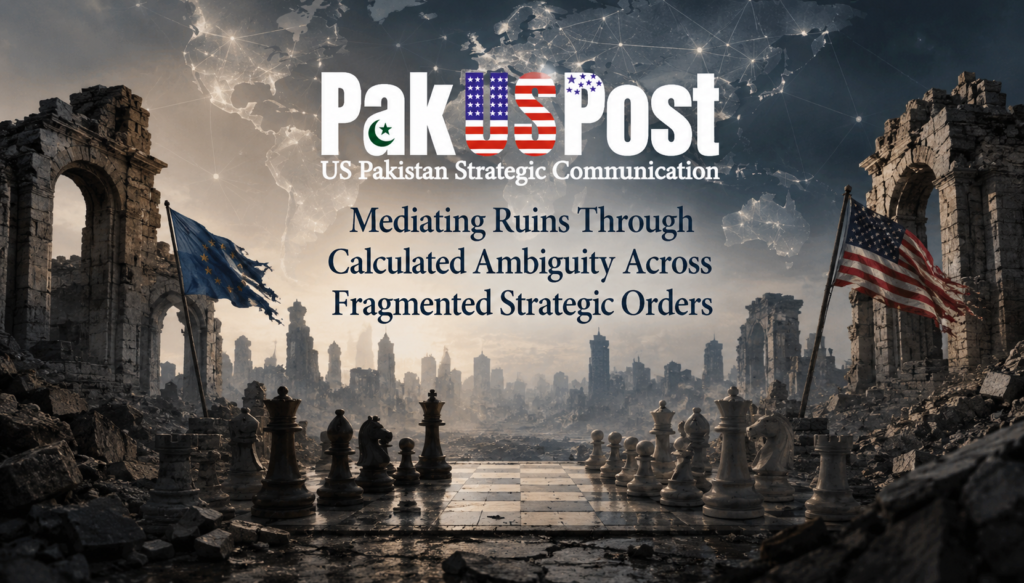
Mediating Ruins Through Calculated Ambiguity Across Fragmented Strategic Orders

The contemporary relationship between Pakistan and the United States is increasingly defined not through alliance permanence but through strategic improvisation inside an unstable international order that no longer possesses a singular center of gravity. The diplomatic choreography emerging between Washington and Islamabad in 2026 reflects less a revival of historical partnership than the institutionalization of selective dependence under conditions of geopolitical exhaustion. What appears publicly as mediation, stabilization, and strategic coordination often conceals a more complex architecture of managed insecurity in which both states seek utility from one another without assuming the liabilities of formal alignment. Pakistan’s growing visibility as an intermediary in Gulf tensions, particularly in relation to indirect US engagement with Iran, must therefore be interpreted not as evidence of restored regional authority but as an indication that fractured powers increasingly outsource crisis management to states capable of absorbing ambiguity.
Within this environment, mediation itself has become a contested strategic instrument. Historically, middle powers derived prestige from neutrality, institutional legitimacy, or economic leverage. Pakistan’s mediation profile, however, emerges from a different ecology. It is rooted in strategic geography, intelligence access, military institutional continuity, and the capacity to maintain simultaneous channels with mutually antagonistic actors. Islamabad’s relevance does not stem from trust in the classical diplomatic sense. Rather, it stems from its survivability inside contradictory alignments. This distinction is crucial because it reveals the paradox at the heart of Pakistan’s present diplomatic moment. The state gains visibility precisely because the surrounding regional system has lost coherence.
The Gulf security landscape no longer operates through fixed alliance blocs. Saudi recalibration toward diversified partnerships, Emirati transactional diplomacy, Iranian strategic patience, and Washington’s fluctuating commitment to military entrenchment have collectively generated a fluid order in which no actor seeks irreversible confrontation, yet none fully trusts de escalation frameworks. In this fragmented setting, Pakistan occupies an intermediate position capable of carrying messages, reducing escalation signals, and preserving communication corridors during periods of crisis volatility. Yet such mediation simultaneously deepens Pakistan’s integration into externally manufactured crises whose escalation dynamics remain beyond Islamabad’s control.
This structural dependency is often obscured by celebratory narratives surrounding diplomatic relevance. Domestic discourse within Pakistan frequently frames mediation initiatives as evidence of sovereign resurgence and geopolitical indispensability. Such interpretations contain partial truth but ignore the asymmetrical nature of contemporary brokerage politics. The intermediary state rarely defines the strategic objectives of the actors it mediates between. Instead, it manages atmospherics, facilitates tactical deconfliction, and absorbs reputational risk should negotiations collapse. The mediator becomes visible while remaining constrained. Sovereignty appears enhanced symbolically while operational autonomy narrows materially.
Washington’s evolving posture toward Pakistan illustrates this contradiction clearly. The post Afghanistan strategic environment removed the organizing principle that had governed Pak US relations for two decades. Counterterrorism cooperation, logistics coordination, intelligence sharing, and military dependence once created a framework of structured engagement. Following the American withdrawal from Afghanistan, the bilateral relationship entered a period of conceptual uncertainty. Pakistan was no longer indispensable as a frontline security platform, yet complete disengagement proved strategically impractical. Regional instability, transnational militancy, nuclear concerns, and Chinese expansion ensured that Islamabad retained residual significance.
The result has been the emergence of a selective relevance doctrine. Pakistan is no longer viewed in Washington as a treaty style ally deserving comprehensive strategic investment. Instead, it is approached as a situational actor whose utility fluctuates according to crisis intensity. This transformation has altered the psychology of bilateral engagement. Cooperation now occurs episodically, often through intelligence and security channels rather than public diplomatic frameworks. The relationship functions through calibrated compartmentalization. Economic coordination, counterterrorism dialogue, technological discussions, and regional diplomacy proceed simultaneously but without the ideological coherence that once accompanied alliance rhetoric.
Such ambiguity creates opportunities for Pakistan but also severe institutional risks. The absence of fixed commitments permits tactical flexibility. Islamabad can maintain ties with Beijing while engaging Washington. It can preserve Gulf relationships while managing communication with Tehran. It can present itself internationally as a stabilizing intermediary while sustaining domestic narratives of sovereign independence. Yet the same ambiguity generates strategic overextension. A state positioned between competing powers becomes vulnerable to pressure from all sides precisely because each actor assumes its dependence.
This is particularly visible in the triangular relationship involving the China, the United States, and Pakistan. Islamabad’s geopolitical behavior can no longer be understood through bilateral analysis alone. Its strategic calculations are increasingly shaped by systemic competition between Washington and Beijing. Pakistan’s economic reliance on Chinese infrastructure financing and military cooperation intersects uneasily with its need for Western financial legitimacy, market access, and diplomatic maneuverability. The state therefore exists within dual dependency structures that pull its strategic orientation in competing directions.
The China Pakistan Economic Corridor once symbolized developmental transformation and geoeconomic integration. Today it also represents exposure to intensifying great power rivalry. American strategic planners increasingly interpret Chinese infrastructure expansion not merely as economic outreach but as embedded geopolitical influence. Within this lens, Pakistan becomes part of a broader contest over technological standards, logistical networks, digital sovereignty, and regional connectivity. Islamabad insists publicly that its partnerships are non exclusive, yet the surrounding strategic environment is becoming progressively less tolerant of neutrality.
This pressure generates what may be termed constrained balancing behavior. Pakistan attempts to maintain equilibrium between major powers without provoking punitive reactions from either side. However, equilibrium becomes difficult when rival powers interpret ambiguity itself as strategic alignment. Washington views excessive dependence on Beijing with suspicion. Beijing views renewed security intimacy with Washington as potential dilution of Chinese influence. Islamabad consequently operates under conditions where every diplomatic gesture acquires amplified geopolitical meaning.
The information domain intensifies these pressures further. Narrative warfare has become central to contemporary Pak US engagement because perception increasingly shapes strategic possibility before formal policy emerges. Competing media ecosystems construct Pakistan through fluctuating frames that directly influence diplomatic behavior. At various moments Islamabad is portrayed internationally as a fragile nuclear state, a counterterrorism partner, a Chinese proxy, a mediation platform, or a geoeconomic transit corridor. These narratives are not passive descriptions. They actively organize policy assumptions within bureaucratic and intelligence institutions.
American think tank discourse frequently oscillates between securitized suspicion and pragmatic engagement regarding Pakistan. During moments of regional escalation, Islamabad is rediscovered as a necessary interlocutor. During periods of relative calm, narratives emphasizing democratic fragility, militant sanctuaries, or strategic unreliability regain prominence. This cyclical framing produces inconsistent policy outputs because institutional perceptions remain unstable. Pakistan is treated simultaneously as a risk and a requirement.
Islamabad also participates actively in narrative management. State aligned discourse increasingly emphasizes themes of responsible mediation, regional connectivity, economic diplomacy, and counter extremism cooperation. The objective is not merely reputational improvement but strategic repositioning. Pakistan seeks to transition from a security burden image toward that of a stabilizing node within an interconnected Eurasian landscape. Yet narrative transformation faces structural obstacles because international perceptions are shaped not only by messaging but by enduring institutional memories accumulated over decades of conflict politics.
The hidden risk within this informational contest lies in the gradual erosion of policy distinction between perception management and strategic reality. States may begin designing policy primarily for narrative consumption rather than operational sustainability. Symbolic diplomacy can create temporary visibility while masking institutional weakness. Public claims of geopolitical centrality may generate domestic legitimacy yet encourage external actors to treat Pakistan as perpetually available for crisis absorption. Visibility becomes responsibility without corresponding leverage.
For Pakistani security planners, the challenge therefore involves preserving mediation utility without allowing the country to become trapped within externally generated escalation cycles. The temptation to maximize diplomatic visibility must be balanced against the dangers of strategic exhaustion. Mediation between adversarial powers often creates short term prestige but long term vulnerability because intermediary states accumulate expectations they cannot fully control. Failure to manage such expectations can rapidly transform perceived indispensability into reputational liability.
There are also deeper civil military dimensions underlying Pakistan’s evolving external posture. The military establishment remains the most institutionally coherent actor within the national security structure, possessing both operational continuity and international credibility among external security partners. Consequently, much of the substantive Pak US engagement continues through defense and intelligence channels even when civilian diplomatic rhetoric dominates publicly. This duality creates functional efficiency but also reinforces external perceptions that Pakistan’s strategic behavior is ultimately securitized regardless of democratic transitions.
Washington’s approach reflects recognition of this institutional reality. American engagement increasingly privileges issue specific coordination over broad democratic transformation agendas. Counterterrorism intelligence, regional stabilization, cyber security, maritime awareness, and strategic deconfliction remain prioritized areas. However, the absence of an overarching alliance framework means cooperation lacks emotional or ideological investment. It is managerial rather than transformational.
This managerial logic corresponds with broader shifts within American foreign policy. The contemporary United States operates under conditions of strategic overstretch, fiscal anxiety, domestic polarization, and declining appetite for permanent military entanglements. Washington increasingly favors flexible partnerships capable of delivering tactical outcomes without requiring expansive commitments. Pakistan fits this model imperfectly but sufficiently. It offers geographic access, intelligence networks, military professionalism, and regional communication channels without demanding treaty obligations. Yet this same flexibility prevents the emergence of durable trust.
Trust deficits remain the defining psychological infrastructure of Pak US relations. Decades of mutual accusations, divergent regional priorities, and episodic abandonment have created deep institutional skepticism on both sides. Pakistan believes Washington instrumentalizes alliances before disengaging abruptly once immediate objectives are achieved. American policymakers suspect Islamabad of selective cooperation shaped primarily by regime preservation and regional competition with India. These suspicions persist despite tactical collaboration because they are embedded within bureaucratic memory.
The reemergence of mediation politics does not erase this history. Rather, it overlays transactional cooperation onto unresolved distrust. Consequently, every phase of renewed engagement contains latent instability. A single regional crisis, intelligence controversy, or domestic political rupture can rapidly reactivate adversarial narratives. The relationship lacks the institutional resilience characteristic of mature alliances because it operates through conditional utility rather than shared strategic identity.
Economic dimensions further complicate the picture. Pakistan’s persistent fiscal vulnerabilities constrain diplomatic autonomy by increasing dependence on external financial architectures. International lending institutions, Gulf financial support, Chinese investments, and Western market access collectively shape Islamabad’s strategic calculations. Economic fragility reduces room for geopolitical experimentation because external actors possess leverage through liquidity channels. In such conditions, mediation can become not merely a diplomatic choice but an economic necessity aimed at preserving external confidence.
This vulnerability intersects with emerging technological competition. Artificial intelligence governance, cyber infrastructure, semiconductor dependency, and digital surveillance architectures are becoming central arenas of global rivalry. Pakistan risks entering these domains primarily as a consumer rather than a rule shaping participant. Both Chinese and Western technological ecosystems seek influence across developing states through infrastructure integration and regulatory alignment. Islamabad’s decisions regarding digital governance will therefore carry strategic implications extending far beyond telecommunications policy.
The hidden establishment concern here involves sovereignty erosion through technological dependency. Infrastructure financed externally often carries embedded strategic assumptions regarding data control, security protocols, and long term institutional alignment. Pakistan’s balancing strategy may become increasingly difficult as technological ecosystems grow mutually incompatible. Choosing standards in cyber governance or digital infrastructure could eventually prove as geopolitically consequential as military alliances once were.
Another underexamined dimension concerns the militarization of economic corridors. Connectivity projects are frequently presented through developmental rhetoric emphasizing trade and regional integration. Yet strategic planners increasingly recognize that infrastructure networks possess dual use implications. Ports, logistics hubs, energy corridors, and digital systems simultaneously serve commercial and security functions. External powers evaluate such projects not only through economic profitability but through strategic accessibility.
Pakistan’s geography therefore remains both its greatest asset and its greatest curse. The state occupies connective terrain linking South Asia, Central Asia, the Gulf, and western China. This geography generates enduring relevance but also perpetual exposure. External actors view Pakistan less as an isolated national entity than as a corridor through which broader regional equations may be managed. The danger lies in becoming permanently valued for location while remaining undervalued institutionally.
This structural condition produces what may be called corridor state anxiety. States positioned at geopolitical intersections often struggle to convert transit importance into sustainable sovereign power. External investment flows through them without necessarily transforming domestic institutional capacity. Strategic attention intensifies during crises but diminishes during stability. Such states risk becoming theaters of external competition rather than autonomous architects of regional order.
For Pakistan, avoiding this outcome requires movement beyond reactive diplomacy toward institutional consolidation. Mediation effectiveness ultimately depends not only on strategic geography but on governance credibility, economic resilience, and coherent state capacity. A mediator unable to stabilize internally cannot indefinitely stabilize externally generated crises. The sustainability of Pakistan’s emerging diplomatic role therefore depends fundamentally upon domestic institutional reform.
At the same time, Washington must recognize that excessive instrumentalization of Pakistan carries long term costs. Treating Islamabad solely as a tactical utility reinforces the cyclical instability that has historically undermined bilateral relations. Sustainable engagement requires broader frameworks encompassing education, technology transfer, economic integration, and institutional cooperation beyond narrow security concerns. Otherwise the relationship will remain trapped within repetitive crisis driven engagement patterns.
Regional actors are observing these dynamics closely. Gulf monarchies increasingly view Pakistan as a useful balancing partner capable of maintaining communication across polarized regional environments. China seeks preservation of strategic continuity without provoking direct confrontation. Iran remains cautious yet aware of Pakistan’s potential utility in reducing escalation risks. India monitors renewed Pak US interaction through the lens of regional competition and American Indo Pacific priorities. Each actor interprets Islamabad’s mediation profile according to distinct strategic anxieties.
This multiplicity of expectations increases the probability of diplomatic overload. Pakistan may find itself pressured simultaneously to reassure Washington, avoid alarming Beijing, maintain Gulf confidence, prevent Iranian hostility, and manage Indian perceptions. Such balancing requires extraordinary strategic discipline and narrative coherence. Any major inconsistency could trigger cascading distrust across multiple relationships simultaneously.
The information ecosystem amplifies these dangers because digital media accelerates narrative volatility. Leaks, speculative reporting, intelligence driven information operations, and algorithmic amplification increasingly shape diplomatic atmospherics. Strategic communication is no longer supplementary to policy; it constitutes part of policy execution itself. States unable to manage narrative environments risk losing control over escalation trajectories.
For Pakistani policymakers, this reality necessitates development of integrated information security architectures capable of coordinating diplomatic messaging, cyber defense, media engagement, and strategic signaling. Traditional distinctions between military operations, diplomatic negotiations, and media narratives are collapsing. Geopolitical competition now unfolds simultaneously across physical and cognitive domains.
The deeper philosophical question underlying the contemporary Pak US relationship concerns whether middle powers can exercise genuine agency within a fragmented post hegemonic order. Pakistan’s experience suggests that agency today is increasingly conditional, negotiated, and situational rather than absolute. States maneuver within overlapping dependency structures while attempting to preserve limited autonomy through ambiguity and selective cooperation. Sovereignty becomes performative as much as operational.
Yet performative sovereignty can still generate strategic space if managed intelligently. Pakistan’s challenge is not to escape interdependence, which is impossible, but to prevent interdependence from becoming unilateral vulnerability. This requires diversification across economic, technological, and diplomatic domains while resisting the temptation to convert every external engagement into symbolic triumphalism.
The most significant hidden risk for the Pakistani establishment is therefore conceptual rather than military. It is the risk of mistaking renewed relevance for restored leverage. Visibility within crisis management architectures does not necessarily translate into strategic autonomy. A state may become indispensable to external powers while remaining structurally dependent upon them. Indeed, indispensability itself can become a mechanism of control if it binds the state to perpetual mediation responsibilities without corresponding capacity enhancement.
Similarly, the United States faces its own strategic illusion. Washington may believe that flexible transactional engagement provides maximum efficiency with minimal cost. However, over reliance on episodic utility partnerships can gradually erode long term influence because such relationships lack normative depth and institutional loyalty. Tactical flexibility may produce strategic shallowness.
The future of Pak US relations will therefore depend less on dramatic diplomatic breakthroughs than on whether both states can construct a stable grammar of limited cooperation compatible with an era of fragmented power. Neither side seeks comprehensive alliance restoration. Neither side desires outright rupture. The relationship instead inhabits an intermediate zone characterized by managed ambiguity, selective engagement, and strategic improvisation.
This liminal arrangement may persist precisely because the global order itself increasingly resembles Pakistan’s diplomatic position: interconnected yet distrustful, cooperative yet competitive, multipolar yet unstable. In such a world, intermediary states acquire temporary significance not because they transcend fragmentation but because they learn to navigate it. Pakistan’s rise as a mediation platform thus reflects a broader transformation in international politics where power no longer resides solely in dominance but in the capacity to survive contradiction.
The central policy imperative for Islamabad is to convert tactical relevance into institutional resilience before external conditions shift again. History suggests that geopolitical attention toward Pakistan intensifies during periods of regional turbulence and declines once immediate crises recede. The current moment may therefore represent not permanent strategic elevation but another cycle of conditional visibility. Unless accompanied by economic reform, governance consolidation, technological modernization, and narrative discipline, mediation prestige alone will prove insufficient.
For Washington, the imperative is equally clear. Sustainable influence in South Asia cannot rely exclusively upon securitized engagement or China centric calculations. A relationship built only upon crisis utility remains vulnerable to rapid deterioration. Long term stability requires acknowledging Pakistan not merely as a risk management platform but as a complex state navigating extraordinary structural pressures within a transforming international order.
Ultimately, the Pak US relationship in 2026 embodies the contradictions of the wider global system. It is neither alliance nor estrangement, neither partnership nor rivalry. It is a negotiated coexistence shaped by uncertainty, strategic fatigue, and the absence of coherent international hierarchy. Mediation, in this context, becomes less an act of peace making than a survival mechanism within a world where fragmentation itself has become the organizing principle of geopolitics.
A Public Service Message