Selective Relevance Reshapes Pakistan After America Abandons Afghan Battlefield


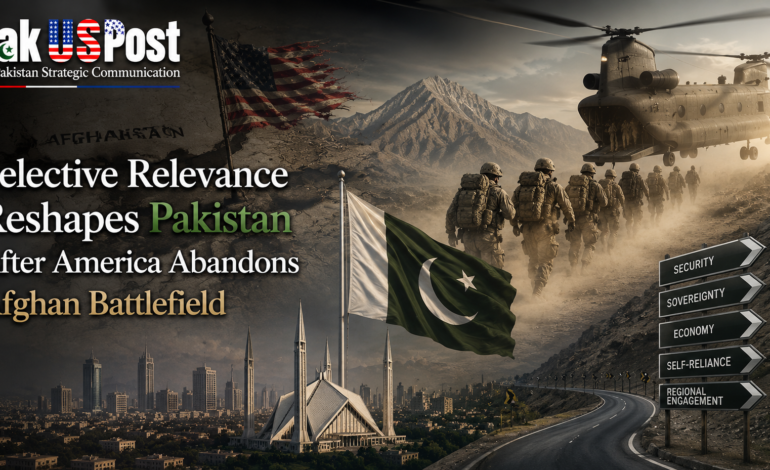
The withdrawal of the United States from Afghanistan did not merely conclude a military campaign. It dismantled the strategic architecture through which South Asia had been interpreted for more than two decades. The collapse of America’s longest war generated consequences extending far beyond Kabul’s political disintegration or the rapid resurgence of the Taliban. It transformed the logic of regional engagement itself, forcing a recalibration of Pakistan’s strategic utility within Washington’s evolving geopolitical hierarchy. For Pakistan, the post withdrawal environment inaugurated neither triumph nor irrelevance, but a far more complex condition best understood as selective relevance within a fragmented post intervention order.
For decades, Pakistan’s importance to American security planning derived from a relatively stable equation. Geography, intelligence access, logistical dependence, and counterterrorism cooperation combined to position Islamabad as a frontline operational partner. The relationship was deeply transactional yet structurally anchored by the permanence of war. Afghanistan functioned as the organizing theater around which military aid, diplomatic pressure, intelligence coordination, and strategic mistrust simultaneously revolved. Once the American military footprint disappeared, the framework sustaining this uneasy equilibrium collapsed almost overnight.
Yet contrary to predictions within sections of both Pakistani and American policy discourse, the end of the Afghan war did not eliminate Pakistan’s strategic relevance entirely. Instead, it transformed the nature of that relevance. Islamabad ceased to be indispensable in a classical military sense, but remained difficult to ignore within broader calculations involving regional stability, militant movements, nuclear security, Chinese expansion, Gulf tensions, and emerging geoeconomic corridors. This shift from permanent utility to conditional necessity defines the contemporary phase of Pak US engagement.
The distinction matters because selective relevance produces a fundamentally different diplomatic psychology than alliance dependence. During the Afghan war, Pakistan operated under the assumption that Washington ultimately required cooperation regardless of periodic tensions. Supply routes, intelligence access, and operational coordination created a degree of strategic leverage despite mutual distrust. In the post withdrawal order, however, leverage has become situational rather than structural. Pakistan is now engaged when crises intensify, ignored when regional temperatures decline, and reassessed continuously through the prism of wider geopolitical competition.
This transformation has altered the internal balance of American policymaking regarding South Asia. Security institutions within Washington no longer dominate regional discourse as completely as they once did. Counterterrorism concerns persist, but they coexist with technological competition against China, supply chain diversification, digital infrastructure politics, energy security, and maritime strategy. Pakistan therefore occupies a more ambiguous position inside American calculations. It is no longer the epicenter of regional military planning, yet it remains embedded within interconnected strategic anxieties.
The disappearance of Afghanistan as a large scale American battlefield also removed a powerful mechanism through which Pakistan’s military establishment historically negotiated influence. During the war years, Islamabad’s security apparatus could calibrate cooperation, manage intelligence flows, and shape operational atmospherics in ways that preserved strategic bargaining power. The post withdrawal environment reduced this direct leverage while simultaneously increasing scrutiny over residual militant ecosystems operating within the broader region.
Washington’s contemporary approach reflects this recalibrated mindset. American engagement with Pakistan now emphasizes limited objectives rather than transformative ambitions. Intelligence coordination regarding transnational militant threats continues quietly. Military to military communication channels remain functional. Diplomatic engagement persists regarding regional de escalation and crisis management. However, the expansive rhetoric once associated with strategic partnership has largely disappeared. The relationship has become narrower, colder, and more managerial.
This managerial logic aligns with broader transformations in American foreign policy. Domestic fatigue with prolonged wars, fiscal pressures, political polarization, and the strategic pivot toward East Asia collectively reduced appetite for open ended military entanglements. Washington increasingly favors flexible arrangements capable of delivering tactical outcomes without requiring deep political investment. Pakistan fits this framework imperfectly but usefully. It offers selective cooperation without demanding formal alliance restoration.
For Islamabad, this creates both opportunity and vulnerability. On one hand, the absence of direct American military dependence provides greater room for diplomatic diversification. Pakistan can deepen Chinese economic integration, strengthen Gulf relationships, and pursue mediation diplomacy without the same intensity of American operational oversight that characterized the Afghan war years. On the other hand, reduced dependence also means reduced tolerance. Washington feels less constrained in applying pressure regarding governance concerns, militant activity, or strategic alignment choices because the costs of diplomatic friction have declined.
The post Afghanistan environment has therefore produced an asymmetrical recalibration rather than a clean strategic break. Pakistan remains relevant but not irreplaceable. The United States remains influential but not singularly dominant. Both states continue engaging one another while simultaneously reducing expectations. This reduction of expectations may paradoxically stabilize the relationship in the short term because it lowers the emotional volatility historically generated by exaggerated alliance rhetoric.
Yet beneath this apparent stabilization lie significant hidden risks. The first concerns the redefinition of counterterrorism itself. During the Afghan war, counterterrorism possessed relatively clear operational parameters centered upon insurgency management, intelligence sharing, and military coordination. Today the threat landscape is more diffuse. Militant organizations operate across decentralized digital networks, ideological ecosystems, and transnational financing structures. Washington increasingly prioritizes over the horizon capabilities involving surveillance, intelligence partnerships, cyber monitoring, and precision operations rather than large troop deployments.
Pakistan occupies an important position within this architecture because of its geographic proximity, intelligence networks, and historical experience dealing with militant movements. However, this renewed counterterrorism utility contains dangers for Islamabad. Excessive alignment with American intelligence priorities could revive domestic accusations of strategic subservience while exposing Pakistan to retaliatory violence from extremist actors. Conversely, insufficient cooperation risks diplomatic isolation and reputational damage. The state must therefore navigate a narrow corridor between operational collaboration and domestic political legitimacy.
Another hidden risk involves the strategic vacuum left by the American withdrawal from Afghanistan. Contrary to optimistic assumptions that regional powers would naturally stabilize the post withdrawal environment, Afghanistan remains economically fragile, politically isolated, and institutionally weak. Humanitarian crises, militant sanctuaries, narcotics trafficking, and refugee pressures continue affecting neighboring states. Pakistan bears disproportionate exposure to these spillover dynamics due to geography and historical entanglement.
Islamabad’s security establishment increasingly recognizes that instability inside Afghanistan now threatens Pakistan more directly than it threatens the distant United States. Cross border militancy, ideological radicalization, and economic disruption generate internal security pressures capable of undermining domestic cohesion. The irony is striking. Pakistan once leveraged Afghan instability to preserve strategic depth against regional adversaries. Today the absence of American containment structures has transformed instability itself into a primary strategic liability.
This has forced a conceptual revision within sections of Pakistan’s security doctrine. Traditional notions of strategic depth centered upon influence within Afghanistan are gradually being replaced by stabilization imperatives emphasizing border control, economic connectivity, and militant containment. Yet doctrinal transitions remain incomplete. Elements within the security ecosystem continue operating through older paradigms shaped by proxy competition and asymmetric leverage. The coexistence of these competing strategic cultures complicates coherent policymaking.
Washington observes these dynamics cautiously. American officials increasingly interpret Pakistan through a dual lens: as both a necessary stabilizing actor and a persistent source of regional unpredictability. This contradictory perception generates policy inconsistency. During moments of militant escalation or regional tension, Islamabad is approached as a critical interlocutor. During calmer periods, concerns regarding democratic fragility, military dominance, and extremist linkages regain prominence within American discourse.
The information environment intensifies these contradictions. Media narratives surrounding Pakistan remain deeply polarized. Some portray Islamabad as a responsible actor managing extraordinarily complex security pressures. Others depict it as a perpetually unstable state dependent upon crisis manufacturing for geopolitical visibility. These narratives matter because they shape congressional attitudes, investment climates, intelligence assessments, and diplomatic expectations within Washington.
Pakistan’s own narrative management strategies have evolved significantly in response. Official discourse increasingly emphasizes economic diplomacy, regional connectivity, climate vulnerability, and mediation initiatives rather than purely securitized identity. Islamabad seeks to reposition itself from a conflict associated state toward a geoeconomic corridor linking South Asia, Central Asia, the Gulf, and western China. This rhetorical transition reflects recognition that military relevance alone no longer guarantees sustained international engagement.
However, narrative repositioning faces structural obstacles rooted in institutional realities. Economic instability, governance challenges, political polarization, and periodic security incidents continue reinforcing older perceptions internationally. Foreign investors and policymakers often evaluate states through long term risk memory rather than current diplomatic messaging. Consequently, Pakistan’s effort to redefine itself encounters persistent skepticism despite genuine shifts within parts of its strategic outlook.
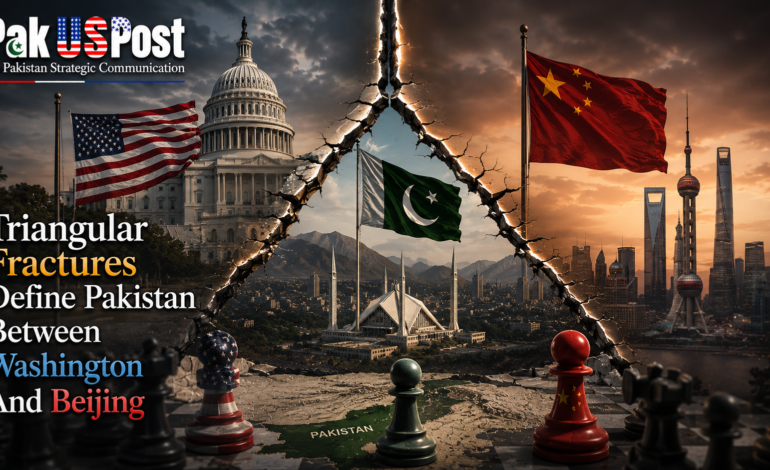
The China factor further complicates the post Afghanistan recalibration. During the war years, Pakistan could partially balance American and Chinese relationships because Washington’s operational needs imposed limits upon geopolitical confrontation. In the current environment, however, intensifying US China competition increasingly shapes all regional calculations. Pakistan’s deepening economic and military integration with Beijing attracts growing scrutiny from American strategic planners concerned about infrastructure influence, digital systems, and regional alignment patterns.
The China Pakistan Economic Corridor exemplifies this complexity. Initially framed primarily as a developmental initiative, it is now interpreted within broader geopolitical competition involving connectivity networks, maritime access, technological ecosystems, and strategic influence. American policymakers worry that Chinese infrastructure penetration could generate long term security implications across South Asia and the Arabian Sea region. Pakistan insists that economic cooperation with Beijing does not preclude constructive relations with Washington, yet strategic rivalry between major powers makes such balancing progressively more difficult.
This dynamic constrains Pakistan’s diplomatic autonomy. Islamabad requires Chinese investment, military cooperation, and financial support. Simultaneously, it needs Western market access, multilateral institutional engagement, and avoidance of international isolation. The result is a delicate balancing strategy aimed at preserving flexibility without provoking punitive reactions from either side. Yet balancing becomes increasingly fragile when rival powers interpret ambiguity itself as alignment.
The post Afghanistan order has also transformed the role of the Pakistani military establishment internally. Historically, the military derived substantial legitimacy and external support from its central role within regional security dynamics. The reduction of direct American military dependence could theoretically weaken this position. However, regional instability, domestic political fragmentation, and continuing security threats have largely preserved the establishment’s institutional dominance.
Indeed, the military’s relative organizational coherence compared to civilian institutions may have increased its importance within external perceptions of Pakistan. Foreign governments frequently view the establishment as the most reliable channel for sustained strategic communication due to continuity, operational discipline, and decision making capacity. This reality reinforces the securitized character of Pakistan’s international engagement even as official rhetoric emphasizes economic transformation.
Yet excessive securitization carries long term costs. States defined primarily through security functions often struggle to attract sustainable investment, institutional trust, and soft power influence. Pakistan risks remaining internationally valuable during crises while marginal during periods of stability. This cycle perpetuates dependency upon external turbulence for geopolitical visibility.
The economic dimension of post Afghanistan recalibration is particularly important. During the war years, security cooperation generated substantial military and financial flows despite periodic tensions. Today Pakistan faces a harsher global economic environment characterized by debt pressures, inflation volatility, climate shocks, and reduced Western appetite for unconditional support. Economic vulnerability increasingly shapes foreign policy behavior because fiscal instability limits strategic flexibility.
International financial institutions now possess greater influence over Pakistan’s policy environment than military alliances once did. Bailout negotiations, debt restructuring, energy reforms, and fiscal adjustments carry geopolitical implications because they affect external confidence and strategic maneuverability. Economic weakness therefore transforms diplomacy into an exercise in financial stabilization as much as geopolitical positioning.
Climate vulnerability adds another layer of complexity. Pakistan’s exposure to floods, water stress, agricultural disruption, and environmental displacement creates long term security challenges extending beyond conventional military frameworks. Washington increasingly incorporates climate considerations into strategic planning, recognizing that environmental instability can generate migration pressures, economic collapse, and social unrest. This creates potential areas for constructive cooperation between Pakistan and the United States outside traditional security paradigms.
Technology represents another emerging frontier. Artificial intelligence governance, cyber security, digital surveillance, and data infrastructure are becoming central components of geopolitical competition. Pakistan risks technological dependency unless it develops domestic innovation capacity and regulatory coherence. American and Chinese technological ecosystems increasingly compete for influence across developing states, forcing countries like Pakistan into difficult alignment choices regarding digital infrastructure and standards.
The hidden establishment concern here involves sovereignty erosion through technological integration. Control over data systems, telecommunications networks, and digital infrastructure increasingly carries strategic significance comparable to traditional military assets. Pakistan’s choices in these domains will shape not only economic development but also intelligence vulnerability and diplomatic orientation.
Regionally, India remains a critical factor influencing post Afghanistan calculations. Washington’s strategic partnership with India continues deepening through Indo Pacific frameworks, defense cooperation, and technological alignment. Pakistan views these developments with concern, fearing regional marginalization and strategic encirclement. American officials insist that relations with India are not directed against Pakistan specifically, yet Islamabad interprets the broader trajectory through the lens of shifting regional power balances.
This perception reinforces Pakistan’s desire to maintain residual relevance within American strategic thinking. Mediation diplomacy, counterterrorism cooperation, and regional stabilization initiatives all partially serve the objective of preventing complete diplomatic sidelining. Islamabad understands that irrelevance poses dangers equal to excessive dependence. States excluded from major strategic calculations often lose bargaining capacity entirely.
However, relevance without institutional reform remains unsustainable. Pakistan’s long term position cannot rely indefinitely upon crisis utility, geographic location, or intermediary diplomacy alone. Durable strategic influence requires economic resilience, governance credibility, technological modernization, and social cohesion. Without these foundations, geopolitical visibility risks becoming performative rather than transformative.
For the United States, the challenge involves avoiding the cyclical opportunism that historically characterized engagement with Pakistan. American policy often oscillated between intense dependence during crises and abrupt disengagement afterward. Such patterns generated deep mistrust within Pakistani institutions and encouraged short term transactional behavior on both sides. A more sustainable relationship would require consistency, realistic expectations, and broader engagement beyond narrow security concerns.
Yet broader engagement faces political obstacles within both countries. In Washington, skepticism regarding Pakistan remains widespread across parts of the political and strategic establishment. In Pakistan, anti American sentiment persists due to historical grievances, sovereignty concerns, and perceptions of abandonment. These psychological barriers complicate efforts to construct stable long term frameworks.
The post Afghanistan order therefore represents neither rupture nor reconciliation. It is a transitional environment defined by selective cooperation, constrained expectations, and strategic ambiguity. Pakistan has moved from being a frontline ally to a situationally significant actor whose importance fluctuates according to regional crises and great power competition. The United States has shifted from military entrenchment toward flexible engagement designed to minimize costs while preserving influence.
This new arrangement may prove more durable precisely because it abandons the illusions that previously destabilized the relationship. There is little remaining rhetoric about unbreakable friendship or transformative alliance. Both states increasingly understand one another in pragmatic rather than ideological terms. Cooperation occurs where interests converge. Distance emerges where priorities diverge. The relationship survives through compartmentalization rather than emotional investment.
Still, compartmentalization cannot eliminate structural tensions entirely. Nuclear security, militant movements, Chinese expansion, Gulf instability, and Indo Pacific competition ensure that Pakistan will remain strategically relevant to Washington even without Afghanistan as the central organizing theater. Likewise, American financial influence, technological dominance, and diplomatic reach ensure that the United States will remain impossible for Islamabad to ignore.
The essential question for Pakistan’s policymakers is whether selective relevance can be converted into sustainable strategic agency. Temporary utility within external calculations does not automatically generate sovereign leverage. States that become permanently useful for crisis management risk losing the capacity to define independent developmental trajectories. Pakistan must therefore avoid becoming trapped within an endless cycle where geopolitical attention substitutes for institutional progress.
Ultimately, the post Afghanistan recalibration reveals a broader transformation within international politics itself. The era of rigid alliances and permanent alignments is giving way to fluid networks of conditional cooperation shaped by overlapping crises, fragmented power centers, and strategic uncertainty. Pakistan’s evolving relationship with the United States reflects this wider systemic transition. It is no longer anchored by shared missions or ideological narratives. Instead, it functions through intermittent convergence within an increasingly unstable regional order.
In that sense, Pakistan’s future strategic position will depend less upon its ability to serve external powers and more upon its capacity to stabilize internally while navigating external fragmentation intelligently. Geography may continue granting relevance. But only institutional resilience can convert that relevance into lasting sovereignty within the emerging post hegemonic landscape.
A Public Service Message