Triangular Fractures Define Pakistan Between Washington And Beijing

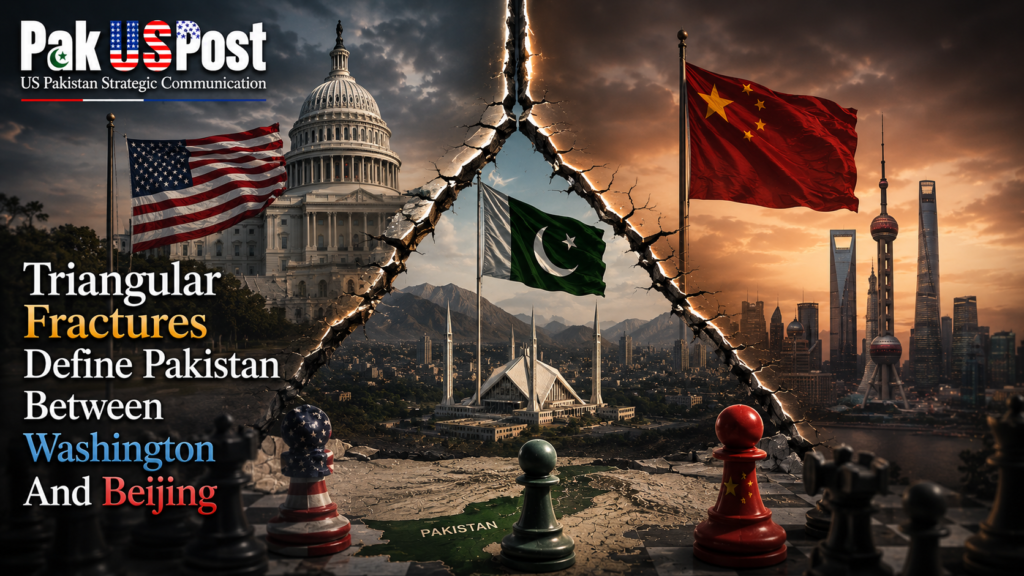
The strategic identity of the Pakistan in 2026 is increasingly being shaped not by bilateral diplomacy with the United States alone, but by its embedded position within an intensifying triangular configuration involving the China. This triadic structure is no longer a theoretical construct of international relations scholarship; it is the operational reality of decision making, alliance signaling, and crisis management in South Asia. Within this geometry, Pakistan is neither a peripheral actor nor a fully autonomous pole. It functions instead as a structurally constrained pivot, navigating competing gravitational pulls that continuously reshape its diplomatic, economic, and security choices.
The transformation of this triangle is rooted in the broader systemic rivalry between Washington and Beijing. As strategic competition deepens across technology, maritime security, supply chains, and institutional governance, every regional actor is increasingly evaluated through the lens of alignment potential. Pakistan’s longstanding attempt to maintain simultaneous engagement with both powers has moved from being a pragmatic hedging strategy to a structurally pressured balancing act. What was once flexibility is now friction.
Historically, Pakistan’s relationship with the United States was anchored in episodic convergence during crises and partial disengagement during periods of relative stability. The Cold War, the Afghan jihad era, post 9/11 counterterrorism cooperation, and the subsequent withdrawal from Afghanistan all marked cycles of intensity and decline. In contrast, Pakistan’s relationship with China evolved along a more continuous trajectory, grounded in infrastructure development, defense cooperation, and strategic convergence rooted in shared perceptions of regional insecurity.
The deepening of China Pakistan connectivity through the China Pakistan Economic Corridor has further institutionalized this alignment. Yet the very success of this partnership has intensified scrutiny from Washington. The corridor is no longer interpreted solely as a developmental initiative but as part of a broader Chinese strategy of regional influence projection. Ports, highways, energy infrastructure, and digital systems are increasingly analyzed through dual use lenses that merge economic planning with strategic forecasting.
This reinterpretation has placed Pakistan at the center of a subtle but persistent contest of influence. The United States does not seek formal rupture in relations with Islamabad, but it increasingly expects clarity of alignment in domains it considers strategically sensitive. China, meanwhile, expects continuity and reliability in a partnership it views as essential for regional stability and western flank security. Pakistan, positioned between these expectations, is compelled to maintain a form of calibrated ambiguity that is becoming progressively harder to sustain.
The tension is not simply diplomatic. It is structural, embedded in economic dependencies, military procurement patterns, technological ecosystems, and financial lifelines. Pakistan’s external financing requirements, managed through a combination of multilateral institutions, bilateral partners, and Chinese investment channels, create overlapping obligations that limit policy autonomy. Each financial engagement carries implicit strategic expectations, even when officially framed as non political cooperation.
Within this environment, the concept of strategic autonomy becomes increasingly difficult to operationalize. Autonomy in theory implies the capacity to make independent decisions unconstrained by external pressures. In practice, Pakistan operates within a dense web of conditional dependencies that shape its policy margins. These dependencies are not uniform. They vary across domains such as defense procurement, energy infrastructure, debt servicing, and digital connectivity. Yet collectively they form a lattice of constraints that define the outer limits of strategic maneuverability.
Washington’s approach to this triangular configuration is increasingly informed by competitive containment logic. The United States views Chinese expansion in South Asia not merely as economic competition but as potential strategic encirclement across critical maritime and continental corridors. Pakistan’s role within this framework is interpreted through the prism of infrastructure dual use potential, military access considerations, and technological integration risks. Consequently, even routine economic cooperation between Islamabad and Beijing acquires heightened geopolitical sensitivity in American policy discourse.
At the same time, Washington continues to recognize Pakistan’s residual utility in areas such as counterterrorism intelligence, regional de escalation, and crisis communication channels involving neighboring conflict zones. This dual perception generates an analytical contradiction. Pakistan is simultaneously treated as a strategic concern and a tactical necessity. The result is a policy posture characterized by intermittent engagement rather than coherent long term alignment.
Beijing’s perspective is shaped by different but equally complex considerations. China’s primary interest lies in ensuring the stability and continuity of its western connectivity routes, particularly those linked to the Belt and Road Initiative architecture. Pakistan represents both a critical transit corridor and a strategic partner in securing access to the Arabian Sea through Gwadar and associated infrastructure nodes. However, Chinese planners are also increasingly aware of Pakistan’s internal economic volatility, security challenges, and political fragmentation.
This awareness introduces caution into what is often externally perceived as unconditional strategic partnership. Chinese engagement with Pakistan is therefore simultaneously ambitious and risk calibrated. Investment flows are accompanied by risk mitigation frameworks, project restructuring, and phased implementation strategies designed to minimize exposure to domestic instability within Pakistan. The relationship is not static trust but managed interdependence.
Within this triangular structure, Pakistan attempts to preserve what policymakers often describe as equilibrium diplomacy. This approach seeks to avoid exclusive alignment with either Washington or Beijing while extracting maximum benefit from both relationships. However, equilibrium is not a stable condition in a system defined by escalating rivalry. It is a dynamic tension that requires constant adjustment and produces cumulative strain over time.
One of the most significant hidden risks in this configuration lies in the politicization of infrastructure. Economic corridors, energy projects, and digital networks are increasingly interpreted not as neutral development tools but as strategic assets embedded within global competition. This shifts the nature of investment from purely economic calculation to geopolitical signaling. Every major infrastructure decision carries implications for external perceptions of alignment.
Pakistan’s attempt to diversify partnerships beyond China and the United States reflects recognition of this constraint. Engagement with Gulf economies, multilateral institutions, and regional connectivity initiatives represents an effort to reduce over dependence on any single axis. However, diversification itself operates within limits defined by scale, capital availability, and technological depth. Neither Gulf investment nor multilateral lending can fully substitute for the structural weight of US China economic and strategic influence.
The military dimension of the triangle remains particularly sensitive. Defense cooperation patterns between Pakistan and China have expanded significantly over recent decades, encompassing hardware procurement, joint production, and technological collaboration. At the same time, historical military engagement between Pakistan and the United States, although reduced, has not disappeared entirely. Training programs, intelligence cooperation, and selective operational coordination continue at lower intensity levels.
This dual engagement creates interpretive ambiguity within both Washington and Beijing. Each side monitors the extent of Pakistan’s defense interactions with the other, often interpreting routine cooperation as strategic signaling. This perception gap amplifies mistrust and reduces the space for neutral interpretation of military relationships. In such an environment, even technical cooperation becomes politically charged.
The information environment further intensifies triangular pressures. Digital narratives circulating across global media ecosystems frequently frame Pakistan as either a Chinese aligned corridor state or a fragile intermediary balancing between competing powers. These simplified narratives obscure the complexity of Pakistan’s actual strategic behavior but nonetheless influence policy perceptions in external capitals. Narrative reductionism thus becomes a form of indirect strategic pressure.
Pakistan’s own narrative strategy seeks to counter this reductionism by emphasizing multipolar engagement, sovereign decision making, and regional connectivity leadership. However, narrative success depends not only on articulation but also on structural credibility. States perceived as economically unstable or institutionally fragmented struggle to sustain long term narrative authority regardless of rhetorical sophistication.
The economic asymmetry within the triangle remains the most decisive structural factor. China’s capacity for infrastructure financing and long term investment provides Pakistan with critical developmental support, but it also deepens dependency cycles. The United States, while less directly involved in infrastructure financing, retains significant influence through financial institutions, trade access, and technological ecosystems. Pakistan’s economic vulnerability ensures that neither relationship can be fully deprioritized without significant cost.
This creates what can be described as constrained dual dependency. Pakistan depends on China for physical infrastructure and strategic depth while simultaneously relying on Western systems for financial stabilization and global integration. These dependencies are not mutually exclusive but structurally interwoven. Attempts to reduce one form of dependence often intensify reliance on the other.
Within this constrained environment, policy autonomy becomes episodic rather than continuous. Pakistan can exercise relative flexibility in certain domains, such as regional diplomacy or limited economic diversification, but faces tighter constraints in macroeconomic policy, defense procurement, and technological alignment. Strategic decisions are therefore often reactive rather than fully proactive, shaped by external pressures as much as internal priorities.
The triangular relationship also has implications for crisis behavior. In moments of regional tension, Pakistan’s role as a communication conduit between competing powers can increase its diplomatic visibility. However, crisis mediation also exposes it to reputational risk if outcomes are unfavorable or if one side perceives bias. The intermediary position thus generates both opportunity and vulnerability simultaneously.
A particularly underexplored risk is the potential for misaligned expectations. Washington may expect Pakistan to limit Chinese strategic access without providing equivalent economic compensation. Beijing may expect Pakistan to resist Western pressure without incurring political instability. Pakistan may expect both powers to accommodate its balancing strategy without imposing conditional constraints. These expectations cannot all be satisfied simultaneously, creating structural tension within the triangle.
Internally, Pakistan’s policy establishment must therefore operate within a constantly shifting decision environment where external signals are often contradictory. Economic necessity pushes toward one set of alignments, security considerations toward another, and diplomatic positioning toward a third. The result is a form of strategic triage in which priorities are continuously reordered in response to external pressures.
The sustainability of this model depends on Pakistan’s ability to strengthen internal institutional coherence. Without economic stabilization, technological upgrading, and governance consistency, external balancing becomes increasingly difficult. Structural weakness amplifies external leverage, reducing the effectiveness of diplomatic maneuvering.
For Washington, the key strategic question is whether engagement with Pakistan can be recalibrated without being subsumed into broader US China competition dynamics. For Beijing, the question is whether Pakistan can remain a reliable long term corridor partner amid internal volatility and external pressure. For Pakistan, the question is whether it can transform structural constraint into managed autonomy without triggering systemic backlash from either side.
The answers to these questions will determine whether the triangular relationship stabilizes into a predictable framework of managed competition or evolves into a more volatile structure of competing coercive expectations. What is already clear, however, is that Pakistan’s strategic environment is no longer defined by bilateral diplomacy alone. It is increasingly governed by the logic of triangulated interdependence in which every move is simultaneously interpreted through multiple strategic lenses.
In such a system, neutrality becomes less a position than a performance, and autonomy less an absolute condition than a negotiated space. Pakistan’s challenge is not to escape the triangle, which is structurally impossible, but to operate within it without being reduced to its most restrictive constraints. Whether this can be achieved will depend not only on diplomatic skill but on the deeper question of whether Pakistan can build sufficient internal resilience to withstand the pressures generated by an increasingly polarized global order.
A Public Service Message