
Urban Heat Governance Shapes National Productivity and Strategic Climate Resilience

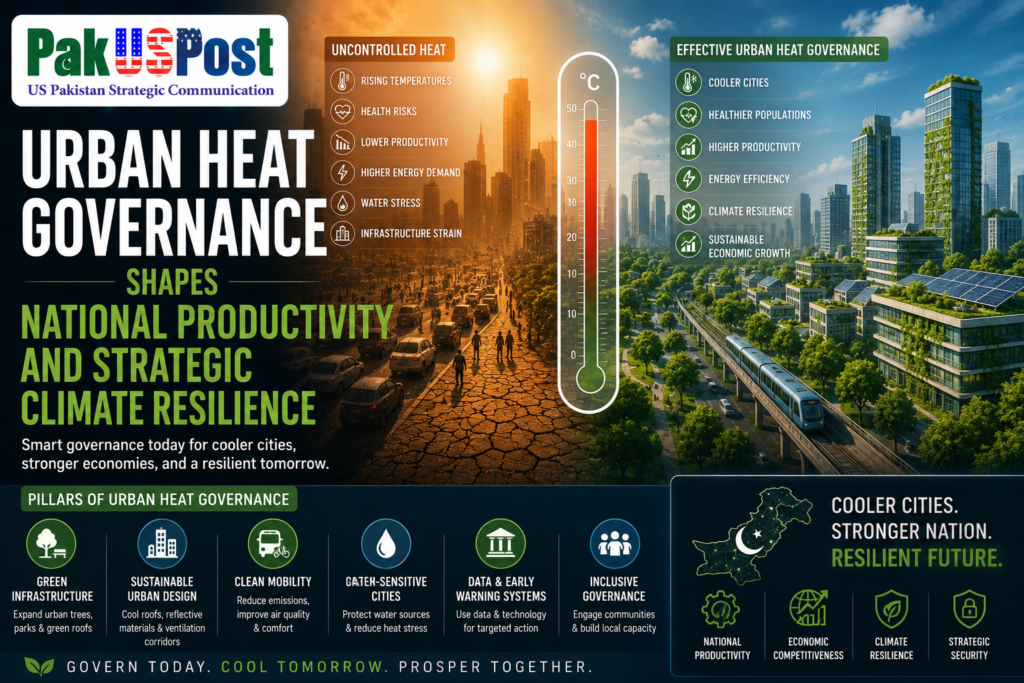
Urban heat is no longer a seasonal inconvenience. It has become a structural economic variable, a public health emergency, an infrastructure challenge, and an increasingly important determinant of national competitiveness. Across the world, prolonged periods of extreme heat are reshaping labour markets, industrial productivity, energy systems, urban governance, and fiscal planning. Cities that once functioned as engines of economic expansion are increasingly confronting the operational costs of sustained thermal stress. For Pakistan, where urbanisation is accelerating while climate vulnerability remains among the highest globally, urban heat governance has emerged as a strategic policy priority rather than merely an environmental concern. The challenge extends beyond rising temperatures. It encompasses institutional preparedness, technological capability, municipal management, infrastructure resilience, and the capacity of governments to maintain economic continuity under increasingly hostile climatic conditions.
Heat waves have traditionally been treated as isolated weather events. Contemporary climate science, however, increasingly identifies them as persistent characteristics of a changing climate system. Longer durations, higher nighttime temperatures, expanding urban heat islands, and cumulative thermal exposure are altering how cities function. Productivity losses accumulate gradually rather than dramatically, making them difficult to quantify yet impossible to ignore. Reduced labour efficiency, increased medical expenditure, declining educational performance, disruptions in transport systems, equipment failures, water shortages, and escalating electricity consumption collectively produce significant macroeconomic consequences.
Pakistan’s demographic transition intensifies these risks. Urban centres including Karachi, Lahore, Faisalabad, Rawalpindi, Multan, Peshawar, and Quetta continue expanding through population growth, industrial concentration, and informal settlement development. Large segments of economic activity remain dependent upon outdoor labour, manufacturing, logistics, construction, transport, agriculture linked supply chains, and municipal services. Workers operating under sustained thermal stress experience measurable declines in cognitive performance, physical endurance, decision making accuracy, and workplace safety. These effects translate directly into lower productivity, increased absenteeism, higher accident rates, and declining industrial efficiency.
Heat stress is becoming an invisible tax upon national economic performance. Unlike conventional economic shocks, thermal stress rarely interrupts production completely. Instead, it steadily reduces efficiency across multiple sectors. Construction schedules require adjustment. Manufacturing plants increase cooling expenditure. Logistics networks slow during peak afternoon temperatures. Public transport systems experience equipment failures. Healthcare facilities encounter surging patient volumes. Educational institutions shorten operational hours. Commercial districts reduce customer activity. The cumulative impact often exceeds the immediate financial damage associated with floods or storms because heat affects virtually every component of urban economic activity simultaneously.
Industrial competitiveness increasingly depends upon climate resilience. Modern manufacturing relies upon precise operational environments, uninterrupted electricity, predictable logistics, and healthy workforces. Rising ambient temperatures increase machinery maintenance requirements, reduce equipment efficiency, elevate cooling costs, and complicate quality control within sensitive manufacturing processes. Electronics assembly, pharmaceutical production, food processing, textiles, and chemical manufacturing all face growing operational challenges under sustained heat conditions.
Pakistan’s export oriented industries illustrate these vulnerabilities. Textile production, the country’s largest industrial employer and export contributor, depends heavily upon continuous electricity supply, controlled humidity, reliable water availability, and stable labour productivity. Extreme heat simultaneously increases electricity demand, strains water systems, reduces worker efficiency, and elevates production costs. International buyers increasingly evaluate supply chain reliability alongside price competitiveness. Climate resilience therefore becomes an industrial competitiveness issue rather than simply an environmental consideration.
Urban heat also presents significant public health implications with profound economic consequences. Heat exhaustion, cardiovascular complications, respiratory illnesses, kidney disorders, dehydration, and mental health stress increase substantially during prolonged heat events. Vulnerable populations including elderly citizens, children, outdoor workers, informal labourers, and individuals with chronic illnesses experience disproportionate risks. Hospitals confront surging admissions precisely when electricity demand threatens healthcare infrastructure stability.
The economic cost extends beyond healthcare expenditure. Families lose income when workers cannot perform physically demanding tasks. Children experience educational disruption as schools suspend activities or reduce operating hours. Employers absorb productivity losses through absenteeism and declining workplace efficiency. Insurance costs gradually increase. Government social protection programmes face expanding fiscal pressure. Labour markets become less predictable. National human capital development consequently slows.
Electricity demand represents perhaps the most immediate manifestation of urban heat stress. Rising temperatures significantly increase cooling requirements across residential, commercial, industrial, healthcare, and public service sectors. Air conditioning transitions from convenience to necessity, particularly within densely populated cities. Simultaneously, electricity generation and transmission infrastructure operates less efficiently under higher ambient temperatures. Transmission losses increase. Thermal power plants require additional cooling. Renewable energy generation faces weather related variability. Distribution systems encounter greater operational stress.
Pakistan’s electricity sector already confronts structural challenges including circular debt, transmission inefficiencies, infrastructure ageing, and uneven distribution capacity. Extreme urban heat magnifies each of these vulnerabilities. Peak demand increasingly coincides with prolonged heat events, creating sustained pressure rather than temporary consumption spikes. Blackouts during heat emergencies rapidly transform infrastructure failures into public health crises.
Urban planning therefore becomes inseparable from national climate resilience. Conventional planning models prioritised land utilisation, transportation efficiency, housing development, and commercial expansion. Climate adaptation now requires integrating thermal performance into every stage of urban design. Building orientation, construction materials, vegetation coverage, water management, public transportation, ventilation corridors, reflective surfaces, shaded public spaces, and emergency cooling infrastructure collectively determine urban resilience.
Many Pakistani cities developed through incremental expansion rather than integrated metropolitan planning. Informal settlements frequently lack adequate green space, drainage systems, building insulation, or climate sensitive infrastructure. Dense concrete development amplifies heat island effects, causing urban temperatures to exceed surrounding rural areas by several degrees. Nighttime temperatures remain elevated, preventing physiological recovery and increasing cumulative health risks.
The strategic significance of urban heat governance extends beyond municipal administration. National security increasingly incorporates climate resilience because infrastructure failures, public health emergencies, economic disruption, migration pressures, and resource competition possess direct implications for political stability. Governments capable of maintaining continuity during prolonged climate stress strengthen public confidence while protecting economic performance. Those unable to adapt face compounding governance challenges.
International cooperation offers important opportunities for strengthening Pakistan’s adaptive capacity. Pakistan and the United States possess complementary capabilities within climate science, satellite observation, forecasting technology, urban planning, engineering innovation, public health research, and infrastructure financing. Constructive cooperation centred upon practical climate resilience rather than geopolitical competition could produce substantial mutual benefits.
American expertise in climate modelling, meteorological forecasting, remote sensing, urban engineering, artificial intelligence applications, and disaster management provides significant opportunities for institutional collaboration. Pakistan contributes valuable operational experience managing extreme climatic conditions across diverse geographic environments, rapidly urbanising populations, and complex infrastructure constraints. Joint research initiatives could generate adaptation strategies applicable throughout climate vulnerable regions globally.
Forecasting systems represent an immediate area for expanded cooperation. Heat emergencies require predictive capability extending beyond temperature measurement. Advanced forecasting increasingly integrates humidity, air quality, infrastructure performance, electricity demand, public health indicators, hydrological conditions, and socioeconomic vulnerability into comprehensive risk assessments. Artificial intelligence supported predictive analytics can identify neighbourhoods facing elevated health risks, anticipate electricity demand patterns, optimise emergency resource deployment, and improve municipal preparedness.
Pakistan could significantly strengthen early warning systems through expanded integration of satellite observations, numerical weather prediction models, machine learning algorithms, geographic information systems, and municipal operational data. American technological institutions possess extensive experience developing integrated forecasting architectures capable of supporting urban decision making. Bilateral cooperation should emphasise institutional capacity building, technical training, shared research, and locally adaptable forecasting technologies rather than dependence upon externally managed systems.
Urban resilience planning represents another promising domain for collaboration. Climate resilient infrastructure requires interdisciplinary expertise encompassing engineering, architecture, hydrology, epidemiology, economics, environmental science, municipal administration, and digital technology. Universities, research institutions, municipal authorities, and private industry from both countries could establish long term collaborative programmes focused upon climate adaptive urban development.
Infrastructure modernisation similarly offers strategic opportunities. Roads, bridges, rail systems, airports, hospitals, schools, electricity networks, telecommunications infrastructure, water systems, and public buildings increasingly require design standards reflecting future climate realities rather than historical weather patterns. Materials science, cooling technologies, smart infrastructure monitoring, resilient construction techniques, and energy efficient architecture constitute expanding sectors where technological cooperation could accelerate domestic capability development.
Public infrastructure investment should increasingly prioritise thermal resilience alongside conventional engineering considerations. Urban trees, green roofs, permeable surfaces, reflective pavements, shaded transportation corridors, water retention systems, and climate adaptive building standards reduce ambient temperatures while simultaneously improving public health, air quality, biodiversity, and energy efficiency. Such investments produce long term economic returns exceeding initial construction costs through reduced healthcare expenditure, lower electricity consumption, enhanced productivity, and improved infrastructure durability.
Climate adaptation technologies also represent emerging economic opportunities. Cooling systems, building materials, heat resistant construction technologies, precision weather forecasting, environmental monitoring equipment, smart electricity management, urban analytics platforms, and climate risk assessment services constitute rapidly expanding international markets. Pakistan should view climate adaptation not solely as expenditure but also as industrial development strategy. Domestic manufacturing capabilities supporting climate resilience technologies could generate employment, strengthen exports, and enhance technological sophistication.
Institutional coordination remains the central governance challenge. Climate adaptation responsibilities frequently remain fragmented across meteorological agencies, municipal authorities, health ministries, energy regulators, planning commissions, disaster management institutions, water authorities, and environmental departments. Separate mandates often produce duplication, inconsistent policy implementation, delayed decision making, and inefficient resource allocation.
Pakistan requires integrated urban climate governance capable of synchronising scientific assessment, municipal planning, fiscal policy, infrastructure investment, emergency management, and economic strategy. National climate resilience councils should incorporate meteorologists, economists, engineers, public health experts, municipal planners, infrastructure operators, energy specialists, security institutions, and private sector representatives. Regular joint planning exercises would strengthen institutional coordination before emergencies emerge.
Economic planning must explicitly incorporate climate productivity analysis. National development strategies traditionally evaluate infrastructure through construction costs and anticipated economic output. Future planning should include projected productivity losses associated with thermal stress, healthcare expenditure, electricity demand growth, labour efficiency changes, infrastructure maintenance requirements, and climate adaptation returns upon investment. Such integrated analysis enables more rational fiscal prioritisation.
Municipal governance reforms remain equally important. Local governments require enhanced technical capability, financial autonomy, data access, and professional expertise to implement climate adaptive planning effectively. Urban resilience cannot be directed exclusively through national ministries because neighbourhood level conditions differ substantially regarding population density, infrastructure quality, socioeconomic vulnerability, and environmental characteristics.
Data governance deserves particular attention. Effective heat management depends upon accurate, timely, and geographically detailed information. Temperature monitoring networks, health surveillance systems, electricity consumption analytics, environmental sensors, satellite imagery, transportation data, and demographic mapping should operate within interoperable digital platforms supporting evidence based municipal decision making. Open standards facilitating secure information sharing across institutions improve operational efficiency while strengthening public accountability.
Private sector participation will prove essential. Businesses increasingly recognise climate resilience as commercial necessity rather than corporate social responsibility. Industrial facilities, commercial property developers, insurance providers, financial institutions, logistics companies, technology firms, and healthcare organisations all possess incentives supporting climate adaptation investments. Public private partnerships can accelerate innovation while reducing fiscal burdens upon government.
Financial markets also increasingly evaluate climate exposure when allocating investment. International investors examine infrastructure resilience, regulatory stability, environmental governance, and adaptation capacity when assessing long term economic prospects. Countries demonstrating credible climate governance strengthen investor confidence while reducing future financing costs. Pakistan’s climate adaptation strategy should therefore integrate financial diplomacy alongside domestic institutional reform.
Education and workforce development constitute another strategic dimension. Engineers, architects, urban planners, public administrators, healthcare professionals, emergency managers, economists, and climate scientists require specialised training reflecting emerging adaptation challenges. Universities should integrate urban climate resilience throughout engineering, planning, economics, environmental science, and public policy curricula. Professional certification programmes could accelerate institutional capability development across municipal administrations.
Public communication similarly influences adaptation effectiveness. Heat risk awareness campaigns should emphasise practical behavioural guidance while avoiding unnecessary alarm. Digital communication platforms, community organisations, educational institutions, employers, healthcare providers, and municipal authorities should coordinate messaging regarding hydration, workplace safety, electricity conservation, emergency response, and vulnerable population protection. Effective communication strengthens social resilience while reducing pressure upon emergency services.
Regional cooperation also deserves consideration. South Asia experiences shared climate challenges transcending political boundaries. Scientific collaboration regarding monsoon variability, atmospheric circulation, heat forecasting, water management, agricultural adaptation, and disease surveillance offers mutual benefits irrespective of broader geopolitical differences. Climate science provides opportunities for practical cooperation grounded in shared environmental realities.
Pakistan’s partnership with the United States should therefore emphasise long term institutional resilience rather than isolated technical assistance. Joint research centres, professional exchanges, municipal cooperation initiatives, infrastructure demonstration projects, university partnerships, climate technology investment platforms, and public health collaboration would generate durable capability development. Such engagement supports both countries’ interests by strengthening regional stability, expanding technological innovation, and reducing future humanitarian crises associated with extreme climate events.
Urban heat governance ultimately represents an economic competitiveness strategy, a public health imperative, and a national resilience requirement. Climate adaptation should no longer be viewed as environmental expenditure competing against development priorities. Instead, it constitutes foundational investment protecting productivity, infrastructure, human capital, industrial performance, and fiscal stability. Governments that successfully integrate climate science with municipal governance, economic planning, technological innovation, and infrastructure modernisation will possess significant competitive advantages within increasingly climate constrained global markets.
For Pakistan, sustained institutional commitment offers an opportunity to transform climate vulnerability into governance innovation. Through integrated planning, evidence based policymaking, technological collaboration with the United States, strengthened municipal capability, resilient infrastructure investment, and comprehensive climate informed economic strategy, the country can protect productivity while enhancing long term national competitiveness. The defining challenge is not whether urban heat will continue intensifying, but whether institutions evolve rapidly enough to ensure that rising temperatures do not permanently constrain Pakistan’s economic potential, strategic resilience, and developmental aspirations.
A Public Service Message