
Critical Mineral Supply Chains Beyond Lithium and Strategic Competition

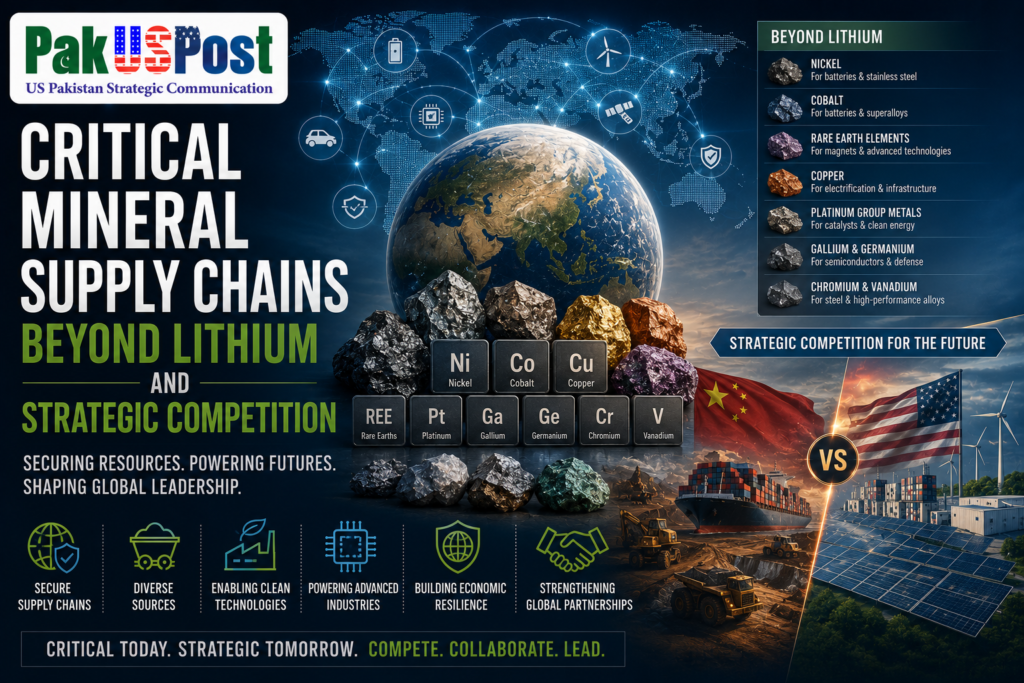
The international debate surrounding critical minerals has become increasingly concentrated on lithium and rare earth elements, yet the strategic landscape now extends far beyond these headline commodities. Industrial powers have entered a broader phase of competition in which copper, antimony, graphite, molybdenum, tungsten and numerous other industrial minerals have become indispensable foundations of economic resilience, military preparedness and technological leadership. The geopolitical significance of these resources no longer derives merely from their commercial value. Instead, they have become strategic enablers of defence production, semiconductor manufacturing, artificial intelligence infrastructure, advanced aerospace systems, renewable energy technologies and resilient industrial supply chains. Governments are therefore redefining mineral policy as an integral component of national security, industrial competitiveness and technological sovereignty.
The acceleration of this transition reflects a profound structural transformation in global manufacturing. Electrification requires unprecedented quantities of copper for power transmission, electric vehicles, renewable energy installations and digital infrastructure. Graphite remains essential for battery production despite rapid innovation in alternative chemistries. Tungsten supports armour piercing ammunition, aerospace engineering and precision machining because of its exceptional hardness and heat resistance. Antimony contributes to military-grade alloys, flame retardants and advanced electronic systems. Molybdenum strengthens high performance steel required for defence platforms, offshore energy facilities and critical infrastructure. These minerals collectively represent strategic inputs whose availability increasingly determines the resilience of industrial economies.
The United States, together with allied economies, has consequently shifted from market driven procurement toward industrial security strategies designed to reduce dependence upon concentrated overseas suppliers. Recent industrial legislation, defence procurement reforms and strategic stockpiling initiatives demonstrate that mineral security has become a permanent element of national industrial policy rather than a temporary response to geopolitical tensions. Governments increasingly view mineral dependence through the same analytical framework previously reserved for energy security, food security and defence logistics.
This transformation reflects uncomfortable realities regarding supply chain concentration. While mining occurs across multiple continents, refining capacity, intermediate processing, advanced metallurgy and specialised manufacturing remain concentrated within relatively few jurisdictions. Strategic competition therefore extends well beyond geological resources toward technological capability, environmental regulation, transportation corridors, financial investment mechanisms and industrial ecosystems capable of converting raw materials into sophisticated products.
The emerging competition illustrates that mineral security depends upon complete value chains rather than isolated extraction activities. A country possessing significant mineral deposits but lacking processing capability, engineering expertise, environmental governance and investment stability remains dependent upon external industrial systems. Conversely, states controlling advanced refining technologies, metallurgical innovation and manufacturing integration can derive disproportionate strategic influence even without dominant geological reserves.
Pakistan enters this evolving landscape with substantial opportunities accompanied by equally significant institutional challenges. Historically, national mineral policy has focused predominantly upon traditional extraction activities with limited emphasis upon downstream industrial capability, geological intelligence, environmental governance or strategic investment coordination. Yet changing international priorities create favourable conditions for countries capable of presenting credible, transparent and sustainable mineral development frameworks.
Pakistan possesses considerable geological diversity extending across Balochistan, Khyber Pakhtunkhwa, Gilgit Baltistan, Punjab and Sindh. Existing exploration has identified substantial copper resources alongside chromite, iron ore, gypsum, limestone, marble and numerous industrial minerals. However, exploration intensity remains comparatively limited relative to geological potential. Modern airborne surveys, digital geological mapping, satellite based mineral identification and advanced geophysical technologies may reveal commercially significant deposits of graphite, antimony, tungsten, molybdenum and associated strategic minerals that remain insufficiently characterised.
Global investors increasingly distinguish between geological uncertainty and governance uncertainty. Geological uncertainty can be addressed through scientific exploration. Governance uncertainty, however, discourages long term investment regardless of resource quality. Regulatory inconsistency, overlapping institutional mandates, contract instability, infrastructure limitations and administrative delays significantly increase investment risk premiums. Consequently, institutional credibility often determines investment decisions more than geological abundance.
The United States industrial security strategy presents Pakistan with both opportunities and responsibilities. Washington seeks diversified mineral partnerships capable of reducing excessive dependence upon concentrated supply chains while strengthening trusted industrial relationships. This approach extends beyond direct resource acquisition toward collaborative investment in geological surveys, environmental standards, processing technologies, workforce development and responsible mining governance. Countries demonstrating regulatory transparency and institutional predictability are more likely to benefit from these evolving partnerships.
Pakistan therefore faces an important strategic choice. It can continue viewing mineral development primarily through concession based extraction models, or it can adopt integrated industrial strategies linking exploration, processing, manufacturing, technological innovation and export competitiveness. The latter approach requires substantially greater institutional coordination but promises considerably higher long term economic returns.
Copper illustrates this transformation particularly clearly. Global electricity demand, renewable energy expansion, electric mobility and digital infrastructure require enormous quantities of refined copper. International projections consistently indicate substantial supply deficits during coming decades as demand significantly exceeds existing mining capacity. Pakistan’s copper potential therefore represents more than a conventional export opportunity. It could support domestic cable manufacturing, electrical equipment production, renewable energy components and industrial engineering sectors if integrated through comprehensive industrial planning.
Graphite presents another emerging opportunity. Battery technologies currently rely heavily upon graphite anodes despite continuing research into alternative materials. Demand growth associated with electric vehicles, stationary energy storage and advanced electronics has elevated graphite from an industrial commodity into a strategic resource. However, commercial success requires purification technologies, processing capability and quality certification rather than simple mineral extraction. Pakistan would therefore benefit from encouraging specialised processing industries capable of supplying international manufacturing standards.
Tungsten similarly demonstrates the relationship between mineral security and defence capability. Advanced military systems, aerospace manufacturing, industrial machinery and precision engineering require reliable tungsten supplies. Because global production remains geographically concentrated, diversification has become an explicit objective within several defence industrial strategies. Pakistan could evaluate whether domestic geological formations warrant systematic exploration supported by international technical cooperation and transparent investment mechanisms.
Antimony has attracted renewed strategic attention because of its applications in ammunition, military electronics, energy storage technologies and specialised industrial products. Supply disruptions have demonstrated vulnerabilities associated with concentrated production and export restrictions. Comprehensive geological assessment within Pakistan may therefore identify commercially viable opportunities requiring further scientific investigation rather than speculative assumptions.
Molybdenum possesses equally important industrial applications through high strength steel production, energy infrastructure, defence manufacturing and chemical processing. Integrated exploration programmes capable of identifying associated mineralisation alongside copper deposits may generate additional commercial value while improving project economics.
Yet mineral abundance alone cannot produce sustainable national capability. Numerous resource rich countries have experienced governance failures characterised by environmental degradation, community conflict, institutional corruption, export dependency and limited industrial diversification. Avoiding these outcomes requires strategic governance before commercial extraction accelerates.
A modern mineral governance framework should begin with comprehensive geological intelligence. Pakistan requires integrated national geological databases combining historical exploration, satellite imagery, geophysical surveys, geochemical analysis and digital mapping. Information asymmetry frequently disadvantages governments during concession negotiations because private investors possess superior technical knowledge. Public geological capability therefore strengthens negotiation capacity while reducing exploration uncertainty.
Investment governance represents another decisive consideration. International investors increasingly prioritise regulatory predictability, independent dispute resolution, transparent licensing procedures and contract stability. Frequent policy reversals undermine investor confidence regardless of resource quality. Pakistan should therefore pursue durable legislative frameworks capable of surviving political transitions while preserving legitimate national interests.
Institutional coordination likewise deserves substantial attention. Mineral governance currently involves multiple federal ministries, provincial authorities, environmental agencies, geological institutions, security organisations and investment promotion bodies. Overlapping mandates frequently generate administrative delays, inconsistent decisions and fragmented accountability. Establishing integrated coordination mechanisms would improve regulatory efficiency while strengthening strategic oversight.
Environmental safeguards must occupy central rather than peripheral positions within mineral policy. International capital markets increasingly evaluate environmental performance alongside commercial viability. Poor environmental governance raises financing costs, generates reputational risks and threatens export competitiveness. Responsible mining therefore constitutes an economic necessity as much as an ecological obligation.
Water management represents a particularly significant consideration within Pakistan. Many prospective mining regions experience water scarcity, climatic variability and ecological sensitivity. Future mining projects should therefore incorporate advanced water recycling technologies, environmental monitoring systems, tailings management standards and community consultation mechanisms from project inception rather than subsequent regulatory compliance.
Community engagement also requires institutional maturity. Mining projects frequently generate expectations regarding employment, infrastructure development and local economic participation. Unrealistic expectations followed by limited implementation often produce social tensions undermining long term project stability. Transparent benefit sharing arrangements, vocational training programmes, local procurement strategies and independent grievance mechanisms can strengthen public confidence while reducing operational risks.
Security considerations cannot be separated from strategic mineral development. Critical mineral infrastructure increasingly constitutes attractive targets for sabotage, organised crime, cyber intrusion and geopolitical competition. Security planning should therefore integrate physical protection, cyber resilience, transportation security and emergency response capabilities without discouraging legitimate commercial investment.
Pakistan should also recognise that future competition increasingly concerns mineral processing rather than extraction alone. Refining technologies, advanced metallurgy, recycling capability and specialised manufacturing generate substantially greater economic value than raw mineral exports. Industrial policy should therefore encourage gradual movement along value chains through targeted investment incentives, technology partnerships and research collaboration.
Higher education institutions possess important responsibilities within this transformation. Universities should expand programmes covering economic geology, extractive metallurgy, environmental engineering, mineral economics, industrial policy and mining technology. Human capital development remains indispensable because sophisticated mineral industries require highly skilled scientific and engineering workforces rather than primarily low skilled labour.
Research institutions should similarly support innovation regarding mineral processing efficiency, environmental rehabilitation, waste reduction, resource recycling and advanced materials science. Collaboration among universities, industry and government agencies would strengthen domestic technological capability while reducing long term dependence upon imported expertise.
Financial architecture also requires strategic adaptation. Large scale mineral projects involve substantial capital requirements extending across exploration, feasibility studies, infrastructure construction and processing facilities. Pakistan should evaluate specialised financing instruments including sovereign investment participation, development finance partnerships, export credit cooperation and public private investment structures capable of reducing commercial risk while maintaining fiscal discipline.
International partnerships should emphasise technological cooperation rather than purely financial investment. Joint ventures involving processing technologies, geological research, workforce training and industrial manufacturing generate significantly greater national capability than concession agreements focused exclusively upon resource extraction. Negotiating such partnerships requires institutional expertise supported by long term strategic planning.
Regional connectivity further strengthens commercial viability. Transport infrastructure connecting mining regions with industrial zones, ports and international markets significantly influences investment attractiveness. Coordinated infrastructure planning should therefore align transportation, electricity supply, digital communications and logistics facilities with prospective mineral development corridors.
Export policy deserves equally careful consideration. Premature restrictions upon raw mineral exports may discourage investment where domestic processing capability remains insufficient. Conversely, unrestricted exports can delay industrial upgrading by reducing incentives for downstream manufacturing. Gradual policy sequencing linking expanding processing capacity with evolving export incentives offers a more balanced approach than abrupt regulatory intervention.
Strategic stockpiling also merits examination. Although Pakistan may not immediately possess resources comparable with larger industrial economies, maintaining limited reserves of strategically important industrial minerals could strengthen resilience against international supply disruptions affecting domestic manufacturing and defence requirements.
Digital governance technologies provide additional opportunities for transparency. Blockchain enabled mineral traceability, electronic licensing systems, digital environmental monitoring and integrated regulatory platforms can reduce administrative inefficiency while strengthening investor confidence. International manufacturers increasingly require documented evidence regarding responsible sourcing throughout supply chains. Digital governance therefore enhances commercial competitiveness alongside regulatory accountability.
Climate policy increasingly intersects with mineral strategy. Critical minerals support global decarbonisation objectives through renewable energy systems, electric transportation and energy storage technologies. However, mining itself produces environmental impacts requiring careful management. Sustainable mining standards integrating emissions reduction, renewable energy utilisation, biodiversity protection and circular economy principles will increasingly determine access to international investment and premium markets.
Recycling should become an essential pillar of national mineral strategy rather than an afterthought. Urban mining, electronic waste recovery and industrial material recycling reduce import dependence while supporting environmental sustainability. Establishing regulatory frameworks encouraging circular resource utilisation would complement primary mining activities while strengthening industrial resilience.
Pakistan should avoid perceiving mineral development solely through short term revenue expectations. International experience demonstrates that sustainable prosperity derives from institutional quality, technological upgrading and industrial diversification rather than extraction volumes alone. Resource nationalism without industrial capability rarely produces enduring competitiveness. Equally, unrestricted concession policies without strategic planning frequently export wealth alongside unprocessed minerals.
Institutional capability ultimately determines whether geological potential becomes national strength. Effective regulatory agencies require technical expertise, operational independence, adequate financial resources and continuous professional development. Parliamentary oversight, judicial predictability and transparent public accountability further strengthen institutional legitimacy while reducing governance risks.
The establishment’s strategic perspective should therefore integrate mineral policy within broader national security planning encompassing industrial resilience, technological competitiveness, defence preparedness, infrastructure protection and international economic partnerships. Critical minerals increasingly represent strategic assets comparable to energy infrastructure, telecommunications networks and advanced manufacturing capacity.
Pakistan’s future competitiveness will depend less upon the quantity of minerals beneath its surface than upon the quality of institutions governing their development. Geological resources provide opportunity, not inevitability. Countries succeeding within emerging critical mineral competition will combine scientific knowledge, regulatory credibility, environmental responsibility, technological innovation and industrial strategy into coherent national capability.
The international system is entering an era in which industrial minerals shape strategic influence as profoundly as hydrocarbons shaped previous decades. Copper, graphite, tungsten, antimony, molybdenum and related resources have become fundamental components of economic security, defence readiness and technological advancement. For Pakistan, this evolving landscape presents an opportunity to reposition mineral policy from a peripheral extractive sector toward a central pillar of industrial transformation. Achieving that objective requires comprehensive geological intelligence, stable investment governance, rigorous environmental stewardship, integrated industrial policy, coordinated institutional leadership and sustained international partnerships. If pursued with strategic discipline, transparent governance and long-term national vision, Pakistan can transform its mineral endowment into durable economic resilience, trusted international partnerships and sovereign industrial capability capable of supporting national development for decades to come.
A Public Service Message