
Washington Recalculates Pakistan’s Place in a Post Afghanistan Order


Pak US POST confronts a relationship increasingly governed by portfolio logic rather than the strategic maximalism that characterised the post 9/11 period. Washington no longer appears to regard Pakistan through the singular prism of Afghanistan, nor does Islamabad possess the coercive or geopolitical centrality that once made its cooperation indispensable to American military operations across the region. The emerging equation is narrower, more transactional and potentially more durable. Counterterrorism, Afghan stability, maritime security, trade, critical minerals, technology and crisis management are progressively becoming discrete policy files, each carrying its own evidentiary threshold for American engagement. This recalibration should not be misread in Islamabad as diplomatic abandonment. It is better understood as a transition from an episodic security compact to selective partnership, in which relevance will have to be demonstrated repeatedly through deliverable capabilities rather than inherited from history.
The central strategic mistake for Pakistan would be to interpret residual American interest as evidence of renewed strategic dependence. Geography still matters, but geography alone no longer confers indispensability. The United States has diversified its regional military architecture, developed alternative logistics, cultivated relationships across the Gulf and South Asia, and reduced the operational requirement for Pakistani territory that was once intrinsic to the Afghan campaign. Washington can therefore afford a relationship with Islamabad that is narrower than Pakistan may prefer. Pakistan, conversely, retains forms of leverage that cannot be replicated merely through bilateral military cooperation. Its proximity to Afghanistan, Iran, the Arabian Sea, China and Central Asia gives it an unusually dense geopolitical interface. Its security institutions possess accumulated knowledge of militant networks, border dynamics and regional threat evolution that remains consequential. The policy challenge is to convert that latent leverage into structured bargaining capital without overstating its scarcity.
Counterterrorism remains the most immediate security file, but its character has changed. The American requirement is no longer principally access for a large expeditionary campaign. It is intelligence quality, disruption capacity, financial tracking, border surveillance and the prevention of militant organisations acquiring the capability to threaten American citizens, personnel, interests or partners. Pakistan should therefore move away from diplomacy centred on declarations of counterterrorism solidarity and propose a measurable bilateral counterterrorism architecture. This could include encrypted intelligence liaison mechanisms, joint threat assessments, watchlist interoperability subject to domestic law, terrorist financing analytics, biometric border verification, forensic cooperation and periodic operational reviews. The objective would be to create an institutionalised mechanism through which Pakistani performance can be evaluated against identifiable indicators rather than interpreted through episodic political signalling.
Afghanistan constitutes a more complicated file because American disengagement from the country has not eliminated American interests there. Washington remains concerned about transnational terrorism, hostage risks, irregular migration, narcotics networks, humanitarian destabilisation and the possibility that Afghanistan becomes a permissive environment for organisations capable of projecting violence beyond its borders. Pakistan cannot realistically determine the behaviour of the Taliban, nor should Islamabad assume that Washington expects it to do so. Its comparative advantage lies elsewhere: border intelligence, transit monitoring, humanitarian facilitation, diplomatic access and calibrated communication with Afghan actors. A credible Pakistani proposition would therefore avoid promising outcomes beyond its control. It should instead offer verified information, controlled access arrangements and crisis communication channels capable of reducing miscalculation.
This distinction matters because Pakistan has historically been vulnerable to the burden of being held responsible for outcomes it could influence but never fully control. Washington, for its part, has sometimes treated Pakistani cooperation as simultaneously indispensable and suspect, producing a cycle of pressure, reassurance and renewed disappointment. A post Afghanistan relationship requires greater analytical discipline on both sides. Pakistan should define the limits of its agency explicitly, while the United States should distinguish between Pakistani capacity, Pakistani preference and Afghan agency. Such differentiation would reduce the temptation to convert every regional failure into an indictment of Pakistani policy.
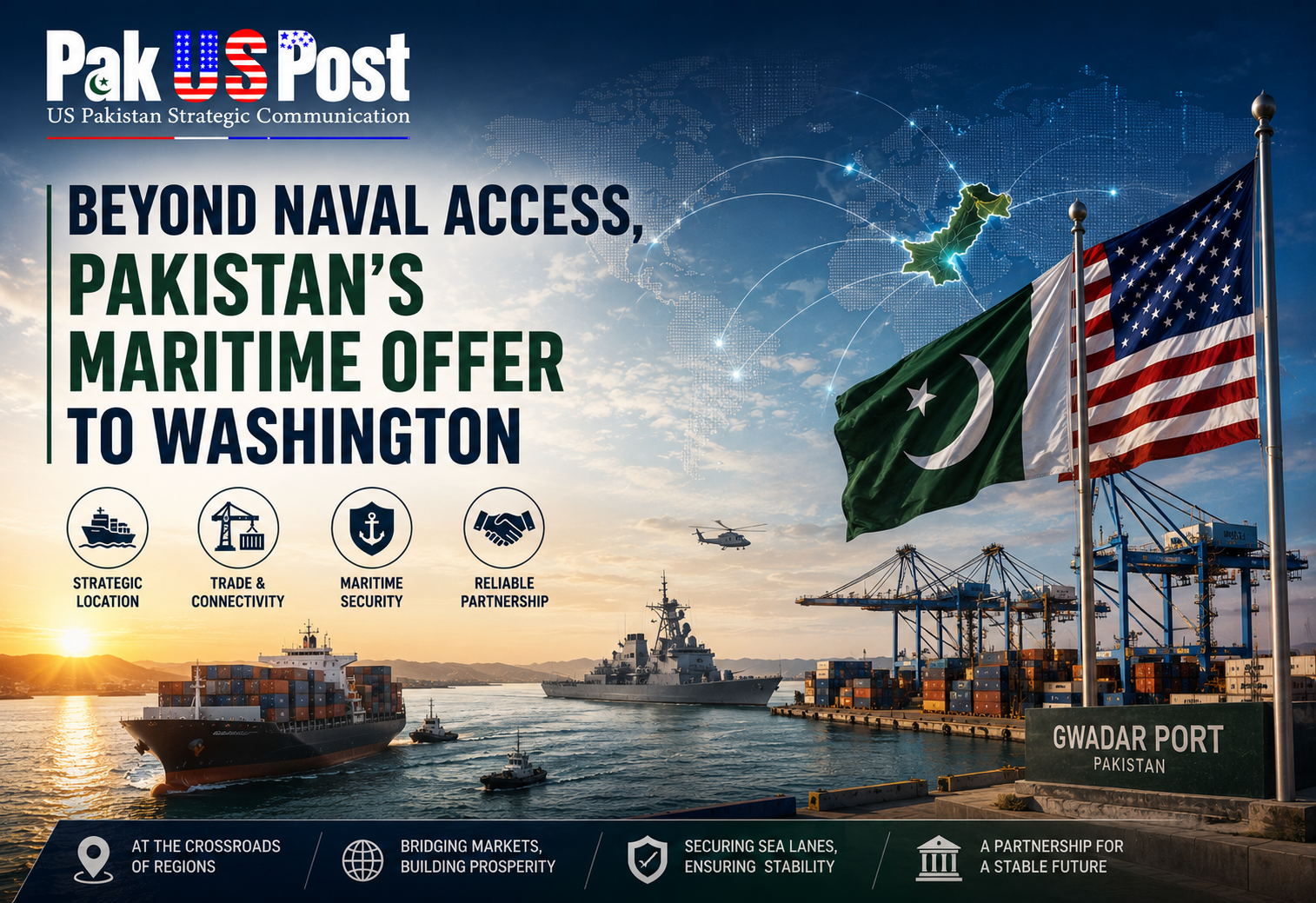
Maritime security provides a particularly underexploited avenue for practical convergence. The Arabian Sea is not merely a naval theatre. It is a commercial artery connecting energy suppliers, Asian manufacturing systems, Gulf markets and European consumers. Pakistan’s ports, shipping lanes, coastal infrastructure and proximity to the approaches of the Gulf create opportunities for cooperation in maritime domain awareness, port security, vessel tracking, search and rescue, anti smuggling intelligence and protection of undersea infrastructure. Washington does not require unrestricted naval access to derive value from Pakistan. A more sustainable arrangement would involve interoperable information systems, professional exchanges, maritime incident protocols and selective technological cooperation. Such a framework would also be less politically provocative inside Pakistan than an expansive military access model.
Trade represents the most underdeveloped component of the relationship. The United States remains a major destination for Pakistani exports, yet the bilateral commercial relationship has never acquired the institutional depth that its economic potential warrants. Pakistan’s diplomatic effort should consequently abandon the rhetoric of friendship as an economic instrument and concentrate on competitiveness. American market access has value only when Pakistani firms possess the productive capacity, compliance infrastructure and logistical reliability required to exploit it. Textiles remain important, but the policy horizon should extend towards surgical instruments, processed food, pharmaceuticals, engineering components, information technology and specialised services. The real question is not whether Washington will provide preferential treatment. It is whether Pakistan can construct an export ecosystem capable of converting stable American demand into higher domestic value addition.
That requires a bilateral trade agenda tied to domestic reforms. Pakistani negotiators should identify product lines in which tariff reductions, customs facilitation, certification recognition and investment incentives can produce measurable increases in American imports from Pakistan. Each sector should have an export baseline, a three year target, identified regulatory obstacles and named institutional responsibilities. Trade diplomacy becomes considerably more credible when Islamabad can demonstrate precisely what it intends to export, which American buyers it seeks to reach and which domestic bottleneck is preventing scale. Washington should similarly be pressed to identify regulatory barriers, standards requirements and investment conditions that Pakistani enterprises must satisfy. Reciprocity in this context means measurable commercial opportunity, not rhetorical symmetry.
Critical minerals introduce another prospective layer, although Islamabad should approach the subject with unusual caution. Geological potential is not equivalent to investable reserves, and mineral discovery does not automatically translate into industrial capacity. American interest could become meaningful if Pakistan can provide transparent licensing, enforceable contracts, credible environmental standards, reliable power and transport infrastructure, geological data of commercial quality and predictable dispute resolution. The strategic objective should not be to persuade Washington that Pakistan possesses resources. It should be to demonstrate that those resources can be developed under governance arrangements acceptable to institutional investors. Pakistan should also resist the temptation to export raw or minimally processed minerals while importing the sophisticated technologies required to capture their downstream value. A serious mineral partnership would incorporate beneficiation, processing, geological services, equipment manufacturing and technical training.
Technology may ultimately provide the relationship with its most consequential civilian dimension. Pakistan possesses a substantial pool of engineers, software developers and digitally enabled entrepreneurs, but workforce scale does not automatically generate international competitiveness. American technology companies evaluate intellectual property protection, data governance, cybersecurity, payment reliability, corporate transparency, technical certification and institutional predictability. Pakistan should therefore propose a Digital Trade and Technology Compact oriented towards compliance rather than promotional rhetoric. Cybersecurity certification laboratories, data protection interoperability, cloud standards, intellectual property enforcement, fintech connectivity and professional accreditation could create the infrastructure necessary for Pakistani firms to enter higher value American supply chains. Washington would gain access to cost competitive technical talent; Pakistan would gain integration into markets where productivity and knowledge transfer are considerably higher.
Regional crisis management constitutes another domain in which Pakistani relevance should be carefully cultivated. Pakistan’s proximity to Iran, Afghanistan, China and the Gulf means that it can sometimes communicate with actors whom Washington finds difficult to engage directly or politically. Yet mediation should not be inflated into strategic indispensability. Message transmission, confidence building and substantive negotiation are distinct diplomatic functions. Islamabad can credibly offer communication channels, discreet facilitation and de escalation mechanisms where its access is trusted by the relevant parties. It cannot manufacture political settlements when the principal actors have incompatible security calculations. The establishment should therefore guard against diplomacy becoming performative. A Pakistani facilitation mechanism should operate with clear mandates, confidentiality protocols, interagency coordination and explicit thresholds for escalation.
Washington’s own institutional architecture also creates an opportunity for Pakistan. The bilateral relationship should not be managed exclusively through the foreign ministry or periodic leadership engagements. Each policy file has different American constituencies. Counterterrorism involves the intelligence and defence establishments; trade engages the executive economic apparatus and congressional interests; technology intersects with commerce, industry and national security; critical minerals involve economic security considerations; maritime security engages defence, transportation and regional commands. Pakistan should consequently develop a Washington policy architecture capable of mapping American bureaucratic stakeholders against Pakistani objectives. Diplomatic effectiveness increasingly depends not simply on access to senior officials, but on sustained engagement with the technical officials who write regulations, allocate programmes and define implementation standards.
This requires a corresponding change in Pakistani internal coordination. Strategic messaging to Washington must be generated from an interagency assessment rather than from disconnected ministerial initiatives. A standing Pakistan US Strategic Portfolio Cell could maintain a live matrix covering bilateral objectives, American stakeholders, deliverables, pending decisions, regulatory obstacles and measurable outcomes. Each quarter, the cell could assess whether cooperation has generated tangible gains. Such institutionalisation would reduce duplication, prevent contradictory messaging and provide the political leadership with an evidence based account of where American engagement is expanding or contracting.
There is also a requirement for strategic restraint. Pakistan should not attempt to insert itself into every American regional calculation, nor should it offer concessions simply to restore the psychological status associated with the post 9/11 partnership. Washington’s selective engagement can be advantageous if Islamabad learns to price its cooperation according to specific national interests. Security assistance, market access, technology transfer, investment facilitation and diplomatic coordination should each be negotiated within their own policy logic. A broad strategic bargain may sound more prestigious, but a collection of enforceable sectoral arrangements can produce greater resilience.
The United States, meanwhile, risks underestimating the institutional and geographic value Pakistan retains. A state does not become strategically irrelevant merely because one military campaign has ended. Pakistan remains connected to several security theatres and possesses substantial state capacity in areas where many regional actors remain institutionally constrained. Its armed forces, intelligence architecture, diplomatic networks, maritime position and proximity to multiple contested zones provide Washington with options that are valuable precisely because they can reduce uncertainty. American policy should therefore avoid oscillating between excessive expectations and strategic neglect. Selective partnership works only when selectivity is accompanied by sustained institutional engagement.
For Islamabad, the more consequential challenge is psychological. Pakistan must cease measuring the bilateral relationship by the frequency of presidential meetings, military delegations or public expressions of strategic warmth. Diplomatic relevance is better measured through the number of American policy processes in which Pakistani interests are materially incorporated, the scale of bilateral investment actually deployed, the growth of exports, the sophistication of technology partnerships, the quality of intelligence cooperation and the frequency with which Pakistani channels contribute to crisis de escalation. These are harder metrics, but they provide a more accurate account of national influence.
The post Afghanistan relationship should therefore be understood neither as strategic decline nor as strategic revival. It is a reconstitution. The old relationship was built around a concentrated security imperative; the emerging one will depend on Pakistan demonstrating utility across several narrower but potentially more durable domains. This creates risks because each file can be downgraded independently. It also creates opportunity because failure in one domain no longer necessarily contaminates the entire relationship. Pakistan can construct a more resilient bilateral architecture by treating counterterrorism as intelligence cooperation, Afghanistan as managed regional risk, maritime affairs as commercial security, trade as competitiveness, minerals as industrial policy, technology as regulatory integration and crisis management as disciplined diplomacy.
The establishment should consequently resist nostalgia and prepare for portfolio diplomacy. Washington is unlikely to restore the strategic centrality Pakistan enjoyed when Afghanistan dominated American military planning, and Islamabad should not waste diplomatic capital attempting to recreate an obsolete bargain. The rational objective is more exacting: make Pakistan difficult to ignore in specific domains while remaining unnecessary as a permanent dependency. That distinction is the foundation of strategic autonomy. A mature Pakistan US relationship will not be sustained by sentiment, inherited assumptions or episodic crises. It will endure when both capitals discover that cooperation produces quantifiable advantages that neither can obtain as efficiently alone. The task for Pakistani diplomacy is to make those advantages visible, institutionalised and reciprocally enforceable before the next regional crisis once again defines the relationship for them.
A Public Service Message